

When the scribes of Dunhuang were given bundles of paper to write Tibetan sutras on, they were allowed to lose a few sheets. If they lost more than their allowance, it was a serious matter. As I discussed a while ago, scribes could be punished with ten lashes per incomplete bundle, their property could be impounded, and their relatives could be imprisoned. I wonder whether this had any effect on the merit that the copying of the sutras was meant to generate.
Anyway, the sheets of paper that scribes were allowed to keep were called lektsé (glegs tshas), and several examples of them have survived in the Dunhuang collections. They provide a fascinating insight into the life of the scribes. Sometimes we see them practising their handwriting or writing drafts of letters. It seems that these sutra scribes were not very well paid, if they were paid at all. But they could use their scribal skills to make some money on the side by writing letters and contracts for those who couldn’t write. This practice became so common that letters and contracts were still being written in Tibetan long after the end of Tibetan rule in Dunhuang.
* * *

But today I just want to look at one of the nicest bits of scribal scrap paper, Pelliot tibetain 1164, which is covered in animal doodles. According to the signature, it was the scrap paper of a scribe called Jeu Taklek (Rje’u Stag legs), unusual in that he seems to have been Tibetan rather than Chinese. Another inscription on the paper states (if I read it right) that these are “all the wild beasts of Shachu.”* Shachu was the name for Dunhuang at this time (Shazhou in Chinese).
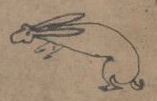
I see an antelope, some kind of large bird, a horse, a pigeon, a dog (or fox) and a rabbit. You may see differently. Some of the animals, especially the dog/fox, have a lot of character…

This dynamic stance reminds me of the sketch of the otter on the back of a woodslip done by a soldier at the Tibetan fort of Miran, which turned up in a previous post here. And here it is again:
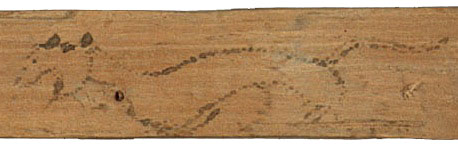 Which makes me wonder, was there a tradition of animal-sketching among the early Tibetans?
* * *
See also
Tales from the Scriptorium I: Expensive manuscripts
Tales from the Scriptorium II: It’s a scribe’s life
Note
* The Tibetan seems to be sha cu rgya rang kun kun. The word rgya might just refer to the antelope.
References
Tsuguhito Takeuchi. 1995. Old Tibetan Contracts From Central Asia. Tokyo: Daizo Shuppan.
 early Tibet