
 One of the most important, yet most difficult to define concepts in pre-Buddhist Tibet is tsuglag (gtsug lag). In the early texts it has a variety of meanings, which were aptly summarized by Rolf Stein:
Il désigne une sagesse, un art, une science, un savoir-faire (et les écrits qui en parlent).
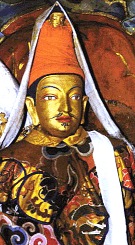
Thus wisdom, art, science, and indeed savoir-faire all coalesce in the tsuglag. It can be found as a personal characteristic of the ancient rulers of Tibet (such as Songtsen Gampo, pictured here), where it signifies the wisdom exercised in rulership. It is also used as a name for non-Buddhist ritual techniques (or ‘sciences’). Later on the word tsuglag became attached to Buddhism (just as the word chos gradually changed from signifying religion in general to Buddhism in particular). Thus one very common name for a Buddhist temple: tsuglakhang (gtsug lag khang), a “house of tsuglag.”
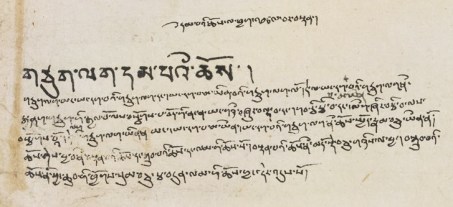
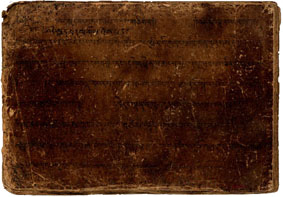
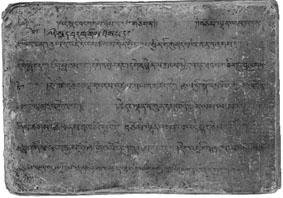
The manuscript shown below (IOL Tib J 339) is a prayer, a series of homages to the Buddha, the dharma, the sangha, and other noble objects. In the verse pictured here, the dharma is called “the supreme tsuglag”. The detailed commentary written in a tiny hand underneath this line goes on to distinguish between right and wrong forms of tsuglag. Right tsuglag is of course Buddhism itself, which is defined here in terms of teaching (bstan pa), accomplishment (bsgrub pa) and the path (lam).
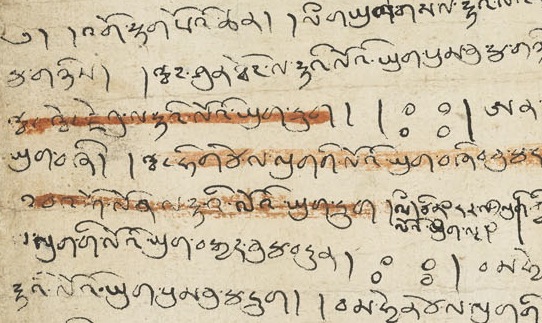
The definition of wrong tsuglag is a bit more interesting, as it reveals the systems (of ‘science’) which were considered to be in competition with Buddhism at the time. The first kind of wrong tsuglag mentioned is called “the king of Chinese tsuglag” (rgya nag gi gtsug lag gi rgyal po). The exact system that is being referred to here is unclear but it is worth noting that Chinese astrologers equated the Pole Star with the emperor.
Then the author of the commentary tells us that there is wrong tsuglag “even within Tibet”. This includes studying the portents of the days (gnyi bzhur blta ba), probably a divination system for deciding whether particular days are favourable for certain activities–a very popular form of divination throughout Tibetan history. Another kind of wrong tsuglag is the gab tse, a word still used by Tibetans to refer to astrological charts. And the last form of wrong tsuglag is li zhi, which is unfamiliar to me but certainly looks like a Tibetan transliteration of a Chinese term—it might be worth investigating a link with the neo-Confucian li (理) and qi (氣).
Another manuscript, which I will discuss soon, shows that advanced forms of Chinese divination based on astrological tables were translated into Tibetan and apparently practised in Dunhuang by the 10th century. In fact Dunhuang and the surrounding area may well have been the entry-point for many elements of Chinese culture into the Tibetan cultural sphere.
References
1. Hahn, Michael. 1997. “A propos the term gtsug-lag”. Helmut Krasser, Michael T. Much, Ernst Steinkellner, Helmut Tauscher (eds.) Proceedings of the 7th Seminar of the International Association for Tibetan Studies. Wien: Österreichische Akademie der Wissenschaften, 1997. 341-348.
2. Macdonald, Ariane. 1971. “Une lecture des Pelliot Tibétain 1286, 1287, 1038, 1047 et 1290. Essai sur la formation et l’emploi des mythes politiques dan la religion royale de Sroṅ-bcan sgam-po”. Études Tibétaines, 190-391.
3. Stein, R.A. 1985. “Tibetica Antiqua III, À Propos du mot gcug-lag et de la religion indigène”. Bulletin de l’École Française d’Extrême Orient, 74, 83-133.
Also in this series
Buddhism and Bon I: the religion of the gods
Buddhism and Bon III: what is yungdrung?
 early Tibet