
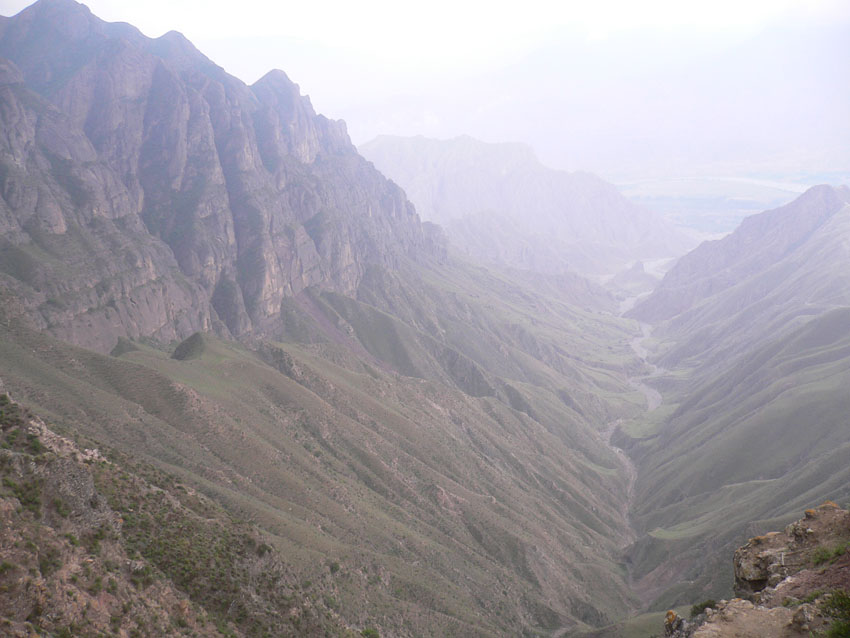
Back in the tenth century the mountain retreat of Dantig was home to the monk Gewa Rabsel, famed as the saviour of Tibet’s monastic tradition. Here in this remote valley he maintained the Vinaya lineage and passed it on to monks from Central Tibet, who then returned to begin the later diffusion of Buddhism in Tibet. (On all this, see my earlier post.)
Surrounded by steep mountains, the valley of Dantig is still only accessible on foot. Starting from the town of Xunhua, you climb up a steep valley and then walk along a vertiginous mountain ridge. The walk took us about five hours, though the locals claim to be able to do it in two. The valley has an impressive sequence of cave temples, and a relatively small monastery. At the moment, there is also a permanent population of around seventy Tibetan monks, most of whom live in mud-brick houses on the valley floor, and study at the valley’s monastic college (slob grwa).
There are many fascinating things about this site, but the one I want to talk about here is the name itself. I’d always assumed it was a local Chinese name that was transliterated into Tibetan when the valley became a major Tibetan Buddhist site. But it seems the truth may be more complicated, and more interesting.
* * *
I travelled to Dantig, with my colleague Imre, to follow the path of a tenth-century Chinese pilgrim. This pilgrim’s itinerary is given in a scroll he carried with him, and left behind in Dunhuang. This itinerary (written in Tibetan) mentions Dantig, and this is in fact the earliest occurence of the name in a documentary source.
So, where does the name Dantig (dan tig) come from?
The ever-informative Religious History of Amdo, begins its section on Dantig with a story from the Jinaputra-arthasiddhi-sūtra. It’s the story of a previous lifetime of the Buddha, when he was a prince called Arthasiddhi. This prince was excessively generous, and when he gave away the king’s best elephant to his enemies, he was exiled to Dantig. (Sound familiar? This is of course a variant on the famous Jātaka story of Prince Vessantara.)
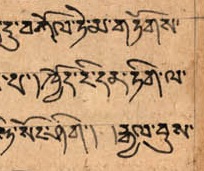 There is a copy of this sūtra in a Tibetan manuscript from Dunhuang – IOL Tib J 76 — which confirms that the story, and the occurrence of the name of Dantig in it, was known in the tenth century.
Now, if we look at the version of the same sutra found in the Tibetan canon, it has a colophon stating that it was translated from the Chinese. And in the original Chinese version of the sutra the name of the mountain is Tante Shan 檀特山. According to the Foguang Dictionary of Buddhism, this in turn represents an Indian place-name, Mount Daṇḍaka, thought to be located in Gandhara.
So, though we have no early source explicitly linking Dantig to the narrative of the Jinaputra-arthasiddhi-sūtra, the mountain named in the Arthasiddhi narrative seems to have provided the Dantig valley with its name. The progress of the name from Sanskrit to Tibetan would then be as follows:
Daṇḍaka (skt.) –> Tante (chi.) –> Dantig (tib.)
* * *
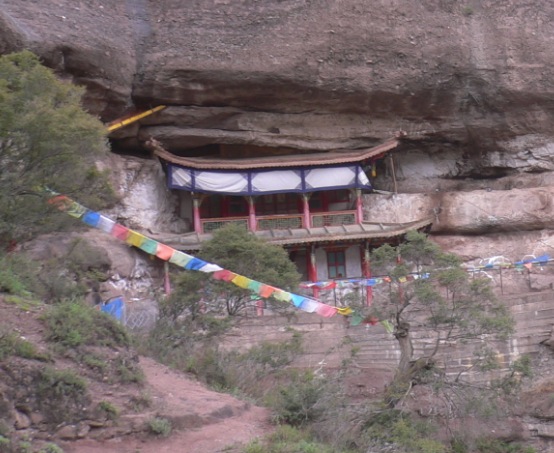
The close association between the valley and the sutra is also made very clear when you visit Dantig. One of the cave temples here is dedicated to a certain Gelong Achuda. Though we had a hard time identifying him at first, it turns out that this fellow is in fact another figure from the Jinaputra-arthasiddhi-sūtra, who was said to have meditated in Dantig for a hundred years.
We’ve made some progress towards understanding how Dantig got its name, but the big question remains. Why did the mountain that features in the Jinaputra-arthasiddhi-sūtra became associated with the valley of Dantig in Amdo in the first place? Are there comparable cases in Tibet or China of Jātaka stories being linked to local sites? I’ll leave these questions open for now.
The Sutra
(Ārya) Jinaputra-arthasiddhi-siddhi-sūtra:
Tibetan version: ‘Phags pa rgyal bu don grub kyi mdo (no.1020 in the Peking bka’ ‘gyur).
Chinese version: Taizi Xudanuo jing 太子須大拏經 (vol 3, no. 171 in the Taisho Tripitaka).
Other References
1. Brag dgon pa dkon mchog bstan po rab rgyas. Mdo smad chos ‘byung, or, Yul mdo smad kyi ljongs su thub bstan rin po che ji ltar dar ba’i tshul gsal bar brjod pa deb ther rgya mtsho. Rig gnas myur skyon dpe mdzod khang. n.p. n.d. (see pp.222-3).
2. Durt, Hubert. 1999. ‘The offering of the children of prince Viśvantara / Sudāna in the Chinese Tradition’. Journal of the International College for Postgraduate Buddhist Studies 2: 266–309.
Photographs
1. The approach to the Dantig valley, looking back over the neighbouring valley, (c) Imre Galambos.
2. The cave temple of Gelong Achuda (c) Imre Galambos.
 early Tibet