The Olapati

Kanha
In the last post I looked at the connections between the ‘new’ schools of Tibetan Buddhism (nowadays the Kagyü, Sakya and Gelug) the Dunhuang manuscripts. I tried to show that there is a shared heritage in the sutras translated in the early period, and the sutric contemplations on topics like impermanence and karma.

Could there by any traces among the Dunhuang manuscripts of the ‘new’ tantric lineages that flooded into Tibet from the late 10th century onward? The library cave at Dunhuang was closed up at the beginning of the 11th century, so it seems unlikely, but just possible that we might be able to catch a trace of the ‘new’ lineages. What’s more, I think I have found one.

This trace is connected to the new lineages of Sakya, which derive a number of Indic siddha traditions. One of those siddhas was the famous Virūpa, the source for the transmission of the ‘path and fruit’ or Lamdré practices. Another was Virūpa’s disciple Kāṇha (also known by an number of other names, but we’ll stick to the shortest one), who is the source of another set of esoteric practices. Kāṇha was a Hindu yogin from South India, who often got into arguments with Buddhists, and was converted to Buddhism by Virūpa.

As with most of the great siddhas, there is a funny story about Kāṇha. He is said to have converted a king by taking advantage of the king’s attachment to his many queens. First Kāṇha spent some time with the queens. Then when the queens explained what had happened to the king, the king declared: “He must be killed!” Kāṇha waited for the king’s troops outside the queen’s palace. When the soldiers arrived, Kāṇha back inside. As soon as the troops followed him inside, Kāṇha appeared outside. When both the inside and outside of the palace were completely filled by the troops, Kāṇha sent forth magical emanations outnumbering the king’s troops. The king realized that Kāṇha was a siddha and bowed at his feet.

Stories aside, we don’t really have firm dates for Kāṇha. We know the lineage between Kāṇha and the great Tibetan translator Drogmi contained three people, and Drogmi was born just before the year 1000. So Kāṇha was probably teaching some time in the mid-10th century, if the traditional lineages are correct. This is just where a bit of contemporary evidence, like a Dunhuang manuscript for example, would come in handy.

Kāṇha’s most famous teaching is known by the (apparently) Sanskrit name Olapati. As a text, the Olapati the is quite mysterious. Nobody really knows what the name means (though if you’re interested, see the guesses at the end of this post). And while the Sakyapas practiced an oral instruction on the Olapati known as The Complete Path of Inner Heat they didn’t preserve the Olapati itself in their collections. But the Olapati does seem to have survived. According to two modern scholars of the Lamdré, Cyrus Strearns and Ronald Davidson, the Olapati is to be identified with a canonical text called The Four Stages attributed to a certain Kṛṣṇa (another name for Kāṇha).

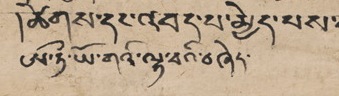
Now the Dunhuang scroll Pelliot tibétain 849 contains a list of tantras. As I mentioned in a previous post, the list includes the Guhyagarbha tantra. It also includes an Olipati tantra (the spelling is slightly different, but that is true for almost all of the Sanskrit titles listed in this scroll). When I first saw this Sakya text in the list of tantras I was very surprised. None of the previous studies of this scroll had connected this title with Kāṇha’s text. Could they be one and the same?

The possibility seems less remote when we remember that Pelliot tibétain 849 dates to the end of the 10th century, and contains the notes taken down by a local from a passing Indian tantric master. This Indian master, Devaputra by name, had travelled via Tibet to China on a pilgrimage to Wutaishan, and was on his way back to India when he stopped at Dunhuang. A local called Dro Könchogpal worked with the Indian master on (among other things) a bilingual list of important tantras.

Is this Olipati tantra in our Dunhuang scroll really Kāṇha’s teaching? I think probably it is. The name is unusual enough, and may come from Kāṇha’s South Indian background. The fact that it is called a tantra in the scroll is not really problematic. The local Tibetan who wrote the scroll was not very accurate, and may have assumed he was writing down the names of tantras, when other instructional texts were being listed as well. Or Kāṇha’s teaching may have taken on the status of a tantra in some circles. So here is a siddha’s teaching that came to Central Tibet in the mid-11th century, but was known in distant Dunhuang (if only by name) half a century earlier. And that seems to confirm the traditional Sakya accounts of both Kāṇha’s dates and teachings.

To conclude on the theme of the previous post, when we see the (to later eyes, thoroughly Nyingma) Guhyagarbha tantra together with the (very Sakya) Olapati in the same list, it is a welcome reminder that sectarian divisions and rarely as fundamental as they might seem. History might seem an arcane pursuit sometimes, but it can be a useful way cutting through such divisions.

*  *  *


References

1. Davidson, Ronald. 2005. Tibetan Renaissance: Tantric Buddhism in the Rebirth of Tibetan Culture. New York: Columbia University Press [on the Olapati: pp.200-201]
2. Hackin, Josef. 1924. Formulaire sanscrit-tibétain du Xe siécle. Librairie orientaliste Paul Geunthner, Paris. [On Pelliot tibétain 849]
3. Kapstein, Matthew. 2006 “New Light on an Old Friend: PT 849 Reconsidered”. In Tibetan Buddhist Literature and Praxis: Studies in its Formative Period 900-1400. Leiden: Brill
4. Stearns, Cyrus. 2001. Luminous Lives. Boston: Wisdom Publications. [on the Yellow Book: pp.32-35]

Tibetan texts
1. Dhongthog Rinpoche, T.G. 1976. A History of the Sakya School of Tibetan Buddhism. New Delhi: Paljor Publications.
2. Nag po spyod pa (Kṛṣṇācaryā, alias Kāṇha). Gtum mo lam rdzogs [The Complete Path of Inner Heat]. In Sa skya Lam ‘bras Literature Series vol.11 pp.445-457.
3. Nag po pa (Kṛṣṇa, alias Kṛṣṇācaryā, alias Kāṇha). Rim pa bzhi po [The Four Stages]. Q.2168.

Images
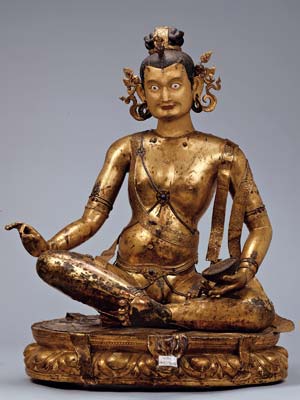
Statue of Kāṇha, from the Museum für Asiatische Kunst, Berlin. From the 2007 exhibition Klöster öffnen ihre Schatzkammern.

And a note…
…on the name Olapati:

  • Matthew Kapstein (2006: p.20) wrote on the name Olipati, from Pelliot tibétain 849: “Oli (perhaps < Skt. āvalī) occurs in the formation of certain technical terms of haṭhayoga, e.g., vajrolimudrā, referring to the yogic practice of sexual congress. A possible interpretation might therefore be *(Vajr)olipaddhatitantra.”
  • Ronald Davidson (2005: 200-201) links the name Olapati to the canonical Tibetan text The Four Stages (Rim pa bzhi pa, Q.2168). He points out that ola survives in the (reconstructed?) Sankrit title to the autocommentary on the The Four Stages, which is Olacatustustaya-vibhaṅga (Tibetan Rim pa bzhi’i rnam par ‘bzhed pa, T.1460). Here ola is equivalent to rim pa, “stage”, while instead of pati we have the standard Sanskrit catuḥ for “four” (bzhi pa).

And another note (added on February 13th)…

The South Indian languages provide plenty of possibilities for all the elements under consideration here, ola, oli and pati. Though I am not any kind of expert in these languages, the possibility is too interesting to ignore, so I am going to speculate, based on Burrow and Emeneau’s A Dravidian Etymological Dictionary and the Cologne Online Tamil Lexicon (http://webapps.uni-koeln.de/tamil).

Since there is no equivalent for the Tibetan bzhi po “the four” in ola/oli/pati, I wonder if the Tibetan name is not a direct translation of Olapati, but rather a descriptive name for the text? In that case, we can look a little more widely for meaning of the name Olapati:

First, ola/oli:

  1. First of all, in many South Indian dialects ōla (or ōlai or ōle) means a page or a book, by extension from the ola palm leaves that are used to make books.
  2. The Tamil noun oli can refer to any sound, to speech or more specifically, to the “loud or audible recitation of a mantra.”
  3. The verbal root oli– or olap– can mean to wash or cleanse in Tamil.
  4. In various South Indian dialects, both oḷa and oḷi have meaning of secrecy and concealment.

Now, pati/patti:

  1. We have the Tamil and Malayam verb pati, “to be imprinted, indented.” Considering that writing on Indian palm leaves is a form of imprinting or indentation, could ōla-pati mean “impressed on palm leaves”?
  2. We have the Tamil verb paṭi, meaning “to practise, habituate oneself to,” which would combine well with some of the meanings of ola/oli attested above, as well as Kapstein’s interpretation of oli.
  3. There is a Tamil noun paṭi, meaning “a step, stair, rung of a ladder, stirrup, grade, rank…” This would be a clear equivalent to the Tibetan rim pa, “stage” and could be combined with some of the meanins of ola/oli above.
  4. And finally, several dictionaries give patti as an equivalent for Sanskrit bhakti, meaning devotion, religious observance and so on. This could be combined with the meaning of oḷa/oīi above to mean “secret” or “hidden” religious observance. Bhakti is particularly associated with deity cults like that of Śīva, which ties in nicely with Kāṇha’s status as a former Śaiva yogin.

In any case, since I have not taken the morphology of these terms into account, I can hardly suggest a best reading here, but if anyone with a knowledge of South Indian languages reads this, I’d be most grateful for any thoughts.
Dunhuang and the ‘new’ schools

Cave 285In several posts over the last year I’ve tried to point out connections between what we see in the Dunhuang manuscripts and the Nyingma tradition. The Nyingma lineages derived from the early transmission of Tibetan Buddhism, which our manuscripts represent, so these connections are not really surprising. In the Nyingma these early transmissions are known as kama (bka’ ma), to distinguish them from terma (gter ma), the rediscovered treasure tradition. Should our Dunhuang manuscripts be considered kama or terma? I suspect that they cannot really be considered either, because they lack one vital aspect of both of these kinds of transmission: a lineage.
Despite the lack of a lineage, connections between the manuscripts and the Nyingma traditions are clear. As I’ve discussed in previous posts, we have found Padmasambhava in the manuscripts, as well as fragments of his Seven Line Prayer. We have seen the growing importance of Avalokiteśvara (or Chenrezig), later to become the centre of the Mani Kambum treasure cycle. We have seen lists of the nine vehicles and the twenty-eight samaya vows, just as they appear in the later tradition. We have seen the influence of the Mahāyoga tantras, especially the Guhyagarbha, and of Dzogchen appearing here as the view of Mahāyoga.

* * *

Now I would like ask a different question: do the Dunhuang manuscripts have any relevance to the other main schools of Tibetan Buddhism? These schools, of which the main ones flourishing today are Kagyü, Sakya and Gelug, are all known as ‘new’ schools (gsar ma) to distinguish them from the ‘old’ lineages (rnying ma). The ‘new’ lineages came to Tibet from India from the late 10th century onwards, so any overlap with our Dunhuang manuscripts seems unlikely (remember, the library cave was closed at the beginning of the 11th century).

But in one fundamental aspect, the answer to this question is certainly yes. That aspect is the sutras. It is not often realized that over 90% of the sutras in the Tibetan canon were translated in the imperial period, that is, by the mid-ninth century. Thus all of the schools of Tibetan Buddhism hold lineages for the sutras that go back to the early period, and all of them are in this sense, Nyingma (that is ‘old’ rather than ‘new’)! The Dunhuang collection is full of sutras, the heritage of every Tibetan Buddhist school.

What’s more, the sutra-based oral instructions that the Kadam school propagated from the 11th century, simple contemplations on topics like impermanence, cause and effect (karma) and suffering, are also to be found in the Dunhuang manuscripts; in fact it was the particular wish of the emperor Trisong Detsen that these basic teachings of the Buddha be propagated in Tibet above all others. So in this sense, all of the Tibetan schools share a continuity with the earlier tradition, since all schools have their own kinds of contemplation on these topics.

* * *

Avalokitesvara Cave 45Turning to the tantric manuscripts, we find that some tantras which are central to the ‘new’ schools were already present in the early period. The most important of these is the Guhyasamāja tantra, which is found among the Dunhuang manuscripts in a version that closely matches the one in the Nyingma tantric canon. This tantra was retranslated in the later period, but the similarities between the ‘new’ and the ‘old’ translation shows that the later translators were quite aware of the previous version, and relied on it when they made their new translation.
As for the Sakya school, there has always been an acknowledged Nyingma aspect of their tantric transmission, that is, the wrathful practices of the deity Vajrakīlaya. The Khön family, from which the heads of the Sakya school have always been selected, goes back to Khön Lui Wangpo, one of the first monks in Tibet, traditionally also considered a disciple of Padmasambhava. Though the Khön family later turned to the ‘new’ transmissions, they kept their lineage of Vajrakīlaya and his associated dharma protectors, as well with the lineages of the deity Viśuddha Heruka (one of the eight deities of the Nyingma Kagyé tradition).

Among our Dunhuang manuscripts are many texts on Vajrakīlaya, both practice texts and the short history that I quoted recently that tells us about Padmasambhava’s teaching of Vajrakīlaya practices. There are also many manuscripts on the wrathful Heruka. So of all the ‘new’ schools of Tibetan Buddhism, the most direct connections with the Dunhuang manuscripts are found among the Sakya, but it seems worth keeping in mind that every school has strong connections (if not always acknowledged) with the early period. It’s good to remember how much everybody has in common. I invite any other ideas about where such connections might lie, and I promise to chase up some more specific connections with the ‘new’ schools in the next posts. Consider it a New Year’s resolution.

Images
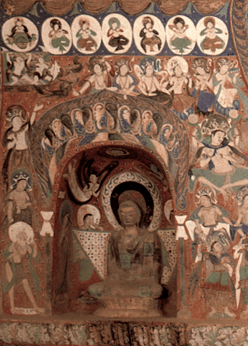
1. Meditating monk. Dunhuang cave 285, west wall. (c) The Dunhuang Academy.
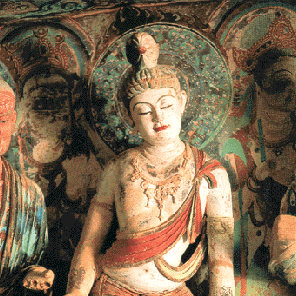
2. Avalokiteśvara. Dunhuang cave 45. (c) The Dunhuang Academy.

Early Dzogchen III: The origin of Dzogchen?

peacock.jpg

The search for an origin is a seductive task, but one to be wary of. As Nāgārjūna pointed out a long time ago, nothing ever really comes into being as such. Any entity we might identify is both composite and has developed through the mutual dependence of causes and conditions. The idea of an ‘origin’ supposes that we can identify a source that is cannot be broken into composite parts and is free from any previous causes.

That said, the whole point of this website, and the materials on which it comments, is that earlier textual sources can tell as something that later sources do not. This survey of the earliest sources on Dzogchen is, then, not the search for an origin, but an examination of the character of Dzogchen as it appears in the earliest reliably dated texts.

What are the earliest reliably dated Dzogchen texts? There is The Meditation on the Awakened Mind by Mañjuśrīmitra, which is mentioned in the Denkarma, an early 9th century library catalogue. And then there are the many texts quoted by Nub Sangyé Yeshé in his Lamp for the Eyes of Contemplation, written in the late 9th century. These are generally short instructional texts which overlap to some extent with the traditional list of eighteen early Mind Series (sems sde) texts.

Earlier still than these is the Guhyagarbha tantra. This tantra is nowadays thought to have been circulating in India by the eighth century (notwithstanding the Tibetan controversies over its Indic origin–see my earlier post). Dzogchen is mentioned four times in the tantra, each time in a different chapter. Let us look at two examples, first from chapter 13, which is on the practice of the perfection stage:

Thus the Great Joyous One settled into the contemplation of the cloud-array that is at the heart of the extremely secret commitment–that all phenomena are, from the beginning, spontaneously present in the great perfection (rdzogs chen).

Here we see not just the word Dzogchen, but the same basic meaning that it is given in the later tradition. The term occurs again in chapter 14, which celebrates the realization arising out of the pefection stage:

Oṃ! The great perfection (rdzogs pa che) of body, speech and mind,
Is the total perfection of enlightened qualities and activities,
From the beginning spontaneous present, perfect, and all good (kun tu bzang)
The great sphere (thig le) of the vast gathered assembly. Ho!

The sense that Dzogchen here means the realization that comes out of the perfection stage is confirmed in The Garland of Views, a treatise on chapter thirteen of the Guhyagarbha found in the Tengyur and attributed to Padmasambhava. If the attribution is correct, then The Garland of Views would probably date from before or during Padmasambhava’s time in Tibet in the 770s. We saw in the previous post a manuscript describing how Padmasambhava taught the meditation on Vajrakīlaya in the context of Atiyoga. Here the author only briefly deals with the actual practices, mainly focusing on the ideas of spontaneous accomplishment and primordial purity as the experiential climax of the practices.

In The Garland of Views, Dzogchen is the culmination of the three ways (tshul) of inner yogic practice: the ways of development (bskyed), perfection (rdzogs), and great perfection (rdzogs chen). In this text these three ways are subdivisions of the vehicle of inner yoga, but not vehicles in their own right. Remember in the last post how often we saw Dzogchen described as a “way”? Here Dzogchen is rooted in the practices found in the Guhyagarbha tantra: the visualization of deities and the experience of bliss through union. Like the manuscripts we looked at in the previous post, Dzogchen here functions as an interpretive framework for these experiences:

The way of the great perfection (rdzogs chen) is to realize that all phenomena of saṃsāra and nirvāṇa are inseparable and have always had the nature of the maṇḍala of body, speech and mind, and then to meditate on that.

Finally, let us return to the Dunhuang manuscripts one more time, for one elegant piece of evidence for the association between Dzogchen and the Guhyagarbha. Pelliot tibétain 322B is a poem from the Dunhuang manuscripts which takes Dzogchen as its theme, while remaining within the frame of reference of the Guhyagarbha and Māyājāla tantras:

The teaching of the primordial, spontaneously present Dzogchen,
This sublime experiential domain of supreme insight
Is bestowed as a personal instruction for those with intelligence;
I pay homage to the definitive counsel spoken thus.

Without centre or periphery, neither one nor many,
The maṇḍala that transcends thought and cannot be expressed,
Illuminates the mind of intrinsic awareness, wisdom and knowledge;
I pay homage to the great Vajrasattva.

In the illusory three worlds which are like the limitless sky,
Many millions of emanations are present everywhere,
Surrounded by the net of insight in the expanse of sameness,
I pay homage to you, the Māyājāla.

The ten directions and the four times secretly have the nature of Dzogchen,
Which itself is the suchness of the definitive essence,
Primordial and spontaneously present, cause and effect inseparable,
I pay homage to the supreme Guhyagarbha.

The close association between early Dzogchen and the Guhyagarbha shouldn’t surprise us, really. When later tantric lineages were brought to Tibet in the 11th and 12th centuries, they came with their own frameworks for interpreting yogic practice in terms of nonconcepualization and the immanence of buddhahood. The Mahāmudrā cycles transmitted in the Kagyü schools are an obvious example. A balance of ritual or meditative practice with a view that transcends both practice and result seems to have characterised late Indic tantra. On the whole, as we know, that balance was skilfully maintained in the Tibetan tradition as well.

References
1. Germano, David. 1994. “Architecture and Absence in the Secret Tantric History of the Great Perfection (rdzogs chen)“, Journal of the International Association of Buddhist Studies 17.2: 203-335.
2. Karmay, Samten. 1988. The Great Perfection. Leiden: Brill. [Includes a translation and edition of The Garland of Views].
3. Norbu, Namkhai and Kennard Lipman. 2001. Primordial Experience: An Introduction to RDzogs-chen Meditation. Boston: Shambhala. [A translation of The Meditation on the Awakened Mind].
4. van Schaik, Sam. 2004. “The Early Days of the Great Perfection” in Journal of the International Association of Buddhist Studies 27/1: 165–206.

Tibetan sources
Gsang ba snying po de kho na nyid nges pa (Guhyagarbha tantra). Tb.417.
‘Jam dpal bshes gnyen. Byang chub kyi sems bsgom pa [The Meditation on the Awakened Mind]. P.3418
Gnubs chen Sangs rgyas ye shes. Bsam gtan mig sgron [Lamp for the Eyes of Contemplation]. S. W. Tashigangpa, Ladakh, 1974.
Padmasambhava. Man ngag lta ba’i phreng ba [The Garland of Views]. P.4726

See also:
In Search of the Guhyagarbha Tantra

Early Dzogchen II: An approach to tantric practice

Swift

In the previous post I looked at the the earliest Dzogchen manuscripts in existence (as far as we know). These two Dzogchen texts appear to reject any kind of structured practice, and yet they exist in the extraordinarily rich Dunhuang collection, containing prayers, manuals for rituals of offering, confession and so on, meditation manuals, and many other things which clearly fall into the category of structured practice. So, we may well ask ourselves, what was going on? Were people practising, or not? Do we really imagine that among the population of tantric practitioners around Dunhuang there were few hip Dzogchenpas secretly scorning the efforts of the rest? I doubt it.

Fortunately we don’t have to rely on speculation here. There are in fact a number of texts from Dunhuang that explain exactly how Dzogchen relates to tantric practice. The Questions and Answers on Vajrasattva is a series of questions and answers, an early FAQ, on tantric practice. In particular, it is concerned with the practice of a level of tantra known as Mahāyoga (“the great yoga”). It was written in the earlyish 9th century by a Tibetan called Nyen Palyang and is preserved in several Dunhuang manuscripts, including IOL Tib J 470.

Now Nyen Palyang clearly had a view of tantric practice that was very close to what we find in the Dzogchen texts. He writes:

This mind itself which is without basis or root
Is, like the sky, not purified by cleansing.
Because enlightenment is free from production,
Enlightenment does not come from cause and effect.

But this is a treatise on tantric practice, in particular, on the practice of visualizing a deity. So the next question Palyang posits is how do we receive the blessing from the deity if the above is true? He answers his own question in this way:

When dirty water becomes clear,
No effort is required for the reflections of the sun and moon to appear.
Similarly, if one transforms one’s own mind through yoga,
No accomplishment is required for the conquerors’ blessings to arise.

The author is keen to get the message across that the practice of deity yoga is emphatically not to be abandoned, but any concept of the practice of yoga as the cause for enlightenment is to be abandoned. Pelyang constantly refers to nonduality, freedom from effort, and the primordial and spontaneous presence of the enlightened mind, using terms familiar from Dzogchen texts, such as awareness (rig pa) and spontaneous presence (lhun gyis grub). The term Dzogchen appears here too. Pelyang poses the question—if there is no cause and effect, how does a yogin obtain accomplishments? The answer is this:

When, as in the example of a king appointing a minister,
The accomplishments are granted from above, this is the outer way.
When the kingdom is ruled having been offered by the people,
This is the way of the unsurpassable, self-arisen Dzogchen.

Leaving aside the interesting political metaphor, what is striking here is that Dzogchen is clearly being presented as a way (tshul) of practicing Mahāyoga. The same applies to the term Atiyoga: there is a note appended to a point in the main text where the following answer is given to the question of how one should perform deity yoga, here called “approach and accomplishment” (bsnyen bsgrub):

In the ultimate approach and accomplishment no subject or object is perceived;
Because there are no difficulties or effort here, this is the supreme approach and accomplishment.

The note underneath the second line states that this is “an explanation of the view of Atiyoga.”

IOL Tib J 470

The Questions and Answers on Vajrasattva is not an isolated case. Another text from Dunhuang, a long tantric treatise on various topics arising out of deity yoga (IOL Tib J 454) makes it clear that the deity is simply the awareness (rig pa) of one’s own enlightened mind or bodhicitta (byang chub sems). The idea of buddhas and buddhahood is also firmly brought back to the practitioner’s own primordially pure mind:

One’s own mind is primordial purity and buddhahood, and to comprehend that this mind is primordially purity and buddhahood is to be accomplished as a buddha, to see the face of the buddha, to hold the buddha in one’s hands.

Finally, there is a brief account of how Padmasambhava taught the meditation on the deity Vajarakīlaya to his students in the manuscript Pelliot tibétain 44, which states:

[Padmasambhava] taught the secret bodhicitta that is included within Atiyoga, and the sādhanas of Vajrakīlaya in accordance with the Mahāyoga texts. He showed that meditation on Vajrakīlaya is the state of reality, and then they meditated on the nonduality of objects and minds within the uncreated bodhicitta.

We are in a better position now to understand how the two Dzogchen texts that I mentioned in the last post coexisted with the vast amount of practical instructions on ritual and meditation practice that are also found in the Dunhuang collections. The texts I’ve quoted here make it plausible that at the time of these manuscripts (9th to 10th centuries) Dzogchen/Atiyoga was primarily a view applied to the practice of deity yoga.

“But what,” you may ask (adopting for the moment the Tibetan question-and-answer method), “about those Dzogchen texts that don’t refer to tantric practice at all, but just talk about nonduality and the uselessness of any practice? Like, for example, your Dunhuang text by Buddhagupta?”

Well, that’s an interesting example. You may remember from the last post that much of Buddhagupta’s Dunhuang text was re-used in another work by none other than Nyen Palyang, author of The Questions and Answers on Vajrasattva. Palyang also wrote several Dzogchen texts that don’t mention deity yoga, or any other practices at all.

Now, I don’t want to draw sweeping conclusions from this limited source material, but this seems to have been a common pattern: to write Mahāyoga commentaries or treatises alongside short instructional texts on the nonconceptual aspect of Mahāyoga practice. Other authors and translators of early Dzogchen texts (like Mañjuśrīmitra and Vimalamitra for instance) also wrote commentaries on Mahāyoga tantras. So it seems that writing (or studying) these early Dzogchen texts didn’t preclude the practice of deity yoga. In fact the point of the the Dzogchen view was to apply it to these practices.

“So, was this the original form of Dzogchen?” I suspect that ‘original’ (like ‘authentic’) is word that seems simple until you start to ask what we really mean when we use it. Let’s leave this question till next time…