Rama in early Tibet

The British Library exhibition on the Rāmāyaṇa has reminded me of one of the most surprising finds from the Dunhuang library cave: a group of manuscripts telling this classic Indian story in Tibetan. Most people know something of story of the Rāmāyaṇa, which tells of how King Rāma’s wife Sītā was abducted by the demon Ravāṇa and rescued with the help of the monkey king Hanumān and his army. The first Rāmāyaṇa is attributed to the poet-sage Vālmīki and is thought to date back to the middle of the first millenium BC. Since then, many other versions of the story have appeared in India and beyond, most recently in that hugely popular television series of the 1980s. Rāma was accepted into the Buddhist world as well, in a jātaka story which tells of Rāma’s banishment from the kingdom by his father.

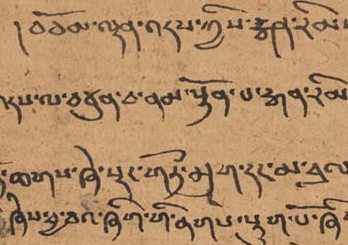
Anyway, the Tibetan Rāmāyaṇa is found in several manuscripts from Dunhuang, which suggests that it enjoyed some popularity this area, far from India but connected to it by the trading routes we call the Silk Road. This version is a retelling of the Indian tale, though it differs in several ways from the Indian versions. It is a condensed retelling of the original story in which many episodes are drastically shortened, making it short enough, perhaps, for a travelling storyteller to relate at one sitting.

Although it is a shortened version, some parts of the Tibetan Rāmāyaṇa are not found in any of the Indian versions (at least as far as I know). An slightly odd addition to the original is the theme of letter-writing. For example, when Hanumān travels to find Sītā, he takes a love letter written by Rāma, and Sītā sends back a love letter in reply. In another episode, Rāma chides Hanumān for forgetting to correspond regularly. A crestfallen Hanumān apologizes: “I should have continually enquired by letter after your health.”

Now, I am not sure that letter-writing was a feature of ancient or medieval Indian culture (perhaps someone more knowledgeable will contest or confirm this). On the other hand, polite enquiries about the health of the addressee are indeed common among the Tibetan letters found at Dunhuang. High ranking Tibetans sent letters back and forth, sometimes containing no more than polite enquiries after the health of the recipient. This social practice explains why Hanumān committed a faux pas when he neglected to send a continual steam of letters to Rāma.
So, if it’s not Indian, where does this version of the Rāmāyaṇa story come from? Some have suggested Khotan, a great little Silk Road kingdom. It’s true that there are a couple of Khotanese manuscripts containing fragments of the stary of Rāma. However, while this Khotanese Rāmāyaṇa contains some of the same elements as the Tibetan story, it also differs from the Tibetan in many ways. There is no letter-writing in the Khotanese version, and the whole story is given a Buddhist moral at the end. The narrative of the Tibetan Rāmāyaṇa, on the other hand, shows no interest in Buddhism at all.

In fact, the Tibetan Rāmāyaṇa seems generally less moralistic than the classic version, in which Rāma and Sītā are ultimately estranged due to Rāma’s suspicion of Sītā’s infidelity. The Tibetan version has a happy ending, in which Rāma’s apology is accepted by Sītā: “They were happier than before. King Rāma, Queen Sītā, husband and wife and the sons together with a large retinue lived happily in the palace Old Earth.” In the end, one can’t help feeling that the reason for the popularity of this version of the Rāmāyaṇa was simply that it’s a great story.

*  *  *

Manuscripts
The manuscripts of the Rāmāyaṇa are: IOL Tib J 737.1 (A), IOL Tib J 737.2 (B & C), IOL Tib J 737.3 (D), Pelliot tibétain 981 (E), Pelliot tibétain 983 (F). In de Jong’s works, these manuscripts are referred to only by the letters A to F, which I have given in brackets after the shelfmarks.

References
1. Bailey, H.W. 1940. ‘Rāma’, (I) BSOAS 10.2 (1940): 365–376; (II) BSOAS 10.3: 559–598.
2. de Jong, J.W. 1971. ‘Un fragment de l’histoire de Rāma en tibétain’ in Études tibétaines dédiées à la mémoire de Marcelle Lalou. Paris: Librairie d’Amérique et d’Orient.
3. de Jong, J.W. 1977. The Tun-huang Manuscripts of the Tibetan Ramayana Story’, Indo-Iranian Journal 19.
4. Kapstein, Matthew. 2003. ‘The Indian Literary Identity in Tibet’, in Literary Cultures in History: Reconstructions from South Asia, edited by Sheldon Pollock. Berkeley: University of California Press.
5. Thomas, F.W. 1929. ‘A Rāmāyaṇa Story in Tibetan from Chinese Turkestan’ in Indian Studies in Honor of Charles Rockwell Lanman: 193–212. Cambridge, Mass: Harvard University Press.

Images
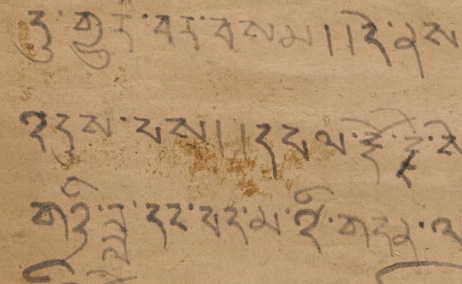
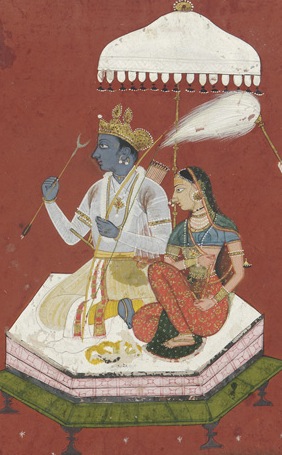
1. British Library manuscript Add. MS 15296(1), from the Rāmāyaṇa exhibition at the British Library. See this site for images of the manuscript.
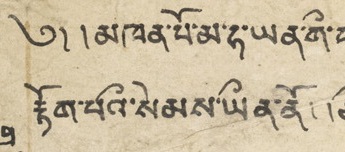
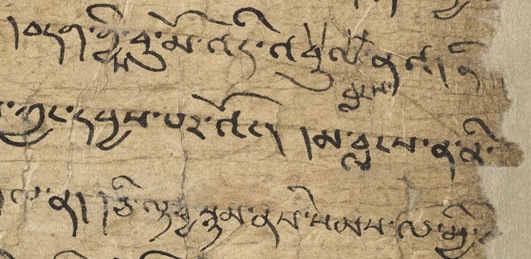
2. The manuscript IOL Tib J 737.2, containing part of one version of the Tibetan Rāmāyaṇa.
Teachers, Students, and Notes

Manuscripts are interesting things. Well, I think so, and over the last year one of the main purposes of this website has been to make this point. Printed books can be objects of beauty, but more often they are just the means by which we get the text itself. And we know that a printed book is one of several hundred, or thousand, or ten thousand almost identical copies. Every manuscript, by contrast, is unique. A manuscript can contain anything from hastily scribbled notes to a fine copy of a revered scriptural text. Every manuscript is different from every other, differing in the circumstances of its creation and in the idiosyncrasies of its creator.

Although each of the Tibetan Dunhuang manuscripts is unique, we can put them in some sort of order, arranging them so that at one end of the scale we have the thousands of carefully copied and corrected sūtras which were the products of organized scriptoria working during the Tibetan imperial period. Here variations are at a minimum and have been eradicated as much as possible in the editorial process…

In the middle of the scale are the manuscripts that have been copied carefully, but outside of the scriptorium and usually without revisions. Most of these would have been for personal use, and contain texts like short treatises, prayers and rituals. Handwritings are individual and sometimes quite stylish….

At the other end of the scale there are  manuscripts that are much more scruffy. The individual letters are poorly formed, as if by children, and the spelling varies quite noticeably more than in most of the Tibetan Dunhuang manuscripts….

The initial temptation is to leave this last type of manuscript well alone, and spend one’s time with more beautiful specimens. However, forced to confront them in my cataloguing work, I had to think about why these people wrote Tibetan so very badly. One possibility is that these weren’t Tibetans, that they had only just learned Tibetan in order to be able to write and understand Tibetan Buddhist prayers and practices.

Another possibility – one that doesn’t exclude the first – is that these manuscripts came out of teaching situations. Most of us will be familiar with taking down notes from some kind of lecture or talk, and with the fact that some people are better note-takers than others. A student might be particulary quick with a pen, and copy nearly every word, or only manage only the most general sort of summary. Taking notes is still important in a variety of teaching situations, including Buddhist ones. But it was even more important before the widespread use of printing made textbooks available. In a manuscript culture, the only textbooks students would own were the ones they wrote themselves.

*  *  *

Dunhuang, the source of our manuscripts, was in its heyday one of the great centres of Buddhist practice, art, scholarship and translation. Situated on the edges of the Chinese and Tibetan cultural spheres, and at the eastern end of the Silk Route, it received a huge cultural input. From the eighth to the tenth centuries, Dunhuang was home to Buddhist communities of Chinese, Tibetan, Khotanese and Turkic monks.  There was also a steady flow of eminent teachers passing through Dunhuang. Chinese Buddhists would stay awhile as they began their pilgrimages to India, and Indians and Tibetans would stop off on their way into China.

For example, in the Stein collection we have a kind of passport (IOL Tib J 754) for a Chinese monk who was on a pilgrimage to visit Nālandā in India. The manuscript contains a series of letters of introduction written in Tibetan, apparently in the tenth century. The Chinese monk passed through the Tibetan areas southeast of Dunhuang before arriving there.  We also have a long scroll (Pelliot tibétain 849) that ends with an account of the journey from India to China – via Tibet – of an Indian teacher called Devaputra. The scroll also contains some written notes perhaps taken by a Tibetan student of this Devaputra.

Another fascinating manuscript is a phrasebook with a series of bilingual conversations in Khotanese and Sanskrit (Pelliot 5386). Among these conversations are some that speak of pilgrims coming from Khotan and India to see the bodhisattva Mañjuśrī in China.  Another conversation mentions the arrival of a travelling Tibetan teacher. Most interestingly, one of the phrasebook’s dialogues contains a series of questions that goes something like this:

Student: “What kind of books do you have?”

Teacher: “Sūtra, Abhidharma, Vinaya, Vajrayāna. Which would you like?”

Student: “I’d like Vajrayāna. Please teach it!”

This little dialogue, as well as others from the phrasebook, give us a sense of a place where Buddhist texts and teachings are frequently passed back and forth. The scruffier Dunhuang manuscripts mentioned above might just be some of the notes of the students who received these teachings.

*  *  *

References
1. Burnett, Charles. 1998. “Give him the White Cow: Notes and Note-Taking in the Universities in the Twelfth and Thirteenth Centuries,” History of Universities 14: 1-30.
2. Sam van Schaik. 2007. “Oral Teachings and Written Texts: Transmission and Transformation in Dunhuang” in Contributions to the Cultural History of Early Tibet, ed. Matthew T. Kapstein & Brandon Dotson. Leiden: EJ Brill. 183–208.

Tibetan Chan II: the teachings of Heshang Moheyan

Dancer as Hashang

In the previous post in this series, we looked at the story of the great debate convened by the Tibetan emperor Trisong Detsen. The debate was to decide between the Chinese and Indian versions of Buddhism that were being taught in Tibet at the time. The Indian teachers favoured the scholastic Buddhism that was found in India’s great monastic universities at the time, while Chinese teachers taught mainly meditation in the style they called Chan (later to become Zen in Japan).

The problem with Chan was that it seemed to dismiss what the Indian teachers were presenting as the essentials of Buddhism, that is, virtuous acts and analytical philosophy leading to wisdom. The Chan teachers chracterised the duality of virtue and nonvirtue and the practice of analysis itself as just the kind of thing that gets in the way of real wisdom. All one had to do, they claimed, was stop making distinctions, whether between virtue and nonvirtue, existence and nonexistence, or any dualities at all.

According to Tibetan histories, the Indian side won the debate decisively–understandably enough, as the anti-analytical approach of the Chan teachers was not best suited to the arena of intellectual debate. The King decreed that Tibetan Buddhism was to follow the Indian example, and the Chinese teachers were to return to China. Whether things really happened in this way, Tibetan historians certainly saw this as a decisive moment in Tibet’s religious history, and never failed to tell the story of the debate. Thus even the debate’s loser achieved a lasting fame, or notoriety. Heshang Moheyan (or Hwashang Mahayan to Tibetans) came to be an emblem of a particular kind of erroneous meditation: the idea that all you have to do to achieve enlightenment is shut down all mental activity.

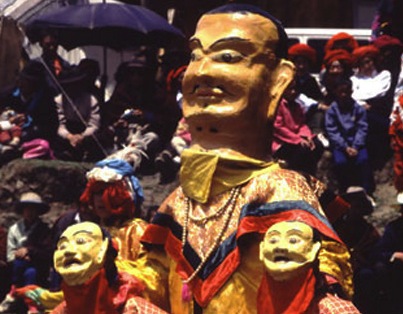
Some Tibetans of a more analytical bent used the Heshang as a polemical stick to beat the meditation traditions that stressed nonconceptual awareness, like Dzogchen and Chagchen. But this was hardly fair, since within even these traditions teachers warned meditators of falling into the extreme of Heshang Moheyan’s blank meditation. Moheyan achieved a long-lasting notoriety in popular culture too, as a figure of fun in ritual dance traditions (as discussed in this recent article).

* * *

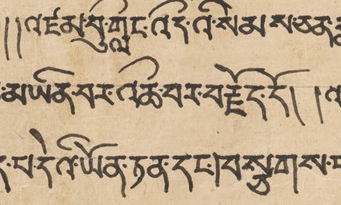
IOL Tib J 468Until recently little was known about the real teachings of Heshang Moheyan except through the Tibetan histories which, written by the spiritual descendants of the winning side of the debate, were unlikely to offer a completely fair representation. Then with the opening of the Dunhuang cave, we suddenly had quite a number of manuscripts apparently written by followers of Tibetan Chan, recording the sayings of Chan masters like Moheyan himself. Great work on piecing together the Dunhuang fragments of Moheyan’s writings has been done by Luis Gomez, and I will look at just one of these manuscripts here, IOL Tib J 468. I want to ask if we can establish whether Moheyan really taught a kind of ‘blank’ meditation, or something a little less extreme. Let’s see.

In his description of meditation, Moheyan writes this:

When you are engaged in contemplation itself, look at your own mind. Then, the lack of any mental activity at all is non-thought. If there is movement of the conceptual mind, be aware of it. “How should one be aware?” Do not analyse the mind which is moving in terms of any kind of quality at all: do not analyse it as moving or not moving; do not analyse it as existing or not exising; do not analyse it as virtuous or non-virtuous; and do not analyse it as defiled or pure. If you are aware of mind in this way, it is natureless. This is the practice of the dharma path.

Well, there is certainly mention here of “the lack of any mental activity.” But the rest of the passage concerns what to do when there is mental “movement”. Interestingly, Moheyan does not suggest suppressing this movement. What he says is: be aware of it without analysing it. What kind of awareness is he talking about? The Tibetan word is tshor, which is used here as a translation for the Chinese character jue 覺 meaning ‘awakening’, ‘illumination’ or ‘awareness’. These words seem a long way from the blankness that Moheyan is supposed to have experienced in his meditation practice. Indeed it seems that he is telling his students here not to suppress mental movement, but to leave it to move in the context of an awareness that does not distinguish it into dualistic extremes.

* * *

Another aspect of Moheyan’s teachings, which I’ll just touch on here, is the fact that he only recommends this technique of meditation to ‘those of sharp faculties’. Others, he says, do need to use various graduated methods. Just what percentage of people he considered to possess these ‘sharp faculties’ is not made clear, but perhaps not so many. In any case, we can see that Moheyan’s teachings were not so radical as they were painted in the later Tibetan tradition. They even seem, dare one say it, quite reasonable…

* * *

References
1. Demieville, Paul. 1952. Le Concile de Lhasa. Paris: Imprimeries Nationale de France.
2. Gomez, Luis. 1983. “The Direct and Gradual Approaches of Zen Master Mahāyāna: Fragments of the Teachings of Moheyan,” in Studies in Ch’an and Hua-yen, edited by Gimello and Gregory: 393–434.
3. Schrempf, Mona. 2006. “Hwa shang at the Border: Transformations of History and Reconstructions of Identity in Modern A mdo.” JIATS 2: 1-32

Tibetan text
IOL Tib J 468: (1v) //bsam gtan nyId du ‘jug pa’I tshe/ bdag gI sems la bltas na/ cI yang sems dpa’ myed de myI bsam mo/ rtog pa’I sems g.yos na tshor bar bya/ cI ltar tshor bar bya zhe na/ gang g.yos pa’I sems de nyId/ g.yos pa dang ma g.yos par yang myI brtag/ yod pa dang myed par yang (2r) myI brtag/ dge ba dang myI dge bar yang myI brtag/ nyong mongs pa dang rnam par byang bar yang myI brtag/ ste// chos thams cad cI lta bur yang myI brtag go// sems g.yos pa de lta bur tshor na rang bzhin myed pa yIn te/ /de nI chos lam spyod pa zhes bya’//

Image
Moheyan in the Rinpung (Rin spungs) ritual dance © 2006 by Mona Schrempf, IATS, and THDL.

Also in this series:
Tibetan Chan I: The Emperor’s Chan
Tibetan Chan III: more teachings of Heshang Moheyan

And an article on a some later Tibetans who supported Moheyan:
The Great Perfection and the Chinese Monk: Nyingmapa Defenses of Hashang Mahāyāna

The Olapati

Kanha
In the last post I looked at the connections between the ‘new’ schools of Tibetan Buddhism (nowadays the Kagyü, Sakya and Gelug) the Dunhuang manuscripts. I tried to show that there is a shared heritage in the sutras translated in the early period, and the sutric contemplations on topics like impermanence and karma.

Could there by any traces among the Dunhuang manuscripts of the ‘new’ tantric lineages that flooded into Tibet from the late 10th century onward? The library cave at Dunhuang was closed up at the beginning of the 11th century, so it seems unlikely, but just possible that we might be able to catch a trace of the ‘new’ lineages. What’s more, I think I have found one.

This trace is connected to the new lineages of Sakya, which derive a number of Indic siddha traditions. One of those siddhas was the famous Virūpa, the source for the transmission of the ‘path and fruit’ or Lamdré practices. Another was Virūpa’s disciple Kāṇha (also known by an number of other names, but we’ll stick to the shortest one), who is the source of another set of esoteric practices. Kāṇha was a Hindu yogin from South India, who often got into arguments with Buddhists, and was converted to Buddhism by Virūpa.

As with most of the great siddhas, there is a funny story about Kāṇha. He is said to have converted a king by taking advantage of the king’s attachment to his many queens. First Kāṇha spent some time with the queens. Then when the queens explained what had happened to the king, the king declared: “He must be killed!” Kāṇha waited for the king’s troops outside the queen’s palace. When the soldiers arrived, Kāṇha back inside. As soon as the troops followed him inside, Kāṇha appeared outside. When both the inside and outside of the palace were completely filled by the troops, Kāṇha sent forth magical emanations outnumbering the king’s troops. The king realized that Kāṇha was a siddha and bowed at his feet.

Stories aside, we don’t really have firm dates for Kāṇha. We know the lineage between Kāṇha and the great Tibetan translator Drogmi contained three people, and Drogmi was born just before the year 1000. So Kāṇha was probably teaching some time in the mid-10th century, if the traditional lineages are correct. This is just where a bit of contemporary evidence, like a Dunhuang manuscript for example, would come in handy.

Kāṇha’s most famous teaching is known by the (apparently) Sanskrit name Olapati. As a text, the Olapati the is quite mysterious. Nobody really knows what the name means (though if you’re interested, see the guesses at the end of this post). And while the Sakyapas practiced an oral instruction on the Olapati known as The Complete Path of Inner Heat they didn’t preserve the Olapati itself in their collections. But the Olapati does seem to have survived. According to two modern scholars of the Lamdré, Cyrus Strearns and Ronald Davidson, the Olapati is to be identified with a canonical text called The Four Stages attributed to a certain Kṛṣṇa (another name for Kāṇha).

Now the Dunhuang scroll Pelliot tibétain 849 contains a list of tantras. As I mentioned in a previous post, the list includes the Guhyagarbha tantra. It also includes an Olipati tantra (the spelling is slightly different, but that is true for almost all of the Sanskrit titles listed in this scroll). When I first saw this Sakya text in the list of tantras I was very surprised. None of the previous studies of this scroll had connected this title with Kāṇha’s text. Could they be one and the same?

The possibility seems less remote when we remember that Pelliot tibétain 849 dates to the end of the 10th century, and contains the notes taken down by a local from a passing Indian tantric master. This Indian master, Devaputra by name, had travelled via Tibet to China on a pilgrimage to Wutaishan, and was on his way back to India when he stopped at Dunhuang. A local called Dro Könchogpal worked with the Indian master on (among other things) a bilingual list of important tantras.

Is this Olipati tantra in our Dunhuang scroll really Kāṇha’s teaching? I think probably it is. The name is unusual enough, and may come from Kāṇha’s South Indian background. The fact that it is called a tantra in the scroll is not really problematic. The local Tibetan who wrote the scroll was not very accurate, and may have assumed he was writing down the names of tantras, when other instructional texts were being listed as well. Or Kāṇha’s teaching may have taken on the status of a tantra in some circles. So here is a siddha’s teaching that came to Central Tibet in the mid-11th century, but was known in distant Dunhuang (if only by name) half a century earlier. And that seems to confirm the traditional Sakya accounts of both Kāṇha’s dates and teachings.

To conclude on the theme of the previous post, when we see the (to later eyes, thoroughly Nyingma) Guhyagarbha tantra together with the (very Sakya) Olapati in the same list, it is a welcome reminder that sectarian divisions and rarely as fundamental as they might seem. History might seem an arcane pursuit sometimes, but it can be a useful way cutting through such divisions.

*  *  *


References

1. Davidson, Ronald. 2005. Tibetan Renaissance: Tantric Buddhism in the Rebirth of Tibetan Culture. New York: Columbia University Press [on the Olapati: pp.200-201]
2. Hackin, Josef. 1924. Formulaire sanscrit-tibétain du Xe siécle. Librairie orientaliste Paul Geunthner, Paris. [On Pelliot tibétain 849]
3. Kapstein, Matthew. 2006 “New Light on an Old Friend: PT 849 Reconsidered”. In Tibetan Buddhist Literature and Praxis: Studies in its Formative Period 900-1400. Leiden: Brill
4. Stearns, Cyrus. 2001. Luminous Lives. Boston: Wisdom Publications. [on the Yellow Book: pp.32-35]

Tibetan texts
1. Dhongthog Rinpoche, T.G. 1976. A History of the Sakya School of Tibetan Buddhism. New Delhi: Paljor Publications.
2. Nag po spyod pa (Kṛṣṇācaryā, alias Kāṇha). Gtum mo lam rdzogs [The Complete Path of Inner Heat]. In Sa skya Lam ‘bras Literature Series vol.11 pp.445-457.
3. Nag po pa (Kṛṣṇa, alias Kṛṣṇācaryā, alias Kāṇha). Rim pa bzhi po [The Four Stages]. Q.2168.

Images
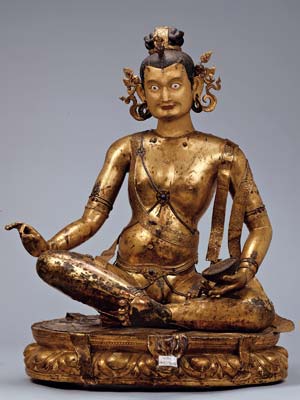
Statue of Kāṇha, from the Museum für Asiatische Kunst, Berlin. From the 2007 exhibition Klöster öffnen ihre Schatzkammern.

And a note…
…on the name Olapati:

  • Matthew Kapstein (2006: p.20) wrote on the name Olipati, from Pelliot tibétain 849: “Oli (perhaps < Skt. āvalī) occurs in the formation of certain technical terms of haṭhayoga, e.g., vajrolimudrā, referring to the yogic practice of sexual congress. A possible interpretation might therefore be *(Vajr)olipaddhatitantra.”
  • Ronald Davidson (2005: 200-201) links the name Olapati to the canonical Tibetan text The Four Stages (Rim pa bzhi pa, Q.2168). He points out that ola survives in the (reconstructed?) Sankrit title to the autocommentary on the The Four Stages, which is Olacatustustaya-vibhaṅga (Tibetan Rim pa bzhi’i rnam par ‘bzhed pa, T.1460). Here ola is equivalent to rim pa, “stage”, while instead of pati we have the standard Sanskrit catuḥ for “four” (bzhi pa).

And another note (added on February 13th)…

The South Indian languages provide plenty of possibilities for all the elements under consideration here, ola, oli and pati. Though I am not any kind of expert in these languages, the possibility is too interesting to ignore, so I am going to speculate, based on Burrow and Emeneau’s A Dravidian Etymological Dictionary and the Cologne Online Tamil Lexicon (http://webapps.uni-koeln.de/tamil).

Since there is no equivalent for the Tibetan bzhi po “the four” in ola/oli/pati, I wonder if the Tibetan name is not a direct translation of Olapati, but rather a descriptive name for the text? In that case, we can look a little more widely for meaning of the name Olapati:

First, ola/oli:

  1. First of all, in many South Indian dialects ōla (or ōlai or ōle) means a page or a book, by extension from the ola palm leaves that are used to make books.
  2. The Tamil noun oli can refer to any sound, to speech or more specifically, to the “loud or audible recitation of a mantra.”
  3. The verbal root oli– or olap– can mean to wash or cleanse in Tamil.
  4. In various South Indian dialects, both oḷa and oḷi have meaning of secrecy and concealment.

Now, pati/patti:

  1. We have the Tamil and Malayam verb pati, “to be imprinted, indented.” Considering that writing on Indian palm leaves is a form of imprinting or indentation, could ōla-pati mean “impressed on palm leaves”?
  2. We have the Tamil verb paṭi, meaning “to practise, habituate oneself to,” which would combine well with some of the meanings of ola/oli attested above, as well as Kapstein’s interpretation of oli.
  3. There is a Tamil noun paṭi, meaning “a step, stair, rung of a ladder, stirrup, grade, rank…” This would be a clear equivalent to the Tibetan rim pa, “stage” and could be combined with some of the meanins of ola/oli above.
  4. And finally, several dictionaries give patti as an equivalent for Sanskrit bhakti, meaning devotion, religious observance and so on. This could be combined with the meaning of oḷa/oīi above to mean “secret” or “hidden” religious observance. Bhakti is particularly associated with deity cults like that of Śīva, which ties in nicely with Kāṇha’s status as a former Śaiva yogin.

In any case, since I have not taken the morphology of these terms into account, I can hardly suggest a best reading here, but if anyone with a knowledge of South Indian languages reads this, I’d be most grateful for any thoughts.