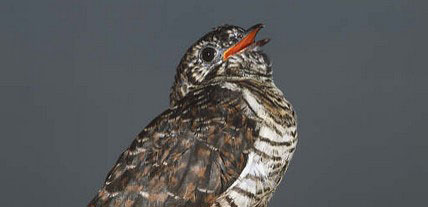
Early Dzogchen I: The Cuckoo and the Hidden Grain

Cuckoo 1

The tradition of Dzogchen has been hugely significant in Tibet, and looks set to be equally important in the global assimilation of Tibetan Buddhism. Yet the early history of Dzogchen (rdzogs chen: “the great perfection”) remains unclear and the subject of controversy. No Indic texts have been found to confirm the tradition’s origins, and most of the early Indic figures in Dzogchen’s lineages remain elusive to modern historians.

The Indic origin of the early Dzogchen texts was disputed by Podrang Zhiwa Ö, a Western Tibetan monk and ruler of the 11th century, and a proponent of the “new transmissions”. From that time on, the question of Dzogchen’s authenticity has been raised, usually by critics of the Nyingma tradition, the home of this and many other transmissions from the early period. (Though we should not let these polemics obscure the fact that Dzogchen has been practised within all of the main schools of Tibetan Buddhism.)

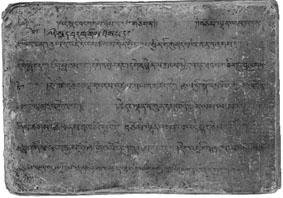
So, the discovery in the 1980s of two Dzogchen texts among the Dunhuang manuscripts seemed to be of some importance and was celebrated by supporters of the historical authenticity of Dzogchen. The texts were noticed, at around the same time, by Namkhai Norbu and Samten Karmay. Namkhai Norbu wrote:

Today, however, the historical authenticity of the Dzogchen texts can be proved, thanks to certain texts rediscovered among the Tun Huang manuscripts, which are considered original and authentic by all scholars.

Now I would never want to impugn Norbu Rinpoche’s understanding of Dzogchen, but I wonder if he overestimated the significance of the Dunhuang manuscripts here. In truth, they probably have little to offer those who would defend Dzogchen against its critics. Before I explain what I mean by this, let’s look at the two Dzogchen texts from Dunhuang. Both have been translated and transcribed in Karmay’s The Great Perfection, and are even more easily accessible in Karen Liljenberg’s online translations.

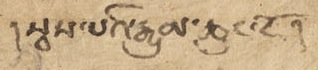
(1) “The Small Hidden Grain” and commentary (IOL Tib J 594)
Sbas pa’i rgum chung

This is a short verse text which argues that the ultimate state, repeatedly called “space” or “sky” (nam mkha’) is beyond conceptualization and cannot be reached through structured practice. The brief commentary divides the text into sections. The commentary also identifies the category of the text as Atiyoga and the author as Buddhagupta. Most of the root text also appears elsewhere in the writings of a Tibetan author, Nyen Palyang (on whom, more in a later post).

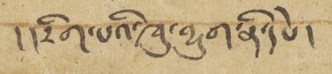
(2) “The Cuckoo of Awareness” and commentary (IOL Tib J 647)
Rig pa’i khu byug

The root text here is a mere six lines (indeed an alternative title is “The Six Vajra Lines”). Again, the emphasis is on non-conceptualization and the uselessness of any practice based on striving toward a goal. The commentary expands on the basic lines without departing from these themes. In addition the commentary is concerned to reinterpret certain tantric concepts, like ‘great bliss’, and the samaya vows, in terms of nonconceptuality and spontaneous presence. The six lines of the root text appear in other Dzogchen texts, including the Kunjé Gyalpo.

Now, what do these manuscripts tell us about the authenticity of the Dzogchen tradition? Well, very little. The Dunhuang cave was closed in the early 11th century, and therefore any Dunhuang manuscript may have been written no earlier than that. It was once thought that the Tibetan manuscripts at least must come from the period of the Tibetan occupation of Dunhuang, that is, between the 780s and the 840s. In recent years this has been shown to be a mistake, as a significant number of Tibetan manuscripts have been dated to the late 10th century. Recent investigations into identifying handwriting styles in the Dunhuang manuscripts (see here) strongly suggest that these two Dzogchen manuscripts should be dated no early than the 10th century.

So what do we mean by “authenticity” anyway? According to Podrang Zhiwa Ö and those polemicists who followed him, it is primarily based on an Indic source, or the lack of it. Yet there is nothing in these manuscripts to confirm an Indic source, not even the Sanskrit versions of the titles found in later Dzogchen texts. The naming of Buddhagupta as an author is interesting, and quite credible, but would hardly be likely to impress a critic who thought that these texts were fabricated by the Tibetans anyway. And then there is the date: with nothing to link them to the Tibetan imperial period, these manuscripts prove nothing about the presence, or otherwise, of Dzogchen texts during the time of the early Tibetan kings.

Perhaps the question of authenticity is not a terribly interesting one anyway.* I would argue that these two Dzogchen texts from Dunhuang are valuable in other ways–at least to those of us interested in the early development of Tibetan Buddhism. Despite their internal rhetoric of non-action, these two Dzogchen manuscripts do not exist in a space-like vacuum, but in the extrordinarily rich context of the rest of the Tibetan manuscripts from Dunhuang. By placing these manuscripts with the other tantric material in the Dunhuang collections (sādhanas, tantras, commentaries, notes from teachings, and so on) we can begin to form a picture of the way Dzogchen was practised in this early period.

To be continued…

References
1. Dalton, Jacob, Tom Davis and Sam van Schaik. 2007. “Beyond Anonymity: Palaeographic Analyses of the Dunhuang Manuscripts” (with Tom Davis and Jacob Dalton) in Journal of the International Association of Tibetan Studies 3.
2. Karmay, Samten. 1980. “An Open Letter by Pho-brang Zhi-ba-‘od” in The Tibet Journal 5.3: 1-28.
3. Karmay, Samten. 1988. The Great Perfection. Leiden: Brill.
4. Norbu, Namkhai. 1989. Dzogchen: The Self-Perfected State. London: Arkana.

* Despite his enthusiasm for these manuscripts expressed in Dzogchen: The Self-Perfected State, Namkhai Norbu suggests he has his own reservations about this concept of “authenticity” in stating that Dzogchen is verified by the state of awareness itself, and not by historical accounts.
Tales from the scriptorium II: It’s a scribe’s life

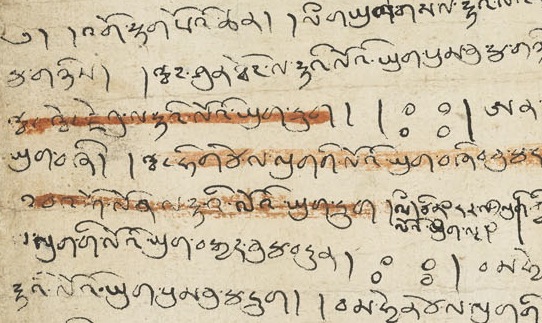
IOL Tib J 1354(B)

This document (IOL Tib J 1359) gives us some real insights into how scribes and their managers worked. The document relates to a particular order for Prajñāpāramitā sūtras paid for by the Tibetan prince (lha sras). The sutras have been copied, and now it’s time to reckon how much paper has gone missing, and to get the scribes who have lost paper to pay the authorities back. The disciplinary work is done by a supervisor (gnyer pa) who is responsible for making sure the scribes pay back the paper they’ve lost.

Any scribes who fail to do so will be in trouble. The supervisor has the authority to kidnap one of their relatives and hold them hostage until the repayment is forthcoming. He can also impound their property and cattle. This interestingly suggests that the scribes were householders, and that their scribal work was done under the threat of serious punishments. Another punishment menioned here is whipping: 10 lashes for each missing batch of paper.

After setting out these rules, the document goes on to list 50 local scribes (all of whom have Chinese names) and the amount of paper allotted to each of them. Scribes were actually allowed to waste some of their paper; this scrap paper was known as legtsé (glegs tshas), and may have been the cover (i.e the top sheet) of each of the batches of paper alloted to the scribes (this is Takeuchi’s suggestion). We have several examples of this scrap paper in the Dunhuang collections. Inevitably they were used by scribes for doodling, writing exercises, or writing practice letters. Several letters are found among the scrap paper (presumably rough drafts) indicating that the scribes made extra earnings by writing letters for others.

Scribes often marked their scrap paper as their own by signing it. We find, for example, written right in the middle of one piece (Pelliot tibétain 1166): “This is the scrap paper of Liu Lutön (Li’u klu rton).” Scribes also wrote contracts for loans between each other. One such contract between two scribes (IOL Tib J 1274), gives some insight into the tools of the scribes’ work. One scribe wants to borrow some paper and wrapping cloth from another. If he fails to repay, the borrowing scribe will have to forfeit his inkpot and handkerchief.

See also:
Tales from the Scriptorium I: Expensive manuscripts
Tales from the Scriptorium III: Scribal doodles

References
1. Takeuchi, Tsuguhito. 1994. “Tshan: Subordinate Administrative Units of the Thousand-Districts in the Tibetan Empire”. Per Kvaerne (ed.), Tibetan Studies: Proceedings of the 6th Seminar of the International Association for Tibetan Studies, Fagernes 1992. Oslo: The Institute for Comparative Research in Human Culture. 848–862.
2. Takeuchi, Tsuguhito. 1995. Old Tibetan Contracts From Central Asia. Tokyo: Daizo Shuppan.
3. Thomas, F.W. 1951. Tibetan Literary Texts and Documents concerning Chinese Turkestan. Part II: Documents. London: Royal Asiatic Society.

Infrared, prayers and booklets

IOL Tib J 76, last page

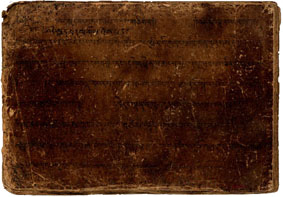
Here’s another manuscript darkened with age and made readable again with infrared photography. IOL Tib J 76 is a booklet (or codex, to give the technical name), with 64 pages measuring about 15 by 22 cm. I tend to think that this kind of darkening is a sign that a manuscript was well used during its lifetime before internment in the Dunhuang cave. The majority of the Dunhuang manuscripts do not look like this; by contrast, many look shockingly fresh, as if they were written weeks rather than centuries ago.

I find the ‘well-used’ theory particularly convincing in the case of this particular manuscript, because the booklet form lends itself to practical use. In contrast to the pothi and scroll form, it is easy to open the book to a particular page. For a monk or lay Buddhist carrying around a collection of frequently perused texts the advantage of this would be particularly clear.

IOL Tib J 76, infrared

This particular booklet does indeed seem to be a collection of such frequently used texts. The first 44 pages contain the Jinaputra-arthasiddhi sūtra, used perhaps for memorization, recitation, or both. The next text is The Butter Lamp Prayer (mar mye smon lam), a prayer recitated during the ceremonial lighting of butter lamps on a shrine, followed by the Hymn to the Bodhisattva Avalokiteśvara Cintamāṇicakra, a popular hymn in Dunhuang, as I have mentioned elsewhere. Both texts would be useful in regular personal devotions and services rendered to others (for a fee).

More interesting still, the next two texts are teaching or study aids. The first is titled Knowledge of Worlds (Lokaprajñā), and is a kind of question-and-answer catechism. It’s contents are well summarized in the colophon:

A teaching, based on the important sutras of the dharma, on the characteristics of the three jewels, the good qualities and the path of liberation, on seeing the two truths, on actions and the ripening of actions, written merely to oppose what is not in concordance with the pure scriptures.

Following this is a Sanskrit-Tibetan dictionary of sorts, defining the Sanskrit terms tantra, mantra, vidyā, dhāraṇī and maṇḍala. Christina Scherrer-Schaub has identified this text as an extract from a translation manual (the Sgra sbyor bam po gnyis pa) composed in the reign of King Senaleg (799–815). Interestingly, only the tantric words have been copied here.

As for the back page, which has now been revealed in stunning infrared, it just contains the first page of the Jinaputra-arthasiddhi sūtra once again, perhaps for handwriting practice or to test memorization.

In any case, this is clearly just the kind of book that a monk or lay Buddhist might carry around, and keep in their home/monastic cell. The darkening of the cover is then probably due to frequent handling (with inevitably greasy hands) or being kept in a room smoky with cooking fire or incense.

References
1. Dietz, Siglinde. 1999. “Jig rten gyi lo rgyus bśad pa, ‘Die Kunde von der Welt.’ Ein katechetischer Text aus Tun-huang.” Helmut Eimer, Michael Hahn, Maria Schetelich and Peter Wyzlic (eds.) Studia Tibetica et Mongolica (Festschrift Manfred Taube). Swisttal Odendorf: Indica et Tibetica Verlag. 71-86.
2. Scherrer-Schaub, Cristina A. 2002. “Enacting Words. A Diplomatic Analysis of the Imperial Decrees (bkas bcad) and their Application in the sGra sbyor bam po gñis pa Tradition.” JIABS 25/1–2: 263–340.

Padmasambhava I: the early sources

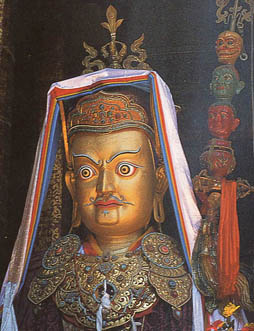
PadmasambhavaKnown as Pema Jungné (‘the lotus-born’) or Guru Rinpoche (‘the precious guru’) in Tibet, Padmasambhava is seen as the true founder of Tibetan Buddhism, a second Buddha who established the dharma in the land of the red-faced men. Padmasambhava is said to have been invited to Tibet to help found the first Tibetan monastery, Samyé, and tame the local demonic forces that were obstructing the establishment of the monastery.

In the earliest histories, Padmasambhava’s role is limited to this, and perhaps to introducing the technology of irrigation to the valleys of Central Tibet. In later histories, Padmasambhava’s role is far greater. In particular, his is said to have concealed uncountable books and sacred objects throughout Tibet, for discovery when the time became ripe. The discoverers are the famed tertön and the hidden treasures are the terma.

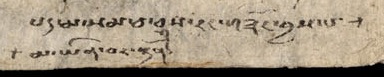
Despite his importance to Tibetan Buddhism there are few early manuscript sources on Padmasambhava (most of which have been discussed by Jacob Dalton and Kenneth Eastman). One of the rare and important sources is IOL Tib J 321, a 10th century manuscript containing a commentary on a tantra called the Upāyapāśa attributed to Padmasambhava. The commentary survived into the later tradition, but the attribution to Padmasambhava was lost. The authorship of the commentary is suggested in two places. The first is a simple note that states: “This was taught by Padmasambhava without any fabrications of his own.”

itj321b.jpg

The second is a verse that is attached to the end of the commentary, praising “Padmarāja”. An interlinear note confirms that this is Padmasambhava: “Acārya Śāntigarbha examined this and found it free from error; afterwards he praised Padmasambhava.”

itj321a.jpg

Śāntigarbha is an obscure figure in Tibetan history, one of the Indian gurus invited to Tibet along with Padmasambhava, who was involved in the transmission of tantras to Tibet. Although the attribution of this text to Padmasambhava is fairly well-known, Śāntigarbha’s verses of praise to Padmasambhava have never been translated or discussed (as far as I know):

Homage to Padmarāja, beyond the world,
The great marvel, attainer of the supreme accomplishment,
Who brought out of the valleys
The great and secret instructions of the tathāgatas.

/dngos grub mchog brnyes ya mtshan chen po’i/
/’jig rten ma gyur pad ma rgyal po yis/
/de bzhin gshegs pa’i man ngag gsang chen rnams/
/klung nas bkrol mdzad de la phyag ‘tshal lo/

Two things about these verses interest me very much. The first is the similarity of the first line (the second line in my translation) to the Seven Line Prayer, a much more famous set of verses of praise to Padmasambhava which is still recited today. Śāntigarbha’s verses seem to have been a forerunner and source for the Seven Line Prayer. The second interesting aspect of these verses is the reference to bringing secret instructions out of the valleys. The “valleys” may be a reference to Oḍḍiyāna, Padmasambhava’s homeland, which also happens to be where many tantras are said to have entered the human realm. The association of Padmasambhava with the revelation of tantras (not found in any history) is a surprising link to the later terma tradition, not in the traditional sense in which he is said to have concealed the terma, but as a revealer of treasures himself, a model for the later tertöns.

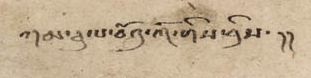
Finally, just in case I have given the impression that Padmasambhava actually wrote this manuscipt, let me be clear that he didn’t. The scribe has signed the manuscript, and we can see that he was a local to the Dunhuang area, probably a Chinese from Ganzhou, who went by the name Kamchupa Buoko.

itj321c.jpg

References
1. Dalton, Jacob. 2004. “The Early Development of the Padmasambhava Legend in Tibet: A Study of IOL Tib J 644 and Pelliot tibétain 307.” Journal of the American Oriental Society 124.4: 759-772.
2. Eastman, Kenneth. 1983. “Mahāyoga Texts at Tun-huang”. Bulletin of Institute of Buddhist Cultural Studies (Ryukoku University) 22: 42–60.
3. Germano, David. 2002. “The Seven Descents and the Early History of rNying ma transmissions.” The Many Canons of Tibetan Buddhism (eds Helmut Eimer and David Germano), Leiden: Brill. 225–263.