
Astrology was, and surely still is, an important part of life in Tibet. As in most other Asian countries, astrology played the vital role of deciding whether to carry out an important activity – a journey, a marriage, a funeral, a battle – and which days were best for embarking on such activities. Tibetan astrology is often said to be a combination of Chinese and Indian astrologies. According to one history, it was the tsenpo Tridé Tsugtsen who introduced Chinese astrology to Tibet in the 8th century. The influence of Indian astrology comes mainly through the Kālacakra tantra I believe, from the 11th century onwards.
There is an old saying, going back to the time of the Tibetan empire, that characterises Tibet’s neighbours according to their special talents (at least in Tibetan eyes):
- To the south is India, the land of religion
- To the north is Turkestan, the land of horses, weapons and war
- To the west is Persia, the land of wealth, jewels and trade
- To the east is China, the land of divination and astrology
Tibet already had a divination method that had little to do with Chinese astrology, in which dice were used to consult oracle deities – the ancestor of the mo divination still practised today. But the study of the stars and their portents was something the Tibetans encountered, and apparently were impressed with, in their early contact with China.
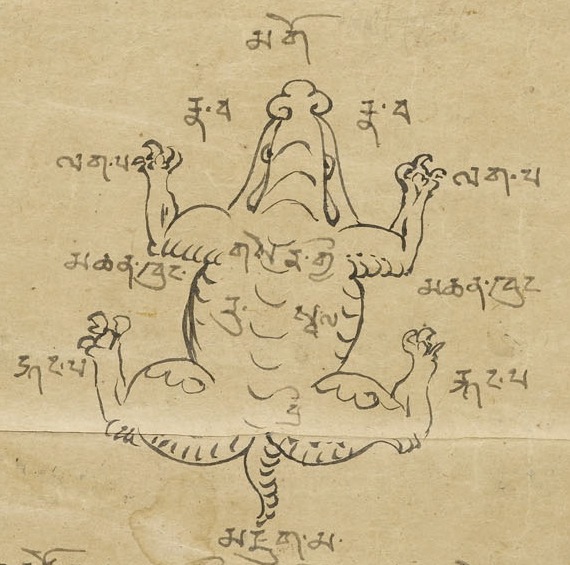
Now I wouldn’t be venturing into an area of which I know so very little, were it not for an amazing and totally unexplored manuscript from the Dunhuang cave that looks like the earliest Tibetan text on Chinese-style astrology – Or.8210/S.6878. It’s been written on the back of a Chinese sutra, and since it was filed along with the Chinese scrolls, the Tibetan side was ignored. How, I don’t know. It’s full of diagrams and ends with the rather strange tortoise that graces the top of this post. So I will say a little about this manuscript, and hope to learn something from anyone who knows more about the subject and is kind enough to comment.
* * *
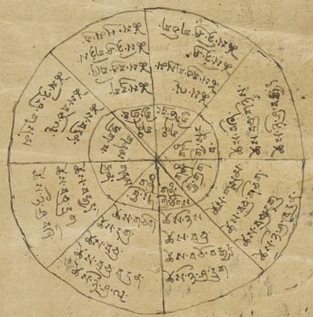 The first diagram comes under the heading “divining the good and bad dates for beginning a journey.” The first result is this:
When the day falls in the “gate of the sky”, if you go on a long journey, it will be good and auspicious.
If you look in the diagram, the “gate of the sky” (gnam gyi sgo) is one of the eight divisions of the diagram, under which is written “the 1st day, the 9th day, the 10th day, the 17th day and the 25th day.” So the sky is divided into eight parts.
I guess it’s not so difficult to do this astrology after all – just check the day of the month against the diagram, and read the result. There are bad days too:
When the day falls in the “junction of the sky”, wherever you go a great loss will occur – very bad.
The word I translated as “loss” is god ka, which usually means a financial deficit, so I have the feeling that the main purpose for making this astrological calculation is to check on the possible success of a journey for the purpose of trade. That is, travelling merchants (not scarce on the Silk Route) would ask an astrologer (probably a Buddhist monk) to check the best days for embarking on a journey. I say “probably a Buddhist monk” because these astrological diagrams have been written on the back of a Chinese Perfection of Wisdom sutra.
* * *
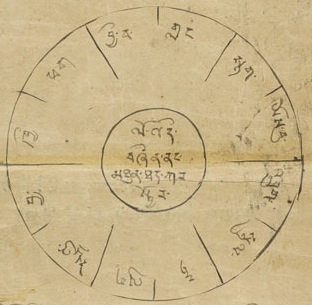 Other diagrams on the scroll contain the twelve animals of the Chinese and Tibetan zodiacs, and underneath is the phrase “If the male and female are joined in this way…” The animal years in the Tibetan calendar always come in male or female form (usually the even-numbered years are the male ones, and the odd-numbered years the female). Note that in the diagram here the animals are divided into pairs. This could be a combination of the animal of the current year with the animal of the day, or of one’s birth year, but I haven’t been able to work this one out yet.
And what of the star animal of this manuscripts – the golden turtle? Well, in early China (I mean the Han dynasty if not earlier) the main methods for divination were to use bones, yarrow sticks and turtle shells. It was the ability of the turtle to live to a great old age that attracted people to it. Turtles from the Yangtse River were thought to have divine powers, and those over a foot long were believed to be a thousand years old. In their age they represented wisdom and – unfortunately for the turtles – longevity, with the inevitable result that they were eaten as a remedy for the problems of old age. Pictured below is the Chinese Pond Turtle, also known as the Golden Turtle.
 Turtles – which have the lovely name rubel (rus sbal) in Tibetan – also had a cultural significance in Tibet. Have a look at the metaphors and riddles of Padampa Sangyé attached to the redoubtable Tibeto-Logic site here. One asks “who drew the design on the turtle’s back; who was the artist?” Which brings us to the fact that the turtle depicted here appears to be without its shell. In fact it looks suspiciously like the artist had never seen a real turtle.
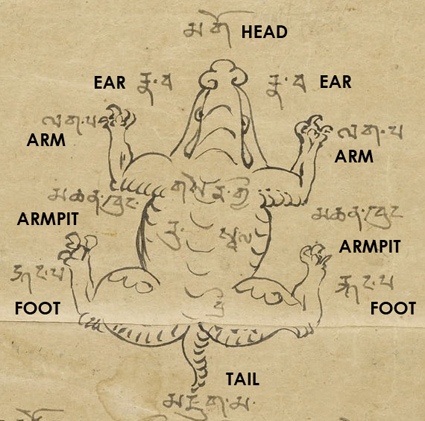
So, how to do the turtle divination? The instructions are quite straightforward, although you need to know what a lunar day is. You need to count the number of lunar days since the day you lost the thing, going around the points of the turtle, and then take the result from where you end up on the turtle’s body. If you lost the thing within thirty days, start at the head and go round clockwise. If it’s over thirty days, start at the bottom and go round anticlockwise. And if you don’t read Tibetan, here’s a translation of the body parts
* * *
The divination practice (mo) of the golden turtle: for finding things that have escaped or been mislaid.
Whichever lunar day it happens to be, calculate from the first day it was lost to the current lunar day, and the result is found in connection with where this falls on the body part of the turtle. If it was lost within the last thirty days, then count to the right from the head. If it is not within thirty days, then count going round to the left from the tail. Write the good or bad result at the turtle’s tail.
- If it was lost on the lunar day of the head, it will be found if you look in the vicinity of a laundry washer.
- If it was lost on the lunar day of the ears, then even if you come across it on the road while searching for it, it will not be beneficial to get your hands on it.
- If it was lost on the lunar day of the arms, you will find it if you look for it on a high mountain, in a ravine, or in the middle of a graveyard.
- If it was lost on the lunar day of the armpits, you will find it if you look for it at the goldsmiths, at the watermill, or in the town centre.
- If it was lost on the lunar day of the feet, you will find it if you look at the the royal gates, the minister’s place, or the conference site.
- If it was lost on the lunar day of the tail, you will find it if you look in the direction of your girlfriend.
* * *
Tibetan text
@//gser gyI ru bal mo ste//bros pa dang/rlag btsal pa’/zla ba gang la bab kyang rung ste//tshes zhag gcig nas bgrangs la stor pa’I/nyi ma ru sbal kyi tshigs gar bab pa dang/sbyar te gdab bo/zla ba sum/cu thub na nI/mgo nas g.yas logsu bgrang/zla ba sum cu myi thub na ni/mjug bas g.yon logsu bskor te bgrango//bzang ngan gyi tsigs ni/ru sbal kyi mjug du bris so//
@//mgo ‘i nyi ma la/stor na btso blag mkhan gyI/ ‘khor du btsal na rnyed//rna ba’I nyi ma la stor na/btsal te lam du phrad kyang /bdag gI lag tu thob la myI phan no//lag pa’I pa’I nyi ma la stor na/rI mthon po dang/grog mo dang/mchad khrod du/btsan (=btsal) na rnyed//mchan khung gI nyi ma la stor na/gser mgar dang/rang tag (=’thag) dang/grong ‘khor du btsal na rnyed//rkang pa’I nyi ma la stor na/rdze (=rje?) sgo dang/zhang lon dang/ tshong dus su btsal na rnyed//mjug ma’I nyi ma la stor na/grog (=grogs?) mo pyogsu btsal na rnyed//
Translator’s notes
- Two words I am uncertain about here are grong ‘khor, which I have tentatively translated as “town centre”, and rdze sgo, which I have even more tentatively translated as “royal gates” (assuming rdze = rje).
- The word tshong dus, which I’ve translated as “conference site” is found in the Dunhuang manuscripts referring to several places where royal/governmental conferences were held during the Tibetan empire. Later, it usually means a marketplace.
- I’ve chosen to read grog mo in the final sentence to grogs mo, changing a ravine to a girlfriend. Since we already had a ravine in an earlier result, it seems redundant here. I like this reading, but it might not be right.
* * *
References
1.Baumann, Brian. 2008. Buddhist Mathematics According to the Anonymous Manual of Mongolian Astrology and Divination. Leiden: Brill.
2. Cornu, Phillipe. 2002. Tibetan Astrology. Boston: Shambhala.
3. Loewe, Michael. 1994. Divination, mythology and monarchy in Han China. Cambridge: Cambridge University Press.
4. Ho Peng Yoke. 2003. Chinese Mathematical Astrology. London: Routledge Curzon.

 early Tibet