The nine vehicles of the Nyingma: new sources

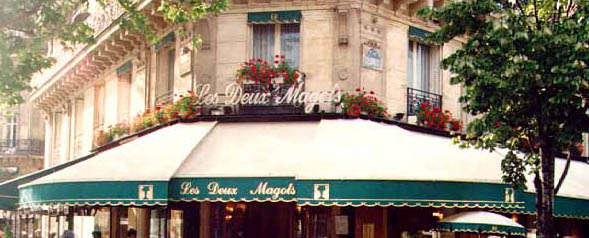
Deux Magots café

It is amazing how many Dunhuang manuscripts of great value for understanding how Tibetan Buddhism developed were overlooked in the century since their discovery. I have already discussed previously overlooked sources on Avalokiteśvara and Padmasambhava. Let’s look here at some “new” sources for the way the Buddha’s teachings are divided up by the Nyingma school of Tibetan Buddhism

The Nyingma school recognises 9 categories of teachings, known as 9 ‘vehicles’ (theg pa, or yāna in Sanskrit). The classical Nyingma formulation, represented in sources like Longchenpa’s Treasury of Philosophical Tenets is:

  1. Śrāvaka
  2. Pratyekabuddha
  3. Bodhisattva
  4. Kriyā
  5. Ubhaya
  6. Yoga
  7. Mahāyoga
  8. Anuyoga
  9. Atiyoga

This system was rejected by the new schools that arose after the 10th century. Some writers of the new schools also cast doubt on the genuine antiquity of the 9 vehicles, and it does seem there was probably no real Indian ancestor. All of these classes of teachings may did exist in India, but bringing them together in this way, and particularly calling them all ‘vehicles’ seems to have happened in Tibet.

Now the 9 vehicles appear throughout the terma (‘treasure’) literature, but modern scholarship tends to take the sceptical position that these texts should be treated as products of the time of their appearance, rather than of when they were said to have been concealed in the late 8th century. Transmitted literature found in the Kangyur and Tengyur and other canonical collections is more admissible as evidence, even though the attribution of authorship is often questionable.

So among the transmitted literature we do have some works referring to the 9 vehicles, or something like them. From the 8th century there is The Garland of Views, which is generally accepted to have been written by Padmasambhava, or at least somebody from the same period (see the Tibetan text and translation in Samten Karmay’s The Great Perfection). There is another text supposedly from the same period, Explaining the Stages of the View, attributed to the early translator Kawa Paltseg, which does contain the 9 vehicles in exactly the same way as they are presented in the later Nyingma school, but for several reasons this looks like a later text falsely attributed to Kawa Paltseg. Then from the late 9th century we have Nub Sangye Yeshe’s Armour Against Darkness, his commentary on the great Anuyoga scripture Gongpa Düpai Do (the 9 vehicles are not explicitly presented in the root text).

If these texts really do date from the 8th to 10th centuries, we ought to see some versions of the 9 vehicles in the Dunhuang manuscripts. Until the last few years however, all we have had is one scroll: Pelliot tibétain 849. This scroll has been known about since the 1920s, when a book-length study of it was published in France by Josef Hackin. The scroll contains a whole series of notes, probaby taken from the teachings of an Indian guru passing through Dunhuang. Among these notes is something similar to the 9 vehicle system of the Nyingma, but still with significant differences.
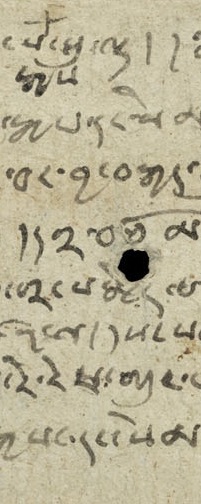
IOL Tib J 644Then a few years ago, when Jake Dalton and I were working on a catalogue of the tantric manuscripts in the Tibetan Dunhuang collections, we came across two more versions of the 9 vehicle system. Amazingly, both were more much more interesting and comprehensive treatments of the subject than the one found in Pelliot tibétain 849.

The first of these manuscript is Pelliot tibétain 656, entitled The Seven Great Transmission Types (Spyi’i lung chen po bdun). It’s a short text, short enough that Jake and I translated it in one sitting at the Deux Magots café in Paris (from a microfilm printout, not the manuscript!). The 7 types are equivalent to the 9 vehicles minus the Pratyekabuddha and Upāya yoga categories; thus:

  1. Śrāvaka
  2. Sautrāntika (here this means a non-tantric Mahāyanist)
  3. Kriyā
  4. Yoga
  5. Mahāyoga
  6. Anuyoga
  7. Atiyoga

In a very clear and methodical treatment, each of these is discussed in terms of its (i) view, (ii) meditation, (iii) practices and (iv) vows. This is an elegant and sophisticated little treatise. In essence there is little difference between the way these classes of teachings are described here and the description of their equivalents in classical Nyingma sources.

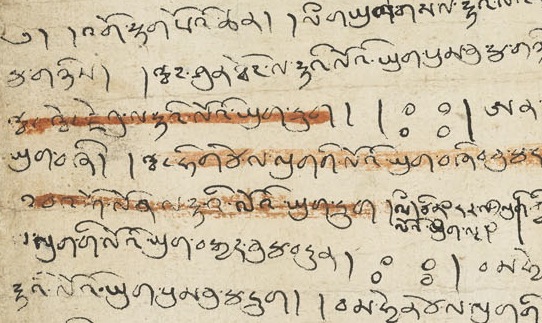
The second “new” manuscript is IOL Tib J 644. Here the 9 vehicles appear in their entirety, exactly as they do in the later tradition. Again, the treatment is very systematic, distinguishing the 9 categories in terms of (i) their deity system, (ii) the relationship between deity and practitioner and (iii) the marks of accomplishment. Jake provided a translation of the complete text in his recent article “A Crisis of Doxography”. The only difference between this manuscript and the later tradition, and I suppose it is not such a small difference, is that the word ‘vehicle’ is never used in the manuscript to refer to these classes. This is significant in that some scholars of the new schools strongly rejected the idea of calling these tantric classes ‘vehicles’. Sakya Paṇḍita, for one, argued that Atiyoga should be treated as a manifestation of wisdom, but not as a vehicle in itself. The general tendency to refer to the 9 categories as vehicles seems to postdate our manuscripts, that is to say, it was not common until after the 10th century.

References
1. Dalton, Jacob. 2005. “A Crisis of Doxography: How Tibetans Organized Tantra in the 8th-12th Centuries”. Journal of the International Association of Buddhist Studies 28.1: 115–182.
2. Hackin, Josef. 1924. Formulaire sanscrit-tibétain du Xe siécle. Paris: Librairie orientaliste Paul Geunthner.
3. Kapstein, Matthew. “New Light on an Old Friend: PT 849 Reconsidered”. Tibetan Buddhist Literature and Praxis. Leiden: Brill. 9–30.
3. Karmay, S. 1988. The Great Perfection. Leiden: Brill.

Tibetan texts
1. Klong chen pa. Grub mtha’ mdzod [Treasury of Philosophical Tenets]. In the Mdzod bdun (click here for bibliographical references to the various editions).
2. Bka’ ba dpal brtsegs(?). Lta ba’i rim pa bshad pa [Explaining the Stages of the View]. Q.5843.
3. Gnubs Sangs rgyas ye shes. Sangs rgyas thams cad kyi dgongs pa ’dus pa mdo’i dka’ ’grel mun pa’i go cha [Armour Against Darkness]. Rnying ma bka’ ma rgyas pa, vols.50-51.
4. Padmasambhava(?). Man ngag gi rgyal po lta ba’i ‘phreng ba [The Garland of Views]. Q.4726.

Buddhism and Empire I: a soldier’s prayer

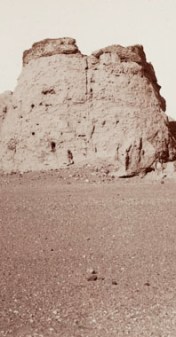
Miran fort Most of the sources we use to study Tibetan Buddhism during the time of the Tibetan empire are officially sanctioned: translations, royal edicts, monastic library lists and the the like. There are far fewer sources revealing how Buddhism was practised by ordinary Tibetans during the empire. Here is one such source: a soldier’s document from the Tibetan fort of Miran (Tibetan name: Nob chung) on the edge of the Lopnor desert.

Tibetan soldiers in Central Asia used wooden documents as much as paper ones. Wood was used for baggage tags, requisition notes, even for short letters. Usually these documents are small rectangular pieces of wood which we call woodslips. In some rare cases, we also find Buddhist texts on these woodslips. The one pictured here (IOL Tib N 404) contains a prayer and a brief dhāraṇī spell of the deity Uṣṇiṣasitātapatra.

The first thing scribbled on the woodslip is a prayer for refuge to the three jewels, with particular reference to avoiding hell (na rag). Then Uṣṇiṣasitātapatra is mentioned, followed by a short version of one of her dhāraṇī spells.

IOL Tib J 404

The role of dhāraṇīs in the popularization of Buddhism in Tibet is rarely mentioned, but they were hugely popular in the early period. The Dunhuang collections contain at least 40 manuscript copies of the Uṣṇiṣasitātapatra dhāraṇī alone. Perhaps we should say a little more about what a dhāraṇī is. Somewhat confusingly, the word can refer to two things:

  1. Dhāraṇī spells: a sequence of Sanskrit syllables, akin to a mantra, but usually longer; in fact dhāraṇī spells can be several pages long.
  2. Dhāraṇī sūtras: scriptural texts presenting one or more dhāraṇī spells. These usually set out the background of the spell—how and why it was taught by the Buddha—and explain the uses of the spell, which is usually to guard against various calamities, from illness to demons, enemies, death and rebirth in hell.

Sometimes, as with this woodslip, the spell was copied without the sūtra, presumably so that it could be carried around and recited when needed. Considering the many uses of dhāraṇī spells, it’s not surprising that soldiers of the Tibetan empire might have carried spells around with them for their protective properties. Of course, many would have memorized the spells, and this woodslip may have served more as an aide-memoire than a permanent record.

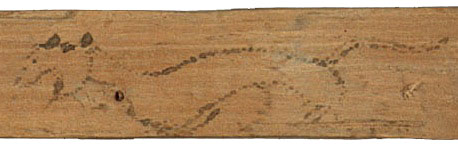
Finally, it’s worth turning over this particular woodslip, as the other side contains a charming picture of an animal. The species is a little hard to make out: a tiger, a dog or perhaps the ubiquitous marmot, found scampering throughout Central Asia? Suggestions please…

IOL Tib J 404 verso

Buddhism and Bön II: What is tsuglag?

Songtsen GampoOne of the most important, yet most difficult to define concepts in pre-Buddhist Tibet is tsuglag (gtsug lag). In the early texts it has a variety of meanings, which were aptly summarized by Rolf Stein:

Il désigne une sagesse, un art, une science, un savoir-faire (et les écrits qui en parlent).

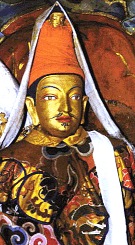
Thus wisdom, art, science, and indeed savoir-faire all coalesce in the tsuglag. It can be found as a personal characteristic of the ancient rulers of Tibet (such as Songtsen Gampo, pictured here), where it signifies the wisdom exercised in rulership. It is also used as a name for non-Buddhist ritual techniques (or ‘sciences’). Later on the word tsuglag became attached to Buddhism (just as the word chos gradually changed from signifying religion in general to Buddhism in particular). Thus one very common name for a Buddhist temple: tsuglakhang (gtsug lag khang), a “house of tsuglag.”

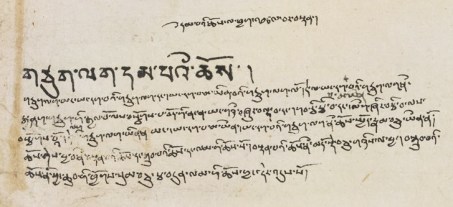
The manuscript shown below (IOL Tib J 339) is a prayer, a series of homages to the Buddha, the dharma, the sangha, and other noble objects. In the verse pictured here, the dharma is called “the supreme tsuglag”. The detailed commentary written in a tiny hand underneath this line goes on to distinguish between right and wrong forms of tsuglag. Right tsuglag is of course Buddhism itself, which is defined here in terms of teaching (bstan pa), accomplishment (bsgrub pa) and the path (lam).

Gtsug lag

The definition of wrong tsuglag is a bit more interesting, as it reveals the systems (of ‘science’) which were considered to be in competition with Buddhism at the time. The first kind of wrong tsuglag mentioned is called “the king of Chinese tsuglag” (rgya nag gi gtsug lag gi rgyal po). The exact system that is being referred to here is unclear but it is worth noting that Chinese astrologers equated the Pole Star with the emperor.

Then the author of the commentary tells us that there is wrong tsuglag “even within Tibet”. This includes studying the portents of the days (gnyi bzhur blta ba), probably a divination system for deciding whether particular days are favourable for certain activities–a very popular form of divination throughout Tibetan history. Another kind of wrong tsuglag is the gab tse, a word still used by Tibetans to refer to astrological charts. And the last form of wrong tsuglag is li zhi, which is unfamiliar to me but certainly looks like a Tibetan transliteration of a Chinese term—it might be worth investigating a link with the neo-Confucian li (理) and qi (氣).

Another manuscript, which I will discuss soon, shows that advanced forms of Chinese divination based on astrological tables were translated into Tibetan and apparently practised in Dunhuang by the 10th century. In fact Dunhuang and the surrounding area may well have been the entry-point for many elements of Chinese culture into the Tibetan cultural sphere.

References
1. Hahn, Michael. 1997. “A propos the term gtsug-lag”. Helmut Krasser, Michael T. Much, Ernst Steinkellner, Helmut Tauscher (eds.) Proceedings of the 7th Seminar of the International Association for Tibetan Studies. Wien: Österreichische Akademie der Wissenschaften, 1997. 341-348.
2. Macdonald, Ariane. 1971. “Une lecture des Pelliot Tibétain 1286, 1287, 1038, 1047 et 1290. Essai sur la formation et l’emploi des mythes politiques dan la religion royale de Sroṅ-bcan sgam-po”. Études Tibétaines, 190-391.
3. Stein, R.A. 1985. “Tibetica Antiqua III, À Propos du mot gcug-lag et de la religion indigène”. Bulletin de l’École Française d’Extrême Orient, 74, 83-133.

Also in this series
Buddhism and Bon I: the religion of the gods
Buddhism and Bon III: what is yungdrung?

Tales from the scriptorium II: It’s a scribe’s life

IOL Tib J 1354(B)

This document (IOL Tib J 1359) gives us some real insights into how scribes and their managers worked. The document relates to a particular order for Prajñāpāramitā sūtras paid for by the Tibetan prince (lha sras). The sutras have been copied, and now it’s time to reckon how much paper has gone missing, and to get the scribes who have lost paper to pay the authorities back. The disciplinary work is done by a supervisor (gnyer pa) who is responsible for making sure the scribes pay back the paper they’ve lost.

Any scribes who fail to do so will be in trouble. The supervisor has the authority to kidnap one of their relatives and hold them hostage until the repayment is forthcoming. He can also impound their property and cattle. This interestingly suggests that the scribes were householders, and that their scribal work was done under the threat of serious punishments. Another punishment menioned here is whipping: 10 lashes for each missing batch of paper.

After setting out these rules, the document goes on to list 50 local scribes (all of whom have Chinese names) and the amount of paper allotted to each of them. Scribes were actually allowed to waste some of their paper; this scrap paper was known as legtsé (glegs tshas), and may have been the cover (i.e the top sheet) of each of the batches of paper alloted to the scribes (this is Takeuchi’s suggestion). We have several examples of this scrap paper in the Dunhuang collections. Inevitably they were used by scribes for doodling, writing exercises, or writing practice letters. Several letters are found among the scrap paper (presumably rough drafts) indicating that the scribes made extra earnings by writing letters for others.

Scribes often marked their scrap paper as their own by signing it. We find, for example, written right in the middle of one piece (Pelliot tibétain 1166): “This is the scrap paper of Liu Lutön (Li’u klu rton).” Scribes also wrote contracts for loans between each other. One such contract between two scribes (IOL Tib J 1274), gives some insight into the tools of the scribes’ work. One scribe wants to borrow some paper and wrapping cloth from another. If he fails to repay, the borrowing scribe will have to forfeit his inkpot and handkerchief.

See also:
Tales from the Scriptorium I: Expensive manuscripts
Tales from the Scriptorium III: Scribal doodles

References
1. Takeuchi, Tsuguhito. 1994. “Tshan: Subordinate Administrative Units of the Thousand-Districts in the Tibetan Empire”. Per Kvaerne (ed.), Tibetan Studies: Proceedings of the 6th Seminar of the International Association for Tibetan Studies, Fagernes 1992. Oslo: The Institute for Comparative Research in Human Culture. 848–862.
2. Takeuchi, Tsuguhito. 1995. Old Tibetan Contracts From Central Asia. Tokyo: Daizo Shuppan.
3. Thomas, F.W. 1951. Tibetan Literary Texts and Documents concerning Chinese Turkestan. Part II: Documents. London: Royal Asiatic Society.