Avalokitesvara in Early Tibet III: Om mani padme hum

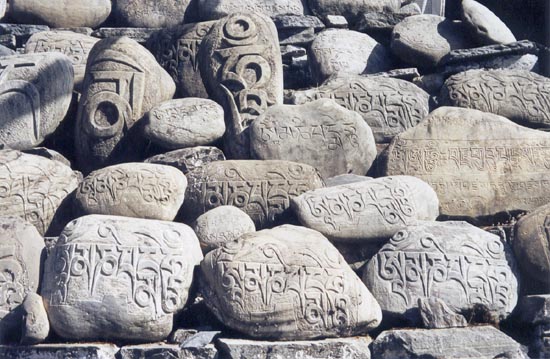
Mani stones

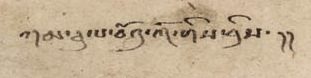
As I’ve shown in previous posts, the bodhisattva of compassion, Avalokiteśvara (Tib. Chenrezig) was popular in Tibet before the second propagation of Buddhism which began in the late 10th century. However the way Avalokiteśvara was worshipped in this early period may have been somewhat different. We associate Tibetan devotion to Avalokiteśvara so closely with the six syllable mantra (Oṃ maṇi padme hūṃ) that it is difficult to think of one without the other. Nevertheless it does seem that before the 11th century, the six syllable mantra was only loosely associated with Avalokiteśvara in Tibet. Among the many Dunhuang texts devoted to the bodhisattva, only two contain the six syllable mantra, and in both cases it is still not quite the mantra as we know it. In particular, it has more than six syllables.

In one manuscript, a guide for the dying (Pelliot tibétain 420/421), the mantra is Oṃ maṇi padme hūṃ mitra svāhā. In another, a ritual collection (IOL Tib J 401), it is Oṃ vajra yakṣa maṇi padme hūṃ. And in all other cases, entirely different mantras are associated with Avalokiteśvara.

Despite this lack of pre-11th century textual sources for the mantra, it might well have been gaining popularity through oral transmission. There is a story in the Blue Annals about a certain Latö Marpo (La bstod dmar po), who went to India in the 11th century to find a teaching to purify the negative actions he committed as a child. Latö found a guru who agreed to teach him a very secret mantra that would remove the obstacles of this life and provide enlightenment in the next. The guru, speaking down a bamboo tube inserted into the ear of the student, so that no-one could overhear, said “Oṃ maṇi padme hūṃ.” Latö immediately thought: “This mantra is recited throughout Tibet by old men, women and even children!” He had to perform some unpleasant acts of penance for having such doubts, but the story ends well.

If true, the story suggests that the six syllable mantra was transmitted in India as a secret oral teaching, but had permeated deep into the popular oral culture in Tibet by the 11th century. This might have been accomplished by wandering religious preachers in Tibet, the forbears of those who later came to be known as maṇipas, because they spread a simple form of dharma which concentrated on recitation of the six syllable mantra.

What really changed in the textual tradition was the appearance of the early treasure cycles (especially the Maṇi Kambum) which took the narrative of Avalokiteśvara from the Kāraṇḍavyūha sūtra and merged it with Tibetan creation myths to make Avalokiteśvara Tibet’s patron deity. And the Avalokiteśvara’s mantra in that sutra is of course Oṃ maṇi padme hūṃ.

References

1. Imaeda, I. 1979. Note préliminaire sur la formule oṃ maṇi padme hūṃ dans les manuscrits tibétains de Touen-houang. In Michel Soymié (ed.) Contributions aux études sur Touen-Houang. Geneva/Paris: Librairie Droz.
2. Kapstein, Matthew. 1992. “Remarks on the Mani bka ‘bum and the Cult of Avalokitesvara in Tibet”. Goodman & Davidson (eds.), Tibetan Buddhism, Reason and Revelation. 79-93.
3. Roerich, G.N. [1949] 1976. The Blue Annals. Delhi: Motilal Banarsidass.
4. Stein, R.A. 1959. Recherches sur l’épopée et le barde au Tibet. Paris: Presses universaires de France.
5. Stein, R.A. 1970. Un document ancien relatif aux rites funéraires des Bon-po tibétains. Journal Asiatique CCLVII, 155–185.
6. van Schaik, S. 2006. “The Tibetan Avalokitesvara Cult in the Tenth Century: Evidence from the Dunhuang Manuscripts”. Tibetan Buddhist Literature and Praxis (Proceedings of the Tenth Seminar of the IATS, 2003, Volume 4), ed. Ronald M. Davidson and Christian Wedemeyer. Leiden: EJ Brill, 2006. 55–72.

Image
Stones engraved with the six syllable mantra. Courtesy of Indologica.

Infrared, prayers and booklets

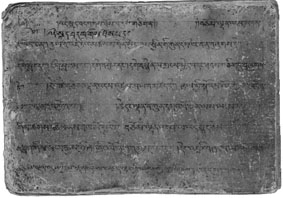
IOL Tib J 76, last page

Here’s another manuscript darkened with age and made readable again with infrared photography. IOL Tib J 76 is a booklet (or codex, to give the technical name), with 64 pages measuring about 15 by 22 cm. I tend to think that this kind of darkening is a sign that a manuscript was well used during its lifetime before internment in the Dunhuang cave. The majority of the Dunhuang manuscripts do not look like this; by contrast, many look shockingly fresh, as if they were written weeks rather than centuries ago.

I find the ‘well-used’ theory particularly convincing in the case of this particular manuscript, because the booklet form lends itself to practical use. In contrast to the pothi and scroll form, it is easy to open the book to a particular page. For a monk or lay Buddhist carrying around a collection of frequently perused texts the advantage of this would be particularly clear.

IOL Tib J 76, infrared

This particular booklet does indeed seem to be a collection of such frequently used texts. The first 44 pages contain the Jinaputra-arthasiddhi sūtra, used perhaps for memorization, recitation, or both. The next text is The Butter Lamp Prayer (mar mye smon lam), a prayer recitated during the ceremonial lighting of butter lamps on a shrine, followed by the Hymn to the Bodhisattva Avalokiteśvara Cintamāṇicakra, a popular hymn in Dunhuang, as I have mentioned elsewhere. Both texts would be useful in regular personal devotions and services rendered to others (for a fee).

More interesting still, the next two texts are teaching or study aids. The first is titled Knowledge of Worlds (Lokaprajñā), and is a kind of question-and-answer catechism. It’s contents are well summarized in the colophon:

A teaching, based on the important sutras of the dharma, on the characteristics of the three jewels, the good qualities and the path of liberation, on seeing the two truths, on actions and the ripening of actions, written merely to oppose what is not in concordance with the pure scriptures.

Following this is a Sanskrit-Tibetan dictionary of sorts, defining the Sanskrit terms tantra, mantra, vidyā, dhāraṇī and maṇḍala. Christina Scherrer-Schaub has identified this text as an extract from a translation manual (the Sgra sbyor bam po gnyis pa) composed in the reign of King Senaleg (799–815). Interestingly, only the tantric words have been copied here.

As for the back page, which has now been revealed in stunning infrared, it just contains the first page of the Jinaputra-arthasiddhi sūtra once again, perhaps for handwriting practice or to test memorization.

In any case, this is clearly just the kind of book that a monk or lay Buddhist might carry around, and keep in their home/monastic cell. The darkening of the cover is then probably due to frequent handling (with inevitably greasy hands) or being kept in a room smoky with cooking fire or incense.

References
1. Dietz, Siglinde. 1999. “Jig rten gyi lo rgyus bśad pa, ‘Die Kunde von der Welt.’ Ein katechetischer Text aus Tun-huang.” Helmut Eimer, Michael Hahn, Maria Schetelich and Peter Wyzlic (eds.) Studia Tibetica et Mongolica (Festschrift Manfred Taube). Swisttal Odendorf: Indica et Tibetica Verlag. 71-86.
2. Scherrer-Schaub, Cristina A. 2002. “Enacting Words. A Diplomatic Analysis of the Imperial Decrees (bkas bcad) and their Application in the sGra sbyor bam po gñis pa Tradition.” JIABS 25/1–2: 263–340.

Avalokiteśvara in early Tibet II: Compassion in many forms

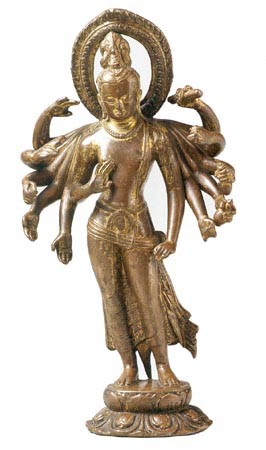
amoghapasa.jpgAs I discussed earlier, Avalokiteśvara (Chenrezig for Tibetans) was a popular bodhisattva in Tibet before the 11th century. His role in the transforming the old Tibetan funeral rites into Buddhist ones has been discussed by several scholars. My own recent research has focussed on Avalokiteśvara’s role as a tantric deity during this early period. In his simplest aspect the bodhisattva has one face and two arms. In the Dunhuang manuscripts we also find:

  • The form with eleven heads called Ekādaśa-mukha (Zhal bcu gcig pa).
  • The form with a thousand arms and a thousand eyes, Sahasrabhuja-sahasranetra (Phyag stong spyan stong dang ldan pa).
  • The form holding a wish-fulfilling jewel and a wheel, known as Cintāmaṇicakra (Yid bzhin ’khor lo).
  • The form known as “the unfailing noose,” Amoghapāśa (Don yod zhags pa).

These forms of Avalokiteśvara are found among the Dunhuang manuscripts in dhāraṇīs, in hymns (stotra) and in practice manuals (sādhana).

There are at least seven different Avalokiteśvara dhāraṇī texts dedicated to the eleven-headed form, the thousand-armed form, and the Amoghapāśa form. The dhāraṇī spells are mostly variations on a single theme, beginning Oṃ Āryāvalokiteśvarāya Bodhisattvāya Mahāsattvāya Mahākarunikāya. Many of these dhāraṇīs were also translated into Chinese, attesting to the popularity of these forms of Avalokiteśvara in China before they were eclipsed by the development of the female form of Avalokiteśvara.

There are two hymns to Avalokiteśvara found in the Dunhuang manuscripts (they exist in many manuscript copies, so must have been popular at the time). The first hymn praises the 108 qualities of the bodhisattva. The second hymn is to Cintāmaṇicakra, whose maṇḍala is described as an embodiment of the mind’s true nature:

If you meditate on this maṇḍala of mind itself,
The equality of all maṇḍalas,
Conceptual signs will not develop.
Conceptualization is itself enlightenment.
With this non-abiding wisdom
All accomplishments will be perfected.

/sems nyid ldan pa’i dkyil ’khor te/
/dkyil ’khor mnyam pa de bsgoms na/
/rtog pa’i mtshan ma myi skye’o/
/rtog pa nyid ni byang chub te/
/myi gnas pa’i ye shes pas/
/dngos grub thams cad rdzogs par ’gyur/

Among the practice manuals, we find or sādhanas based on the Yoga tantra Sarvatathāgata- tattvasaṃgraha. We also find a Mahāyoga sādhana with a red Avalokiteśvara and the goddes Pāṇḍaravāsinī as his consort.

To sum up, Avalokiteśvara was an important presence in Tibetan Buddhism by the 10th century, as an object of devotion, a tantric deity, and a guide for the post-death state. Advocates of Avalokiteśvara in the later diffusion of Buddhism in Tibet, such as Atiśa, may have introduced new texts and forms of the Avalokiteśvara, but the bodhisattva was already well-established in Tibet before they began their work.

References
Sam van Schaik. 2006. “The Tibetan Avalokitesvara Cult in the Tenth Century: Evidence from the Dunhuang Manuscripts” in Tibetan Buddhist Literature and Praxis (Proceedings of the Tenth Seminar of the IATS, 2003, Volume 4), ed. Ronald M. Davidson and Christian Wedemeyer. Leiden: EJ Brill, 2006. 55–72.

Images

Amoghapaśa sculpture. Nepal, 8th–9th c. © Nyingjei Lam.

Padmasambhava I: the early sources

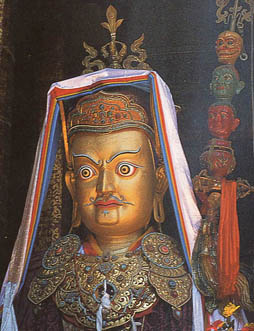
PadmasambhavaKnown as Pema Jungné (‘the lotus-born’) or Guru Rinpoche (‘the precious guru’) in Tibet, Padmasambhava is seen as the true founder of Tibetan Buddhism, a second Buddha who established the dharma in the land of the red-faced men. Padmasambhava is said to have been invited to Tibet to help found the first Tibetan monastery, Samyé, and tame the local demonic forces that were obstructing the establishment of the monastery.

In the earliest histories, Padmasambhava’s role is limited to this, and perhaps to introducing the technology of irrigation to the valleys of Central Tibet. In later histories, Padmasambhava’s role is far greater. In particular, his is said to have concealed uncountable books and sacred objects throughout Tibet, for discovery when the time became ripe. The discoverers are the famed tertön and the hidden treasures are the terma.

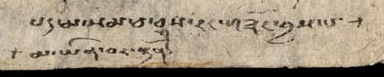
Despite his importance to Tibetan Buddhism there are few early manuscript sources on Padmasambhava (most of which have been discussed by Jacob Dalton and Kenneth Eastman). One of the rare and important sources is IOL Tib J 321, a 10th century manuscript containing a commentary on a tantra called the Upāyapāśa attributed to Padmasambhava. The commentary survived into the later tradition, but the attribution to Padmasambhava was lost. The authorship of the commentary is suggested in two places. The first is a simple note that states: “This was taught by Padmasambhava without any fabrications of his own.”

itj321b.jpg

The second is a verse that is attached to the end of the commentary, praising “Padmarāja”. An interlinear note confirms that this is Padmasambhava: “Acārya Śāntigarbha examined this and found it free from error; afterwards he praised Padmasambhava.”

itj321a.jpg

Śāntigarbha is an obscure figure in Tibetan history, one of the Indian gurus invited to Tibet along with Padmasambhava, who was involved in the transmission of tantras to Tibet. Although the attribution of this text to Padmasambhava is fairly well-known, Śāntigarbha’s verses of praise to Padmasambhava have never been translated or discussed (as far as I know):

Homage to Padmarāja, beyond the world,
The great marvel, attainer of the supreme accomplishment,
Who brought out of the valleys
The great and secret instructions of the tathāgatas.

/dngos grub mchog brnyes ya mtshan chen po’i/
/’jig rten ma gyur pad ma rgyal po yis/
/de bzhin gshegs pa’i man ngag gsang chen rnams/
/klung nas bkrol mdzad de la phyag ‘tshal lo/

Two things about these verses interest me very much. The first is the similarity of the first line (the second line in my translation) to the Seven Line Prayer, a much more famous set of verses of praise to Padmasambhava which is still recited today. Śāntigarbha’s verses seem to have been a forerunner and source for the Seven Line Prayer. The second interesting aspect of these verses is the reference to bringing secret instructions out of the valleys. The “valleys” may be a reference to Oḍḍiyāna, Padmasambhava’s homeland, which also happens to be where many tantras are said to have entered the human realm. The association of Padmasambhava with the revelation of tantras (not found in any history) is a surprising link to the later terma tradition, not in the traditional sense in which he is said to have concealed the terma, but as a revealer of treasures himself, a model for the later tertöns.

Finally, just in case I have given the impression that Padmasambhava actually wrote this manuscipt, let me be clear that he didn’t. The scribe has signed the manuscript, and we can see that he was a local to the Dunhuang area, probably a Chinese from Ganzhou, who went by the name Kamchupa Buoko.

itj321c.jpg

References
1. Dalton, Jacob. 2004. “The Early Development of the Padmasambhava Legend in Tibet: A Study of IOL Tib J 644 and Pelliot tibétain 307.” Journal of the American Oriental Society 124.4: 759-772.
2. Eastman, Kenneth. 1983. “Mahāyoga Texts at Tun-huang”. Bulletin of Institute of Buddhist Cultural Studies (Ryukoku University) 22: 42–60.
3. Germano, David. 2002. “The Seven Descents and the Early History of rNying ma transmissions.” The Many Canons of Tibetan Buddhism (eds Helmut Eimer and David Germano), Leiden: Brill. 225–263.