Tales from the scriptorium I: expensive books

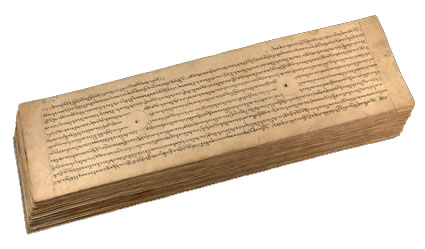
IOL Tib J 105 (pothi)

This huge book (IOL Tib J 105) contains a Buddhist sutra in the loose leaf format known as pothi. The pothi was invented in India, where palm leaves were used for the pages. Along the Silk Road, Buddhist bookmakers used the Chinese invention of paper (which had not yet reached India) but kept the Indian pothi format. The Tibetans inherited this hybrid book from the Buddhists of the Silk Road.

The manuscript is a copy of the large Perfection of Wisdom (Prajñāparamitā) sutra. It was written as a joint effort by a team of Chinese and Tibetan scribes working together at Dunhuang in the early ninth century. In fact, although all of the scribes wrote Tibetan, the majority of them were Chinese. Apparently, under the rule of the Tibetan empire masses of Chinese were trained to write in Tibetan. Discipline was tough–on that, more later.

The book was an expensive production that would have to have been sponsored by a wealthy donor. This donor may have been the king of Tibet himself: another manuscript (Pelliot tibétain 999) mentions that the Tibetan king Ralpachen (ruled 815–838) sponsored the copying of hundreds of sutras, which were kept in a temple near Dunhuang.

See also:
Tales from the Scriptorium II: It’s a scribe’s life
Tales from the Scriptorium III: Scribal doodles

References
1. Marcelle Lalou. 1954. “Les manuscrits tibétains des grandes Prajñāpāramitā trouvés à Touen-houang”. Silver jubilee volume of the Zinbun-kagaku-kenkyusho, pp.257-261.
2. Marcelle Lalou. 1957. “Les plus anciens rouleaux tibétains trouvés à Touen-houang”. Rocznik Orientalistyczny Tom. 21, pp.149-152.
3. Marcelle Lalou. 1964. “Manuscrits tibétains de la Satasāhasrikā-prajñāpāramitā cachés à Touen-houang”. Journal Asiatique 1964, pp.479-486
Avalokiteśvara in early Tibet I: Guiding the dead

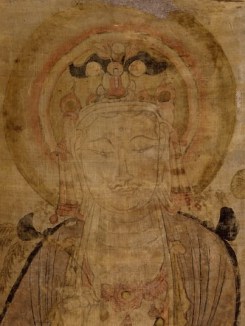
Avalokiteśvara in a Dunhuang painting (1919,0101,0.25)To the Tibetans, who know Avalokiteśvara as Chenrezig (Spyan ras gzigs), he is both compassion personified and the patron deity of Tibet. The popularization of Avalokiteśvara in Tibet is often linked to the figure of Atiśa, the Bengali monk who helped revive Buddhism in Tibet in the 11th century. However, our manuscripts show that by the 10th century, well before Atiśa came to Tibet, Avalokiteśvara was an important part of the Tibetan Buddhist landscape.

In the 1970s some important Tibetan Dunhuang texts on after-death states featuring Avalokiteśvara were discovered by Rolf Stein and Ariane Macdonald. The first of these was Showing the path to the land of the gods (Lha yul du lam bstan pa), which describes the various paths which the dead can follow, and encourages the them to remember the name of Avalokiteśvara and to call upon him in order to avoid the hells. The second text was identified by Stein as a funeral rite of the pre-Buddhist Tibetan religion transformed into a Buddhist practice featuring Avalokiteśvara. A third text, also concerned with death and the after-death state and called Overcoming the three poisons (Gdug gsum ’dul ba), was examined by Yoshiro Imaeda, who found that it contained Avalokiteśvara’s six-syllable mantra, oṃ maṇi padme hūṃ.

These discoveries showed that Avalokiteśvara played an important role in replacing the pre-Buddhist funeral rituals with Buddhist ones. In future installments I’ll say more about the many different forms of Avalokiteśvara which became popular, and his role in meditation practices.

References
1. Imaeda, I. 1979. “Note préliminaire sur la formule oṃ maṇi padme hūṃ dans les manuscrits tibétains de Touen-houang.” In Michel Soymié (ed.) Contributions aux études sur Touen-Houang. Geneva/Paris: Librairie Droz.
2. Macdonald, A. 1971. “Une lecture des Pelliot tibétain 1286, 1287, 1038, 1047, et 1290: Essai sur la formation et l’emploi des mythes politiques dans la religion royale de Sroṅ-bcan sgam-po.” In Études tibétaines dédiées à la mémoire de Marcelle Lalou. Paris: Libraire d’Amerique et d’Orient Adrien Maisoneuve.
3. Stein, R.A. 1970. “Un document ancien relatif aux rites funéraires des Bon-po tibétains.” Journal Asiatique CCLVII: 155–185.

Image
Avalokiteśvara in a Dunhuang painting: 1919,0101,0.25. © The British Museum.

Buddhism and Bön I: The religion of the gods

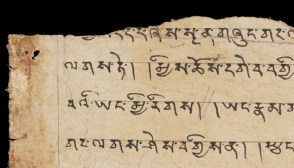
IOL Tib J 990 (detail)Here is a fascinating manuscript that has previously gone unnoticed: a treatise on how to combine the pre-Buddhist religious practice of Tibet with Buddhism. The manuscript (IOL Tib J 990) is a fragment of a scroll, which may date to the 9th century. The pre-Buddhist religion of Tibet is often (and perhaps erroneously) called Bon, but here it is referred to as the religion of men (myi chos) and the religion of the gods (lha chos).

Though the manuscript is fragmentary, there is enough here to gain a sense of the argument. The religion of men is summarized as the practice of virtue. The religion of the gods is a series of behavioural rules that are said to avert the emnity of the gods. The rules mentioned here are:

  1. Do not perform sexual intercourse with relatives.
  2. Do not kill any sentient being.
  3. Avoid quarrels with the malicious, the angry and the stupid.
  4. Rely on spells for a multitude of joys.

The first three of these are fairly normative social injunctions which would not have been problematic for those attempting to combine the religion of the gods with Buddhism. However the last obviously relates to the ritual practices associated with the religion of the gods, and the treatise goes on to ask the question of whether the rituals for worshipping the gods, which involve killing, are contrary to the rituals of Buddhism.

Unfortunately the manuscript ends before the question is answered, but it seems that the author of this treatise is trying to reconcile pre-Buddhist Tibetan rituals with Buddhism. This process continued right through to the 20th century (see Eva Dargyay’s article below), but after the triumph of Buddhism in Tibet such reconciliations were rarely discussed openly in the literary tradition. Therefore this fragment is probably the most explicit attempt (that we know of) to bring the two ritual worlds together

References
1. Dargyay, Eva K. 1988. “Buddhism in Adaptation: Ancestor Gods and Their Tantric Counterparts in the Religious Life of Zanskar”. History of Religions 28.2: 123–134.
2. Karmay, Samten: 1998 (1983). “Early Evidence for the Existence of Bon as a Religion in the Royal Period”. In The Arrow and the Spindle. Kathmandu: Mandala Book Point. 157–168.
3. Stein, Rolf A. 1970. “Un document ancien relatif aux rites funéraires des Bon-po tibétains. Journal Asiatique 258: 155–185.

Also in this series
Buddhism and Bon II: what is tsuglag?
Buddhism and Bon III: what is yungdrung?

Infrared, seals and nomads

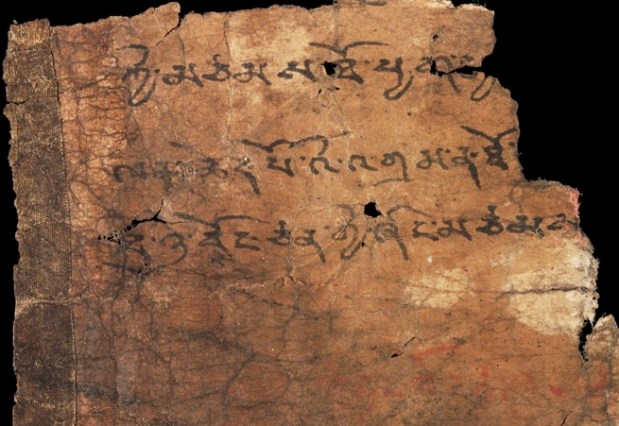
Digital photography is allowing us to read some previously unreadable manuscripts. Take for example IOL Tib J 834, part of a scroll that almost certainly dates back to the Tibetan occupation of Dunhuang (c.781-848 CE). The importance of this scroll is indicated by the silk lining that was used to strengthen the edges (visible in the image below).
IOL Tib J 834 (detail)
The scroll has become darkened by handling, or because of where it was stored before being placed in the Dunhuang library cave, so that some of it is unreadable. What makes it worse is that some of the writing and all of the seals stamped on the manuscript are in red ink, which is now almost invisible.

Now, this scroll is a perfect candidate for infrared photography. Though infrared is not as magically efficacious as some believe (see these pages), it works very well with manuscripts that have darkened over time, and, of course, with red ink. As the infrared image below shows, we can now clearly see the seal on this manuscript, a rectangular seal containing a picture of a horse and (perhaps) a pasture? The writing underneath states that this is the seal of Drog (‘Brog), a word that means ‘nomad’, which fits rather well with the horse and pasture image.

IOL Tib J 834 (seal, infrared)

This raises another question. As Kazushi Iwao has kindly pointed out to me, this scroll is a land registry, that is to say, it parcels out land between different landowners. So why would nomads be involved with this kind of thing?