
Perhaps it was a forgone conclusion that Tibet would become a Buddhist country, surrounded as it was by the Buddhist kingdoms of India, China and Central Asia. Nevertheless, Tibet was subject to other the influences of other religions during its formative period, and among those influences we may perhaps include Christianity.
The best evidence of the involvement of Christian missionaries in early Tibet comes in the letters of Timothy I, who was Patriarch of the Nestorian Church between 780 and 823, overlapping with the reigns of three of Tibet’s great Buddhist emperors, Trisong Detsen, Senaleg and Ralpachen. Timothy I’s letters contain a couple of references to Tibet. In one letter, he lists the lands in which the Trisagion, one of the oldest Christian prayers, is recited. This list includes Tibet. In another letter, Timothy relates that he has recently appointed a metropolitan bishop for the Turks, and is about to do the same for the Tibetans. These references both date to the early 790s, during Trisong Detsen’s reign.
Another kind of evidence is the many examples of crosses carved onto rocks in Western Tibet and its neighbouring regions. Some examples were recorded by A.H. Francke in the early 20th century. The first of these crosses has a Tibetan inscription, “…in the year of the pig.”
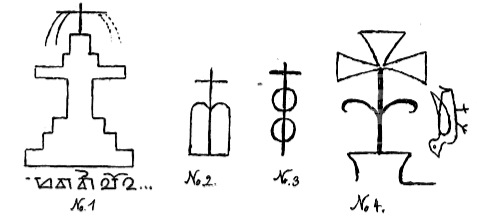
As far as I know this is the only record of cross with a Tibetan inscription from Western Tibet. In addition, Giuseppe Tucci found small metal crosses, apparently worn as ornaments, in the same regions.
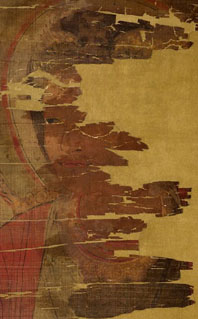 Now let’s turn to Central Asia, where we have another interesting assortment of crosses, and a Tibetan reference to Jesus the Messiah. First of all, there is a rather beautiful painting from Dunhuang, which at first glance looks like a bodhisattva. On closer inspection, we can see that his crown and necklace are adorned with crosses. What we have here seems to be a picture of a Christian (probably Nestorian) saint, by an artist trained in the Chinese style. Roderick Whitfield dates the painting to the late 9th century, shortly after the Tibetan rule of Dunhuang.
We have more evidence of Christian influence among the Tibetan manuscripts. There is a divination (mo) text, Pelliot tibétain 351, which is mainly Buddhist in character, but includes the following surprising passage:
Man, your ally is the god called “Jesus Messiah”. He acts as Vajrapāṇi and Śrī Śākyamuni. When the gates of the seven levels of heaven have opened, you will accomplish the yoga that you will receive from the judge at the right hand of God. Because of this, do whatever you wish without shame, fear or apprehension. You will become a conqueror, and there will be no demons or obstructing spirits. Whoever casts this lot (mo), it will be very good.
Géza Uray argued that the Christian elements here must have come from a Nestorian source, especially the idea of Jesus as the judge at the right hand of god, which is found in the Nicene Creed of the Nestorians, a copy of which is found in a Sogdian 9th-10th century manuscript in Turfan, not so far from Dunhuang. Rolf Stein, on the other hand, argued for a Manichaean source. Perhaps the source is not terribly important here anyway, since Jesus seems simply to have joined the array of local and Buddhist deities.
Uray also located drawings of crosses on two Dunhuang manuscripts from the French collection, Pelliot tibétain 1182 and 1676. There is nothing Christian in the writings on these manuscripts; the first contains a scribe’s doodles and writing exercises, while the second is a copy of the Prajñāpāramitā in 100,000 verses
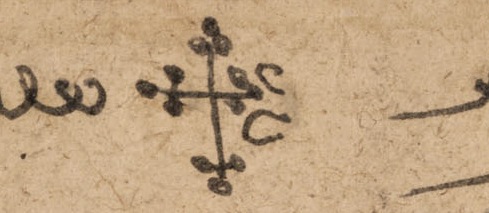
To these I’d like to add another cross, one that nobody has ever mentioned it before, partly no doubt because the manuscript was passed over in de la Vallée Poussin’s catalogue and didn’t even have a number until recently. IOL Tib J 766 contains the sketch of a cross that is shown at the top of this post (just click on that image to view the whole manuscript). The manuscript is just a strip of paper, probably an offcut from a manuscript, which has been used as a doodle pad by a scribe. The writing is Tibetan and a Sogdian or Uighur script, perhaps both written by the same scribe, who may have been a Uighur Turk who also wrote in Tibetan. As we know that Nestorianism was quite popular among the Uighurs, this would make sense.
This particular cross has three beads at the end of each arm. It’s quite similar to the one in Pelliot tibétain 1182, which has three lines at the end of each arm, and to the cross in the crown of the saint pictured above, which has two beads at the end of each arm.
Having reviewed the evidence, it seems after that Buddhism was never in much danger of being supplanted by Christianity in Tibet. Even so, when we think about Timothy I’s appointment of a bishop for Tibet during the reign of Trisong Detsen, and see sketches of crosses surrounded by Tibetan writing in the Dunhuang manuscripts it becomes possible to imagine an alternative history. And having this so clearly, and visually, impressed upon us might encourage us to think again about the reasons for the ultimate success of Buddhism in Tibet.
References
1. Francke, A.H. 1925. ‘Felseninschriften in Ladakh’. In Sitzungsberichte der Preussischen Akademie der Wissenschaften. Philosophisch-Historische Klasse. Jahrgang 1925: 366-371.
2. Klimkeit, H.J. 1979. ‘Das Kreuzessymbol in der zentralasiatischen Religionsbegegnung’. In Zeitschrift für Religions-und Geistesgeschichte 31.1: 99-116.
3. Stein, R.A. ‘Une mention du manichéisme dans le choix du bouddhisme comme religion d’état par le roi tibétain Khri-sroṅ lde-bcan. In Indianisme et bouddhisme: Mélanges offerts á Mgr Étienne Lamotte. Louvain-la-Neuve. 329–337.
4. Tucci, Guiseppe. 1973. Transhimalaya. London: Barrie & Jenkins. [Translated from the French by James Hogarth.]
5. Uray Géza. ‘Tibet’s Connections with Nestorianism and Manicheism in the 8th–10th Centuries’. In Steinkellner and Tauscher (eds), Contributions on Tibetan Language, History and Culture. Vienna: Arbeitskries für Tibetische und Buddhistische studien Universität Wien.
Do also visit the Tibeto-Logic blog for a fascinating dissection of the popular story of Jesus’s visit to Tibet.
 early Tibet
