Buddhism and Bön I: The religion of the gods

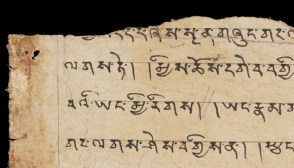
IOL Tib J 990 (detail)Here is a fascinating manuscript that has previously gone unnoticed: a treatise on how to combine the pre-Buddhist religious practice of Tibet with Buddhism. The manuscript (IOL Tib J 990) is a fragment of a scroll, which may date to the 9th century. The pre-Buddhist religion of Tibet is often (and perhaps erroneously) called Bon, but here it is referred to as the religion of men (myi chos) and the religion of the gods (lha chos).

Though the manuscript is fragmentary, there is enough here to gain a sense of the argument. The religion of men is summarized as the practice of virtue. The religion of the gods is a series of behavioural rules that are said to avert the emnity of the gods. The rules mentioned here are:

  1. Do not perform sexual intercourse with relatives.
  2. Do not kill any sentient being.
  3. Avoid quarrels with the malicious, the angry and the stupid.
  4. Rely on spells for a multitude of joys.

The first three of these are fairly normative social injunctions which would not have been problematic for those attempting to combine the religion of the gods with Buddhism. However the last obviously relates to the ritual practices associated with the religion of the gods, and the treatise goes on to ask the question of whether the rituals for worshipping the gods, which involve killing, are contrary to the rituals of Buddhism.

Unfortunately the manuscript ends before the question is answered, but it seems that the author of this treatise is trying to reconcile pre-Buddhist Tibetan rituals with Buddhism. This process continued right through to the 20th century (see Eva Dargyay’s article below), but after the triumph of Buddhism in Tibet such reconciliations were rarely discussed openly in the literary tradition. Therefore this fragment is probably the most explicit attempt (that we know of) to bring the two ritual worlds together

References
1. Dargyay, Eva K. 1988. “Buddhism in Adaptation: Ancestor Gods and Their Tantric Counterparts in the Religious Life of Zanskar”. History of Religions 28.2: 123–134.
2. Karmay, Samten: 1998 (1983). “Early Evidence for the Existence of Bon as a Religion in the Royal Period”. In The Arrow and the Spindle. Kathmandu: Mandala Book Point. 157–168.
3. Stein, Rolf A. 1970. “Un document ancien relatif aux rites funéraires des Bon-po tibétains. Journal Asiatique 258: 155–185.

Also in this series
Buddhism and Bon II: what is tsuglag?
Buddhism and Bon III: what is yungdrung?
Infrared, seals and nomads

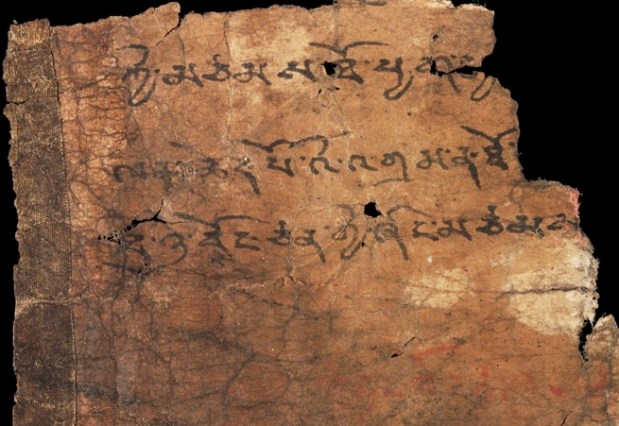
Digital photography is allowing us to read some previously unreadable manuscripts. Take for example IOL Tib J 834, part of a scroll that almost certainly dates back to the Tibetan occupation of Dunhuang (c.781-848 CE). The importance of this scroll is indicated by the silk lining that was used to strengthen the edges (visible in the image below).
IOL Tib J 834 (detail)
The scroll has become darkened by handling, or because of where it was stored before being placed in the Dunhuang library cave, so that some of it is unreadable. What makes it worse is that some of the writing and all of the seals stamped on the manuscript are in red ink, which is now almost invisible.

Now, this scroll is a perfect candidate for infrared photography. Though infrared is not as magically efficacious as some believe (see these pages), it works very well with manuscripts that have darkened over time, and, of course, with red ink. As the infrared image below shows, we can now clearly see the seal on this manuscript, a rectangular seal containing a picture of a horse and (perhaps) a pasture? The writing underneath states that this is the seal of Drog (‘Brog), a word that means ‘nomad’, which fits rather well with the horse and pasture image.

IOL Tib J 834 (seal, infrared)

This raises another question. As Kazushi Iwao has kindly pointed out to me, this scroll is a land registry, that is to say, it parcels out land between different landowners. So why would nomads be involved with this kind of thing?

The samaya vows and the Nyingma

IOL Tib J 436 (detail)

All higher tantric empowerments bind those who receive them with serious vows, known as samaya vows. In the Nyingma school, there are 28 samaya vows, divided into three root vows and 25 branch vows. The three root vows are:

(i) The vow of the body: to venerate the guru
(ii) The vow of speech: to continually practice the mantras and mudras of the deity
(iii) The vow of mind: to keep the restricted teachings of the tantras secret.

The other 20 vows are placed in four groups:

(i) The five to be accepted
(ii) The five not to be rejected
(iii) The five to be practised
(iv) The five to be known
(v) The five to be accomplished

Now, like most things Nyingma, the authenticity of these 28 vows has been called into question by representatives of the other Tibetan schools, who generally follow a system of 14 samaya vows. In response to this, it should be pointed out that arrangements of the samaya vows similar to the Nyingma 28 are found in the Guhyagarbha tantra and in Vilāsavajra’s Exposition of the Samaya. Similar but not identical; the Guhyagarbha as 20 vows, and Vilāsavajra gives 29. For an identical set of 28 vows, we need to go to the Dunhuang manuscripts. At least two of these manuscripts (probably 10th century) explain the samaya vows in the almost exactly the same way as the later Nyingma tradition. The presentation is perhaps not as clear as it might be, but I will quote from one of them, IOL Tib J 436 (folios 1v to 2r):

What are the relevant samayas?” In order to strive in that which is concordant and to restrain that which is discordant, in order to obtain and accomplish, one should take build up the samayas. There are twenty-eight samayas; this is the oral transmission (lung). According to the esoteric instructions (man ngag) they are grouped into three. This one should know.

What are they?” They are (i) the samaya of view, (ii) the samaya of practice and (iii) the samaya of accomplishment. Now to distinguish these. The samaya of mind (not disseminating the secret instruction to others) and the five aspects to be known are the samaya of the view. The samaya of the body (not developing animosity or scorn towards the vajra master and brothers and sisters), the five samayas to be practiced and the five samayas not to be renounced are the samaya of practice. The samaya of speech (not stopping the mantras and mūdras) and the five samayas to be accomplished are the samaya of accomplishment. The result of these three is the nature of accomplishment.

Note how this passage parcels up the samaya vows into another set of divisions:

(i) The samaya of the view.
(ii) The samaya of practice.
(iii) The samaya of accomplishment.

References
1. Dorje, Gyurme. 1987. The Guhyagarbhatantra and its XIVth Century Tibetan Commentary, phyogs bcu mun sel. Ph.D. thesis, the School of Oriental and African Studies, University of London.
2. Dorje, Gyurme. 1991. “The rNying-ma interpretation of commitment and vow.” In T. Skorupski (ed.) The Buddhist Forum, vol.II. London: SOAS.

Tibetan sources
1. Gsang ba’i snying po de kho na nyid nges pa [Guhyagarbha tantra]. Tb.417.
2. Vilāsavjara. Dam tshig gsal bskra [Exposition of the Samaya]. Q.4744.

The Temple of the Hat: pillars and treasures

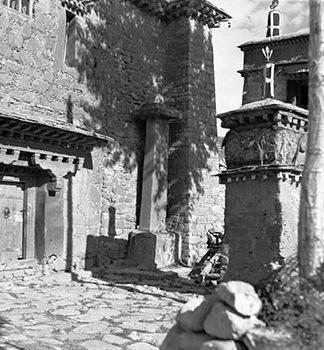
The eastern pillar at the Temple of the HatThe Temple of the Hat (Zha’i lha khang) is a small temple about 50 miles northeast of Lhasa, founded by the monk minister Nyang Tingdzin Zangpo, a significant figure in Tibetan religious history. Nyang was one of the first Tibetans to be ordained as a monk after the completion of Samye temple. He acted as guardian to the young prince who later became King Senaleg (who ruled between 799 and 815).

Later religious history includes Nyang as one of the 25 disciples of Padmasambhava, and even more importantly, as the recipient (along with King Trisong Detsen) of the Seminal Heart (Nyingtig) teachings of Dzogchen from Vimalamitra. These teachings are said to have been concealed in the Temple of the Hat and rediscovered in the eleventh century.

The inscriptions of the pillars placed on each side of the entrance to the temple have no bearing on the Dzogchen tradition. They both record the words of Senaleg, expressing gratitude for the services offered by Nyang and promising recompense for those services:

Bandé Tingdzin, has been loyal from first to last, and from my childhood until I obtained the kingdom he took the place of a father and mother and acted with devotion to my welfare.

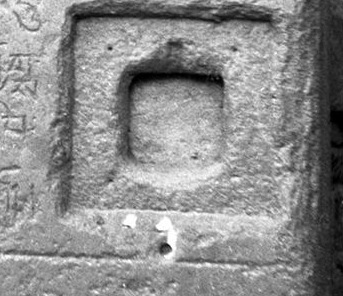
The two pillars are of different dates. The pillar to the west of the temple entrance is the earlier, probably dating to 804–5, while the pillar to the east of the entrance is dated to 812. At the end of the west pillar inscription it is stated that a detailed document of this edict was written and placed in the archives while a sealed copy was been placed in a special enclosure, perhaps in the temple or even within the pillar itself. The last part of the edict states the procedures for re-opening the enclosure (presumably if there was a need to check or update the edict), and for resealing and re-depositing the edict.

The seal socket in the eastern pillarNow, the depositing of edicts in special rooms and the procedures for opening and resealing them seem to prefigure the later hidden treasure (terma) tradition. The Dzogchen texts which were were said to have been hidden here at the Temple of the Hat by Nyang Tingdzin Zangpo are part of the collection known as the Vima Nyingtig, perhaps the earliest of the hidden treasures. According to an early history, The History of the Seminal Heart, these texts were rediscovered by a certain Denma Lhungyal in the late 10th or early 11th century. Apparently the treasure texts were hidden in three places in the temple: (i) inside its storeroom or treasury, (ii) in the gate house or vestibule, and (iii) in a hole inside one of the pillars.

As Ronald Davidson has pointed out, the old imperial and temple archives were undoubtedly opened up when monks returned to Central Tibet in the late 10th and 11th centuries. They probably found something in these old archives.

References

1. Davidson, Ronald. 2005. Tibetan Renaissance. New York: Columbia University Press. p.215.
2. Karmay, Samten 1988. The Great Perfection. Leiden: Brill. pp.210–211
3. Richardson, Hugh. 1985. A Corpus of Early Tibetan Inscriptions. London: Royal Asiatic Society. pp.43–63

Tibetan sources
Snying thig gi lo rgyus [The History of the Seminal Heart], in Bi ma snying thig, part 3, 83a–83b. (Klong chen pa dri med ‘od zer. Snying thig ya bzhi. 11 vols. New Delhi: Trulku Tsewang, Jamyang and L. Tashi. 1970.)

Images:
1. Photograph of the two pillars at the Temple of the Hat, by Hugh Richardson.
2. Photograph of the seal socket in the east pillar, by Hugh Richardson.
These images are copyright of the Pitt Rivers Museum, Oxford. See their website: The Tibet Album.