Buddhism and Empire III: the Dharma King

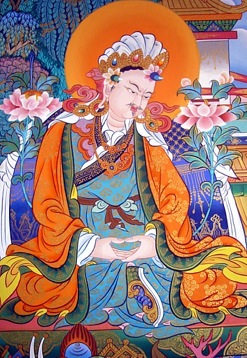
Among the most celebrated figures in Tibetan history are the “dharma kings” (chögyal in Tibetan) who supported Buddhism and helped it to take root in Tibet. And probably the most important of all the dharma kings is Tri Song Detsen. Prince Song Detsen was given the title Tri – meaning “throne” – when he came of age, and he wasted little time in curbing the anti-Buddhist movement that had taken root in recent years since the death of his father, the previous king.

Seeking Buddhist teachers, first from China, then from Nepal and India, he went about getting Tibet its first proper monastery. That monastery, Samyé, was built with the help of the Nepalese abbot Śāntarakṣīta and the tantric adept from modern Pakistan, Padmasambhava. The king also supervised the ordination of the first Tibetan monks, and a vast project for the translation of Buddhist scriptures into Tibetan.

That is the briefest of summaries of the traditional Tibetan view of Tri Song Detsen’s achievements. If we turn to the Dunhuang manuscripts, we find – for once – that they are much in agreement with that traditional view. Tri Song Detsen is celebrated in quite a few Dunhuang poems and prayers as a great Buddhist king. Most of these celebrations of the king have already been translated (see the References section below) but I recently came across one that seems to have been missed. And it’s really quite interesting indeed…

* * *

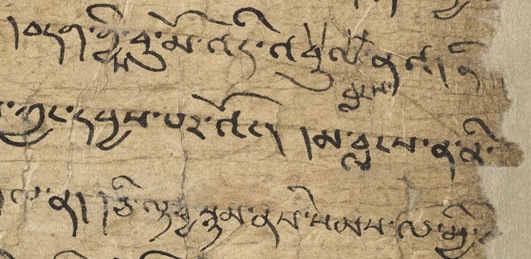
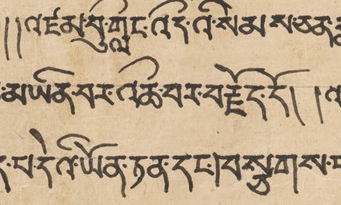
IOL Tib J 466 is a scroll with a long prayer of offerings to the buddhas, bodhisattvas, deities, dharma kings and patrons of Buddhism. First among the kings is, of course, Tri Song Detsen.

I make offering to the spiritual teachers of our own Tibet,
The great dharma kings, like the great king Tri Song Detsen,
He who has mastered the royal methods of fortune,
And rules the kingdom with the sword of the sky-gods,
The magically emanated lord Tri Song Detsen;
And to those teachers who have gone to nirvāṇa,
Including Dharmāśoka, Kaniṣkā, Śīla Atidāna and so on;
To all of these propagators of the teachings
I respectfully make the offering of homage.

I suspect that this prayer dates from not too long after the reign of Tri Song Detsen himself. Every aspect of the scroll – paper, ink, handwriting, and the arrangement of the text on the page – is similar to the sutras commissioned by the last Tibetan kings at the end of the Tibetan Empire in the 840s. So the scroll may have been written only a half-century after the end of Tri Song Detsen’s reign.

The prayer puts Tri Song Detsen right into the historical tradition of dharma kings. Dharmāśoka is of course the famous Aśoka, ruler of the great Mauryan Empire in the 3rd century BC, and patron of Buddhism. Some of the edicts that he had carved throughout his empire still survive, and confirm that he was, to some extent, a Buddhist king. He is said to have convened the third council of the Buddhist sangha to clear up some doctrinal issues. As for Kaniṣka, he was the ruler of the Kushan Empire, based in Gandhara in the 2nd century AD, and we have evidence from the coins made in his reign that he supported Buddhism (among other religions). He is also credited with organizing a Buddhist council for the compilation of a Sanskrit Buddhist canon.

Considering the importance of the councils that Aśoka and Kaniṣka are supposed to have convened, it’s not surprising that the debate between Indian and Chinese Buddhism organized by Tri Song Detsen is often considered to be another council – in the grand tradition of dharma kings.

Of the identity of the king called Śīla Atidāna I have no idea. The first part of his name means “moral conduct” and the second “supreme giving”. The extreme generosity of bodhisattvas in some Buddhist stories is sometimes called “supreme giving”. One of the most popular of these stories is that of Prince Vessantara, who gave away his wife and children to a cruel Brahman (perhaps we should translate atidāna as “extreme giving”). In the end of the story the family is reunited and Vessantara is crowned king. So it could be this king that is intended here. I welcome any alternative suggestions…

*  *  *

As well as associating Tri Song Detsen with this Indian tradition of dharma kings, the prayer highlights the divine and magical nature of Tibetan kingship. The king has “mastered the royal methods of fortune.” What I’ve translated here as “fortune” is the enigmatic word phywa. In later Tibet it refers to luck, fortune-telling and the like. During the time of Tibet’s imperial kings, it seems to have been the special possession of the kings, but it as a method rather than a personal quality.

In any case, there wasn’t much distinction between the kings and the gods. The prayer also says that Tri Song Detsen “rules the kingdom with the sword of the sky-gods.” What does this mean? The Tibetan kings were thought to be the descendents (literally!) of a race of gods who lived in the sky, and came down to earth to perform their kingly duty. Instead of dying, they ascended back to the sky – beamed up along a “sky-cord” made of light. Later generations, including Tri Song Detsen, were said to have lost the sky-cord connection. Nevertheless, they were still the children of the gods (lhasé). That sword is an interesting symbol of the king’s military power, something that is downplayed – if not totally ignored – by many later Buddhist historians. Did Tri Song Detsen really carry a sword said to be inherited from his divine ancestors?

So it seems to me that in this prayer Tri Song Detsen stands somewhere between the earlier vision of Tibetan kings as agents of the divine – with magical military power and special royal methods of prognostication – and ideal of the Buddhist king as a patron and practitioner of Buddhism above all else.

*  *  *

Tibetan text
IOL Tib J 466/3: 5r.9–12: bdag cag bod khams kyI dge ba’I bshes gnyen//rgyal po chen po khri srong lde brtsan lastsogs pa//chos kyI rgyal po chen po rnams la mchod pa//phyva’i rgyal thabs mnga’ brnyes shing//chab srId gnam gyI lde mtshon can//’phrul rje khrI srong lde brtsan dang//dar ma sho ka/ka ni skā/shI la a tI da ṇya lastsogs//ston pa mya ngan ‘das phyIn//bstan pa rgyas mdzad thams cad la//phyag ‘tshal bsnyen bkur mchod pa dbul//

References
1. Karmay, Samten. 1998. “King Dza / Tsa and Vajrayāna” in The Arrow and the Spindle: Studies in History, Myths, Rituals and Beliefs in Tibet. Kathmandu: Mandala Book Point.
2. Richardson, Hugh Edward. 1998. “The Dharma that fell from Heaven” in High Peaks, Pure Earth: Collected Writings on Tibetan History and Culture, Edited with an Introduction by Michael Aris. London: Serindia.

Images
1. Tri Song Detsen: detail of 20th c. painting, sourced from Wikipedia.
2. Coin of Kanishka, (c) The British Museum.
3. Sky-cord (OK, a tornado).

See also:
Buddhism and Empire I: A Soldier’s Prayer
Buddhism and Empire II: Portrait of a Monk
Rama in early Tibet

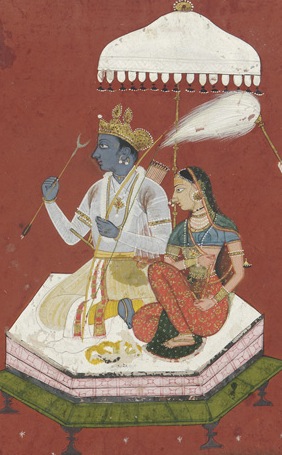
The British Library exhibition on the Rāmāyaṇa has reminded me of one of the most surprising finds from the Dunhuang library cave: a group of manuscripts telling this classic Indian story in Tibetan. Most people know something of story of the Rāmāyaṇa, which tells of how King Rāma’s wife Sītā was abducted by the demon Ravāṇa and rescued with the help of the monkey king Hanumān and his army. The first Rāmāyaṇa is attributed to the poet-sage Vālmīki and is thought to date back to the middle of the first millenium BC. Since then, many other versions of the story have appeared in India and beyond, most recently in that hugely popular television series of the 1980s. Rāma was accepted into the Buddhist world as well, in a jātaka story which tells of Rāma’s banishment from the kingdom by his father.

Anyway, the Tibetan Rāmāyaṇa is found in several manuscripts from Dunhuang, which suggests that it enjoyed some popularity this area, far from India but connected to it by the trading routes we call the Silk Road. This version is a retelling of the Indian tale, though it differs in several ways from the Indian versions. It is a condensed retelling of the original story in which many episodes are drastically shortened, making it short enough, perhaps, for a travelling storyteller to relate at one sitting.

Although it is a shortened version, some parts of the Tibetan Rāmāyaṇa are not found in any of the Indian versions (at least as far as I know). An slightly odd addition to the original is the theme of letter-writing. For example, when Hanumān travels to find Sītā, he takes a love letter written by Rāma, and Sītā sends back a love letter in reply. In another episode, Rāma chides Hanumān for forgetting to correspond regularly. A crestfallen Hanumān apologizes: “I should have continually enquired by letter after your health.”

Now, I am not sure that letter-writing was a feature of ancient or medieval Indian culture (perhaps someone more knowledgeable will contest or confirm this). On the other hand, polite enquiries about the health of the addressee are indeed common among the Tibetan letters found at Dunhuang. High ranking Tibetans sent letters back and forth, sometimes containing no more than polite enquiries after the health of the recipient. This social practice explains why Hanumān committed a faux pas when he neglected to send a continual steam of letters to Rāma.

So, if it’s not Indian, where does this version of the Rāmāyaṇa story come from? Some have suggested Khotan, a great little Silk Road kingdom. It’s true that there are a couple of Khotanese manuscripts containing fragments of the stary of Rāma. However, while this Khotanese Rāmāyaṇa contains some of the same elements as the Tibetan story, it also differs from the Tibetan in many ways. There is no letter-writing in the Khotanese version, and the whole story is given a Buddhist moral at the end. The narrative of the Tibetan Rāmāyaṇa, on the other hand, shows no interest in Buddhism at all.

In fact, the Tibetan Rāmāyaṇa seems generally less moralistic than the classic version, in which Rāma and Sītā are ultimately estranged due to Rāma’s suspicion of Sītā’s infidelity. The Tibetan version has a happy ending, in which Rāma’s apology is accepted by Sītā: “They were happier than before. King Rāma, Queen Sītā, husband and wife and the sons together with a large retinue lived happily in the palace Old Earth.” In the end, one can’t help feeling that the reason for the popularity of this version of the Rāmāyaṇa was simply that it’s a great story.

*  *  *

Manuscripts
The manuscripts of the Rāmāyaṇa are: IOL Tib J 737.1 (A), IOL Tib J 737.2 (B & C), IOL Tib J 737.3 (D), Pelliot tibétain 981 (E), Pelliot tibétain 983 (F). In de Jong’s works, these manuscripts are referred to only by the letters A to F, which I have given in brackets after the shelfmarks.

References
1. Bailey, H.W. 1940. ‘Rāma’, (I) BSOAS 10.2 (1940): 365–376; (II) BSOAS 10.3: 559–598.
2. de Jong, J.W. 1971. ‘Un fragment de l’histoire de Rāma en tibétain’ in Études tibétaines dédiées à la mémoire de Marcelle Lalou. Paris: Librairie d’Amérique et d’Orient.
3. de Jong, J.W. 1977. The Tun-huang Manuscripts of the Tibetan Ramayana Story’, Indo-Iranian Journal 19.
4. Kapstein, Matthew. 2003. ‘The Indian Literary Identity in Tibet’, in Literary Cultures in History: Reconstructions from South Asia, edited by Sheldon Pollock. Berkeley: University of California Press.
5. Thomas, F.W. 1929. ‘A Rāmāyaṇa Story in Tibetan from Chinese Turkestan’ in Indian Studies in Honor of Charles Rockwell Lanman: 193–212. Cambridge, Mass: Harvard University Press.

Images
1. British Library manuscript Add. MS 15296(1), from the Rāmāyaṇa exhibition at the British Library. See this site for images of the manuscript.
2. The manuscript IOL Tib J 737.2, containing part of one version of the Tibetan Rāmāyaṇa.

Teachers, Students, and Notes

Manuscripts are interesting things. Well, I think so, and over the last year one of the main purposes of this website has been to make this point. Printed books can be objects of beauty, but more often they are just the means by which we get the text itself. And we know that a printed book is one of several hundred, or thousand, or ten thousand almost identical copies. Every manuscript, by contrast, is unique. A manuscript can contain anything from hastily scribbled notes to a fine copy of a revered scriptural text. Every manuscript is different from every other, differing in the circumstances of its creation and in the idiosyncrasies of its creator.

Although each of the Tibetan Dunhuang manuscripts is unique, we can put them in some sort of order, arranging them so that at one end of the scale we have the thousands of carefully copied and corrected sūtras which were the products of organized scriptoria working during the Tibetan imperial period. Here variations are at a minimum and have been eradicated as much as possible in the editorial process…

In the middle of the scale are the manuscripts that have been copied carefully, but outside of the scriptorium and usually without revisions. Most of these would have been for personal use, and contain texts like short treatises, prayers and rituals. Handwritings are individual and sometimes quite stylish….

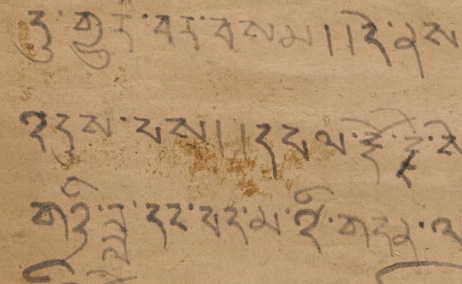
At the other end of the scale there are  manuscripts that are much more scruffy. The individual letters are poorly formed, as if by children, and the spelling varies quite noticeably more than in most of the Tibetan Dunhuang manuscripts….

The initial temptation is to leave this last type of manuscript well alone, and spend one’s time with more beautiful specimens. However, forced to confront them in my cataloguing work, I had to think about why these people wrote Tibetan so very badly. One possibility is that these weren’t Tibetans, that they had only just learned Tibetan in order to be able to write and understand Tibetan Buddhist prayers and practices.

Another possibility – one that doesn’t exclude the first – is that these manuscripts came out of teaching situations. Most of us will be familiar with taking down notes from some kind of lecture or talk, and with the fact that some people are better note-takers than others. A student might be particulary quick with a pen, and copy nearly every word, or only manage only the most general sort of summary. Taking notes is still important in a variety of teaching situations, including Buddhist ones. But it was even more important before the widespread use of printing made textbooks available. In a manuscript culture, the only textbooks students would own were the ones they wrote themselves.

*  *  *

Dunhuang, the source of our manuscripts, was in its heyday one of the great centres of Buddhist practice, art, scholarship and translation. Situated on the edges of the Chinese and Tibetan cultural spheres, and at the eastern end of the Silk Route, it received a huge cultural input. From the eighth to the tenth centuries, Dunhuang was home to Buddhist communities of Chinese, Tibetan, Khotanese and Turkic monks.  There was also a steady flow of eminent teachers passing through Dunhuang. Chinese Buddhists would stay awhile as they began their pilgrimages to India, and Indians and Tibetans would stop off on their way into China.

For example, in the Stein collection we have a kind of passport (IOL Tib J 754) for a Chinese monk who was on a pilgrimage to visit Nālandā in India. The manuscript contains a series of letters of introduction written in Tibetan, apparently in the tenth century. The Chinese monk passed through the Tibetan areas southeast of Dunhuang before arriving there.  We also have a long scroll (Pelliot tibétain 849) that ends with an account of the journey from India to China – via Tibet – of an Indian teacher called Devaputra. The scroll also contains some written notes perhaps taken by a Tibetan student of this Devaputra.

Another fascinating manuscript is a phrasebook with a series of bilingual conversations in Khotanese and Sanskrit (Pelliot 5386). Among these conversations are some that speak of pilgrims coming from Khotan and India to see the bodhisattva Mañjuśrī in China.  Another conversation mentions the arrival of a travelling Tibetan teacher. Most interestingly, one of the phrasebook’s dialogues contains a series of questions that goes something like this:

Student: “What kind of books do you have?”

Teacher: “Sūtra, Abhidharma, Vinaya, Vajrayāna. Which would you like?”

Student: “I’d like Vajrayāna. Please teach it!”

This little dialogue, as well as others from the phrasebook, give us a sense of a place where Buddhist texts and teachings are frequently passed back and forth. The scruffier Dunhuang manuscripts mentioned above might just be some of the notes of the students who received these teachings.

*  *  *

References
1. Burnett, Charles. 1998. “Give him the White Cow: Notes and Note-Taking in the Universities in the Twelfth and Thirteenth Centuries,” History of Universities 14: 1-30.
2. Sam van Schaik. 2007. “Oral Teachings and Written Texts: Transmission and Transformation in Dunhuang” in Contributions to the Cultural History of Early Tibet, ed. Matthew T. Kapstein & Brandon Dotson. Leiden: EJ Brill. 183–208.

Tibetan Chan III: more teachings of Heshang Moheyan

In the last post we were looking at Heshang Moheyan, the Chinese teacher of Chan (better known in the West as Zen) who became for Tibetans a lesson in how to go wrong in meditation. He taught, they said, a method of suppressing thoughts leading to a blank state of mind that could be mistaken for enlightenment, but was really just a dead end. Not only that, but his teachings were dangerous too, scorning the traditional division between virtue and vice, because both were just thoughts and therefore obstacles to enlightenment. As an old saying attributed to Moheyan goes, it doesn’t matter whether the cloud is white or black–it still blocks the sun.

Well, as I mentioned last time, the Dunhuang manuscripts contain the teachings of Heshang Moheyan, and they were much less simplistic, and more reasonable, than the later cartoonish version of him might suggest. For one thing, he didn’t advocate the suppression of thoughts (with a blank mind “like an egg” as one version of the Samyé debate nicely puts it). He says this quite clearly:

Therefore you should not suppress concepts. Whenever they arise, if you do not fabricate anything but instead let them go, then they will stay as they are and come to rest by themselves; thus you will not pursue them.

So I think we can say with some confidence that the ‘real’ Heshang Moheyan (insofar as we can claim to know him) was quite aware of the dangers of approaching meditation as the mere suppression of thoughts. He also didn’t think that the simple approach set out in the quotation above was right for everybody. In fact it was only intended for “those of the sharpest faculties.” For the rest of us he taught a series of five techniques of increasing subtlety. All are misguided in some way apart from the fifth and ultimate method.

1. A direct awareness of the arising of deluded thoughts.
2. An examination of that awareness.
3. The prevention of the arising of thoughts.
4. The perception that thoughts have no intrinsic nature (that is, they are empty).
5. Awareness of the arising of deluded thoughts without analysing or pursuing this awareness, so that thoughts are freed the instant they arise.

So it would clearly be an oversimplification to characterize Moheyan as teaching a single method for every student. It seems here that he is well aware of the need for different methods depending on the ability of the student. Likewise, he didn’t reject the bodhisattva’s classic path of six ‘perfections’: generosity, morality, patience, energy, meditation and wisdom. In the Dunhuang manuscripts Moheyan answers a question on this very topic with subtlety. The question is, “is it necessary to practice the other dharma methods, like the six perfections?” Moheyan answers:

“According to conventional truth, the six perfections are said to be the means for teaching the ultimate truth; it is not that they are unnecessary. According to the scriptures that speak of the ultimate truth beyond the ordinary mind, there is no knowing or saying whether the other dharma methods like the six perfections are necessary. This is explained more extensively in the sutras.”

Isn’t this the move that the Perfection of Wisdom sutras make over and over again? From the conventional point of view, ethical practice and meditation are necessary to progress toward the goal. But from the point of view of the goal, ultimate truth itself, these practices are all empty of any real existence. So, as Moheyan says, one can’t speculate from the position of ultimate truth about the need for methods which don’t truly exist. What one cannot say, according to Moheyan, is that the six perfections are unnecessary. That possibility is the only one that he is excluding here.

* * *

Perhaps the disagreement between the two sides in the Samyé debate really comes down to this question: who are these people with sharp faculties who can access ultimate truth directly through their own awareness? Because for everybody else, Moheyan’s teachings are not that different from the Indian and Tibetan masters he is supposed to have faced in the debate. If a significant proportion of students may be considered to have sharp faculties, then the difference between the two sides is a significant one; but as that proportion shrinks, so does the difference between the two sides.

I’m not sure we can ever say what Moheyan’s position was here. It might be argued that if he spent so much time teaching the direct approach to ultimate truth, he must have thought that there were plenty of students able to practise it. Perhaps. If we look at a similar (though not identical!) tradition, that of Dzogchen, the Great Perfection, we find that the same issue comes up again and again. The greatest exponent of Dzogchen, the fourteenth-century scholar and meditator Longchenpa, wrote this:

“The great yogins who arrived at that [ultimate] state–such as Padmasambhava, Vimalamitra and Tilopa–taught it directly, without cause and effect, virtue or sin. Even if we can understand this intellectually, we have not reached it through becoming truly accustomed to it. Therefore we are taught it only when we are no longer afraid of that state and can be careful about the subtleties of cause and effect.”

For Longchenpa then, the class of those who can approach ultimate truth directly without a gradual build-up is very small, and perhaps no longer exists at all, consisting only of famous masters from the distant past. As we know from his many other works, Longchenpa was very serious about teaching the direct approach to the ultimate. Yet as this passage makes clear, for everyone but the very greatest of meditators this did not mean rejecting the Buddha’s teachings on causation, or ethics.

If the Dunhuang fragments really do present Moheyan’s teachings, then there is every reason to believe that he held much the same view. He may have had a more optimistic idea of the number of students able to approach the nature of mind directly with no previous training, but he was careful to emphasise the need and value of the rest of the Buddha’s teachings.

*  *  *

References and Tibetan texts

This post, like the last, is indebted to Luis Gomez’s excellent article which gathers the Tibetan sources for Moheyan’s teachings (see the reference in the previous post). The first quote in this post comes from The Lamp for the Eyes of Contemplation (p.165). The five approaches are found in Pelliot tibétain 117 and The Lamp for the Eyes of Contemplation (p.165). The quotation on the six perfections appears in Pelliot tibétain 823 (f.2.4 to 3.3) and is also found the Chinese version of the Samye debate in Pelliot chinois 4646 (136b.2-5). Finally, the Longchenpa quote is found in Jigmé Lingpa’s Yeshé Lama (p.332; I haven’t found the location of this passage in Longchenpa’s work yet). I also discussed the issue of the different types of student in the context of Dzochen in my book Approaching the Great Perfection (pp.115-124).

Bsam gtan mig sgron p.165: de bas na ‘du shes dgag par yang mi bya / ‘byung bzhin ci la yang mi bcos par gyi na ye gtang ji bzhin du bzhag dang rang zhi ste rjes su mi ‘brang ngo //

Pelliot tibétain 823: f.2.4-3.3: pha rol tu phyin pa drug la stsogs pa’i chos kyi sgo gzhan dgos saM myI dgos/ smras pa/ kun rdzob ltar pha rol tu phyin pa drug kyang/ don dam par bstan pa’i phyIr thabs su bshad de/ myI dgos pa yang ma yin// don dam par smra bsam las ‘das pa’i gzhung ltar na/ pha rol tu phyin las stsogs pa chos kyI sgo gzhan dgos saM myI dgos shes smos su yang myed de/ mdo sde las kyang rgyas par bshad do/

Ye she bla ma p.332: gshis der phebs pa’i rnal ’byor pa chen po rnams la rgyu ’bras dge sdig med pa thad drang du bshad de padma dang/ bi ma la dang/ te lo pa la sogs pa bzhin no/ rang cag rnams la blos de ltar rtogs kyang goms pas thog du ma ’phebs pas/ gshis la mi skrag cing las ’bras cha ’phra ba la ’dzem pa dang sbyar nas bshad do/

Also in this series:
Tibetan Chan I: The Emperor’s Chan
Tibetan Chan II: the teachings of Heshang Moheyan