Tibetan Chan II: the teachings of Heshang Moheyan

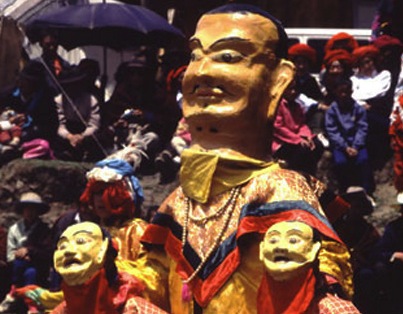
Dancer as Hashang

In the previous post in this series, we looked at the story of the great debate convened by the Tibetan emperor Trisong Detsen. The debate was to decide between the Chinese and Indian versions of Buddhism that were being taught in Tibet at the time. The Indian teachers favoured the scholastic Buddhism that was found in India’s great monastic universities at the time, while Chinese teachers taught mainly meditation in the style they called Chan (later to become Zen in Japan).

The problem with Chan was that it seemed to dismiss what the Indian teachers were presenting as the essentials of Buddhism, that is, virtuous acts and analytical philosophy leading to wisdom. The Chan teachers chracterised the duality of virtue and nonvirtue and the practice of analysis itself as just the kind of thing that gets in the way of real wisdom. All one had to do, they claimed, was stop making distinctions, whether between virtue and nonvirtue, existence and nonexistence, or any dualities at all.

According to Tibetan histories, the Indian side won the debate decisively–understandably enough, as the anti-analytical approach of the Chan teachers was not best suited to the arena of intellectual debate. The King decreed that Tibetan Buddhism was to follow the Indian example, and the Chinese teachers were to return to China. Whether things really happened in this way, Tibetan historians certainly saw this as a decisive moment in Tibet’s religious history, and never failed to tell the story of the debate. Thus even the debate’s loser achieved a lasting fame, or notoriety. Heshang Moheyan (or Hwashang Mahayan to Tibetans) came to be an emblem of a particular kind of erroneous meditation: the idea that all you have to do to achieve enlightenment is shut down all mental activity.

Some Tibetans of a more analytical bent used the Heshang as a polemical stick to beat the meditation traditions that stressed nonconceptual awareness, like Dzogchen and Chagchen. But this was hardly fair, since within even these traditions teachers warned meditators of falling into the extreme of Heshang Moheyan’s blank meditation. Moheyan achieved a long-lasting notoriety in popular culture too, as a figure of fun in ritual dance traditions (as discussed in this recent article).

* * *
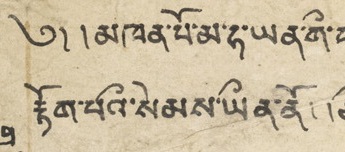
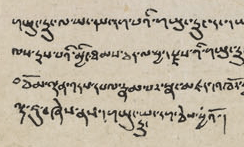
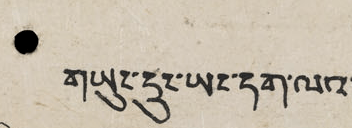
IOL Tib J 468Until recently little was known about the real teachings of Heshang Moheyan except through the Tibetan histories which, written by the spiritual descendants of the winning side of the debate, were unlikely to offer a completely fair representation. Then with the opening of the Dunhuang cave, we suddenly had quite a number of manuscripts apparently written by followers of Tibetan Chan, recording the sayings of Chan masters like Moheyan himself. Great work on piecing together the Dunhuang fragments of Moheyan’s writings has been done by Luis Gomez, and I will look at just one of these manuscripts here, IOL Tib J 468. I want to ask if we can establish whether Moheyan really taught a kind of ‘blank’ meditation, or something a little less extreme. Let’s see.

In his description of meditation, Moheyan writes this:

When you are engaged in contemplation itself, look at your own mind. Then, the lack of any mental activity at all is non-thought. If there is movement of the conceptual mind, be aware of it. “How should one be aware?” Do not analyse the mind which is moving in terms of any kind of quality at all: do not analyse it as moving or not moving; do not analyse it as existing or not exising; do not analyse it as virtuous or non-virtuous; and do not analyse it as defiled or pure. If you are aware of mind in this way, it is natureless. This is the practice of the dharma path.

Well, there is certainly mention here of “the lack of any mental activity.” But the rest of the passage concerns what to do when there is mental “movement”. Interestingly, Moheyan does not suggest suppressing this movement. What he says is: be aware of it without analysing it. What kind of awareness is he talking about? The Tibetan word is tshor, which is used here as a translation for the Chinese character jue 覺 meaning ‘awakening’, ‘illumination’ or ‘awareness’. These words seem a long way from the blankness that Moheyan is supposed to have experienced in his meditation practice. Indeed it seems that he is telling his students here not to suppress mental movement, but to leave it to move in the context of an awareness that does not distinguish it into dualistic extremes.

* * *

Another aspect of Moheyan’s teachings, which I’ll just touch on here, is the fact that he only recommends this technique of meditation to ‘those of sharp faculties’. Others, he says, do need to use various graduated methods. Just what percentage of people he considered to possess these ‘sharp faculties’ is not made clear, but perhaps not so many. In any case, we can see that Moheyan’s teachings were not so radical as they were painted in the later Tibetan tradition. They even seem, dare one say it, quite reasonable…

* * *

References
1. Demieville, Paul. 1952. Le Concile de Lhasa. Paris: Imprimeries Nationale de France.
2. Gomez, Luis. 1983. “The Direct and Gradual Approaches of Zen Master Mahāyāna: Fragments of the Teachings of Moheyan,” in Studies in Ch’an and Hua-yen, edited by Gimello and Gregory: 393–434.
3. Schrempf, Mona. 2006. “Hwa shang at the Border: Transformations of History and Reconstructions of Identity in Modern A mdo.” JIATS 2: 1-32

Tibetan text
IOL Tib J 468: (1v) //bsam gtan nyId du ‘jug pa’I tshe/ bdag gI sems la bltas na/ cI yang sems dpa’ myed de myI bsam mo/ rtog pa’I sems g.yos na tshor bar bya/ cI ltar tshor bar bya zhe na/ gang g.yos pa’I sems de nyId/ g.yos pa dang ma g.yos par yang myI brtag/ yod pa dang myed par yang (2r) myI brtag/ dge ba dang myI dge bar yang myI brtag/ nyong mongs pa dang rnam par byang bar yang myI brtag/ ste// chos thams cad cI lta bur yang myI brtag go// sems g.yos pa de lta bur tshor na rang bzhin myed pa yIn te/ /de nI chos lam spyod pa zhes bya’//

Image
Moheyan in the Rinpung (Rin spungs) ritual dance © 2006 by Mona Schrempf, IATS, and THDL.

Also in this series:
Tibetan Chan I: The Emperor’s Chan
Tibetan Chan III: more teachings of Heshang Moheyan

And an article on a some later Tibetans who supported Moheyan:
The Great Perfection and the Chinese Monk: Nyingmapa Defenses of Hashang Mahāyāna

Buddhism and Bön III: what is yungdrung?

Those who translate Buddhist texts from Tibetan into English sometimes talk in nostalgic terms of our forbears who laboured to translate the vast corpus of Sanskrit Buddhist literature into Tibetan. In contrast to the chaotic scene today, where nobody can agree on a standard English word to translate any given Tibetan term, Tibetan translators worked under a top-down system in which royal edicts decreed the correct Tibetan word to be used for every Buddhist Sanskrit term. The result was the admirably coherent and consistent canons of Tibetan Buddhism, undoubtedly one of the wonders of the Buddhist world.

When we look at the Dunhuang manuscripts however, the situation seems rather less coherent, and a bit closer to the chaos of our times. The coherence of the Tibetan canons was the result of a process, centuries long, of rethinking translation practices, revising earlier translations, and weeding out dubious texts. This process is visible in all its messiness in the Dunhuang manuscripts, and one of the ways it reveals itself to us is the many different ways a single Tibetan word is used in Buddhist translations.

One of the problems for the early translators was what to do with certain important and powerful words that came from the pre-Buddhist culture of Tibet. In some ways it was clearly beneficial to use these words, so as to give them a new, Buddhist resonance. But they came with a lot of baggage. The same problems face translators nowadays when we contemplate using Christian words like ‘hell’ and ‘sin’ to translate Buddhist concepts.

One of the most powerful and resonant words in pre-Buddhist Tibet was yungdrung (g.yung drung). It was a the key terms for the old royal religion, the mythological backdrop to the kingly lineage of the Tibetan Empire. For example, the inscription of the tomb of Trisong Detsen has the line: “In accord with the eternal (yungdrung) customs (tsuglag), the Emperor and Divine Son Trisong Detsen was made the ruler of men.” I discussed how to translate that term tsuglag in an earlier post. Here, as you no doubt noticed, I have translated yungdrung here as “eternal”. Eternity seems to be the general meaning of yungdrung in the early religion. In addition, the word was associated with the ancient Indo-European swastika design, which in Tibet was the graphic symbol of the eternal.

So, what did the early Buddhist writers and translators do with this term? Many of them just attached it to the word “dharma” (i.e. Buddhism), no doubt in an attempt to transfer its prestige from the earlier religion to Buddhism. Thus we see “the eternal dharma” (g.yung drung chos) in many Dunhuang manuscripts. Translators of Chinese Buddhist scriptures into Tibetan used it to translate nirvana. Translators of Sanskrit Buddhist scriptures used it to translate the Sanskrit samyak, meaning “correct” or “perfect”, as well as various Sanskrit terms meaning “eternal”. This messy scene begins to look more like the chaos that bedevils contemporary translation efforts..

Later standardizations of translation practice in Tibet fixed yungdrung as the translation of just one Sanskrit word, sanātana, meaning “eternal”. This Sanskrit word doesn’t appear very often in Buddhist texts, where the Sanskrit word nityā is prefered, and the latter was translated by a different Tibetan term (rtag pa). So yungdrung was almost written out of Buddhist translations, but its story doesn’t end there. From the 11th century it became a central concept of the later Bon tradition, so that the later Bon tradition itself came to be known as ‘Yungdrung Bon’. There is much more to tell, but the full realization of those developments comes later than the Dunhuang manuscripts, where yungdrung is still in the process of being redefined by the Buddhists.

*  *  *

IOL Tib J 339 2rLet’s look at just one Dunhuang manuscript, in which the attempt to redefine yungdrung in the Buddhist context is unusually clear. The manuscript (IOL Tib J 339) is a the prayer with interlinear notes. One line of the prayer is an homage to “correct yungdrung” and the notes go on to spell out the difference between correct and incorrect yungdrung. I’ll translate the note here:

“Yungdrung” comprises correct yungdrung and incorrect yungdrung. Of these, incorrect yungdrung itself comprises the yungdrung of words and the yungdrung of substances. The yungdrung of words means all of the names drawn from yungdrung. The yungdrung of substances means the yungdrung of substances. Even if this yungdrung, it is still incorrect yungdrung.

Correct yungdrung means the following: when you remain as the Bhagavan Vairocana and his entourage of bodhisattvas, you take in the meaning of the unborn nature of phenomena. Then you are not endowed with birth or death. When the yungdrung of the lifespan is accepted as the [nature of] the deity, this is correct yungdrung.

The definition of incorrect yungdrung is strikingly unhelpful here: “the yungdrung of substances means the yungdrung of substances(!)”. Fortunately the definition of correct yungdrung is better. It means freedom from the constraints of birth and death, and is linked to the lifespan, so we could translate it either as “eternity” or, considering the emphasis on lifespan, “immortality”.

IOL Tib J 339 2rHere we see a Buddhist re-reading of immortality as the unborn nature of the meditation deity. ‘True’ immortality is not a long life, but the realization that transcends birth and death. I wonder if the incorrect yungdrung here refers to Chinese (especially Daoist) practices of securing long life or immortality, particularly the teachings (“the yungdrung of words”) and alchemical experiments (“yungdrung of substances”)? After all, in the previous post on this manuscript it emerged that the definition of incorrect tsuglag was aimed at Chinese practices of astrology.

*  *  *

In any case, perhaps we translators can take heart. The coherence of the Tibetan corpus of translations was the end result of a process of centuries. Take a slice out of that process (like 9th-10th century Dunhuang) and it sometimes looks as messy as the contemporary scene.

*  *  *

References
1. Karmay, Samten. ‘A General Introduction to the History and Doctrines of Bon.’ In The Arrow and the Spindle. Kathmandu: Mandala Book Point. 104-156.
2. Stein, R.A. 1983. ‘Tibetica Antiqua I: Les deux vocabulaires des traductions indo-tibetaines et sino-tibetaines dans les manuscrits Touen-Houang.’ Bulletin de l’Ecole Francaise d’Extreme Orient LXXII: 149-236.

Tibetan text
* g.yung drung yang dag la’ gus par phyag ‘tshal lo *
[1] g.yung drung la yang <yang> dag pa’i g.yung dang yang dag pa ma yin ba’i g.yung drung ngo/ de la yang dag pa ma yIn pa’I g.yung drung la yang/ tshIg gi g.yung drung dang rdzas gi g.yung drung ngo/ tshig gi g.yung drung shes pya ba nI/ g.yung drung [2] las dra[ng]s pa’i mying thams cad la bya/ rdzas gi g.yung drung nI rdzas gi g.yung drung la bya’o/ de yang nI g.yung drung yIn na yang yang dag pa’i g.yung drung ma yIn/ de la g.yung drung yang yIn la/ yang dag pa <ma> yin ba nI/ [3] bcom ldan ‘das dpal rnam par snang mdzad ‘khor pyang chub sems dpa’ rnams kyis bskor cing bzhugs pa de ni chos rnams gyI chos skye ba myed pa’i don thugs su chud pas skye shi myi mnga’/ sku tshe g.yung drung [4] lha du bzhes nas/ g.yung +drung+ yang dag ces bya’o/

Also in this series
Buddhism and Bon I: the religion of the gods
Buddhism and Bon II: what is tsuglag?

The Decline of Buddhism III: Should the secret mantra be secret?

Nowadays we tend to see secrecy as a bad thing. When secrets are kept by governments, we suspect repression, and as recent events in Tibet have shown, we’re often right on that count. On the personal level, the secrets people keep from each other are found as plot devices, from Shakespeare to soap operas, that lead to all kinds of conflict and sorrow. In our post-Enlightenment (and I mean the 18th-century kind) world, do we need secrecy?

Secrecy that is of course very much a part of tantric Buddhism, which is also known as ‘secret mantra’. Keeping the tantric practices secret from those who have not been initiated into them is one of the fundamental samaya vows undertaken by those who do receive empowerment in these practices. When modern suspicions about secrecy are applied here, we find people suggesting that the secrecy in tantric Buddhism is all about the gurus (or in Tibet, the lamas) keeping the teachings to themselves, and thereby gathering numerous disciples, fame and of course, wealth. This is to see secrecy as a power issue, like the secrecy practised by governments or corporations.

I’d like to suggest a more sympathetic view of secrecy in tantric Buddhism, using the poem that we looked at in the last post. As you may remember, this was a poem about the decline of Buddhism since the time of Lang Darma, a decline caused not by too few people practising Buddhism, but too many practising tantric Buddhism:

Masters who are lost in the errors
Of not judging the levels of meditative experience
Know nothing of the transworldly meaning.
For every hundred students there are a thousand teachers,
And nobody listens to the divine dharma.
For every village there are ten masters,
And the number of vajra assistants is uncountable.
Everyone thinks “I am accomplished as the deity.”
In the end, since there are so many of this type,
Won’t the vajra body be destroyed?

Let’s think about the situation described here. Clearly the tantric teachings have become very popular, which should not be a bad thing. The statement that there are ten masters per village may be a rhetorical exaggeration, but it does indicate that Buddhism has ‘trickled down’ to the lives of ordinary people in the villages. The problem, for the author of our poem, is that disproportionate number of these ordinary people  have set themselves up as tantric masters, having decided that they have achieved the necessary accomplishments without applying any empirical tests to their own meditative experiences.

Now, I’m a great believer in looking at manuscripts as a whole, rather than plucking individual texts out of them. The poem we’re looking at here is on a scroll (Pelliot tibétain 840) with other Tibetan texts, all written in the same handwriting. That is to say, it was the same person who wrote all these Tibetan texts on the scroll (which he picked up somewhere to reuse–it already had a Chinese sutra written on the front).* The main text that he wrote on the back of the scroll is a long tantric meditation practice. So, for a start, we can see that he had no problem at all with tantric practices as such. Then he turned the scroll over and wrote some more Tibetan texts in between the lines of the Chinese sutra, an unusual thing to do: paper must have been scarce.

The poem I just quoted is one of the texts written ‘between the lines’. Interestingly enough, the text that was written above it is all about the samaya vows. There are different ways of presenting these vows, and this text uses one that was popular at Dunhuang, and later found its way into the Nyingma school: the three root vows (see this previous post on the subject). These are: to respect the guru, always to practice the mantras and mudras, and to keep the tantric teachings secret. This text, then, seems very much related to our poem. The author of our poem seems to imply that the problems he describes are due to an ignorance (willful or not) of these vows. So what does the text above it have to say about secrecy?

There are three types who will damage the samaya if the secrets ever get out to them: (i) frauds who bestow tantric texts when they haven’t received the samaya, and haven’t had an empowerment, (ii) those who practise based on the words alone, and (iii) those who don’t practise the divine dharma.

The justification of secrecy seems quite clear here. When the master-disciple relationship (symbolized in tantric Buddhism by the ceremony of empowerment), fraudulent teachers can get hold of texts and teach others, without ever having had personal instruction. Individuals might think that it’s fine to pick up a book and put what is written there into practice without any clarification. And finally, people might think that tantric Buddhism can be practised in isolation from the rest of the dharma.

It does seem to me that these were genuine concerns, not merely the justification for keeping knowledge and power in the hands of the few.† For our writer, the evidence of the problems caused by ignoring the reasons for secrecy were evident all around him, with more masters offering to bestow the tantric teachings than students putting them into practice. This was no local problem: the same complaints about village tantric masters appear in the edict of the West Tibetan king Lha Lama Yeshé Ö, written in the 980s, and it was these very concerns that led to the reforming movements of the later transmission (phyi dar) of Buddhism in Tibet.

* * *

Just to show that the suspicions that I alluded to at the beginning of this post were common among Tibetans as they first came into contact with Buddhism, and with tantric masters in particular, I’d like to add one of the questions and answers from Nyen Palyang’s 9th century text Questions and Answers on Vajrasattva. I’ll let the answer stand for itself.

“When the tantric master requests an offering at the time of empowerment, isn’t this just something they’ve made up?”

The enlightened path to liberation is an eternal treasure
That is found after having been lost on the road of samsara for innumerable aeons.
It wouldn’t be excessive to offer one’s life ten million times, not to mention anything else.
The truth or falsity of this can be checked in all the secret tantras.

* * *

References
Karmay, Samten. 1980. “The Ordinance of lHa Bla-ma Ye-shes-‘od”. In M. Aris and S. Aung San (eds.) Tibetan Studies in Honour of Hugh Richardson. Warminster: Aris and Phillips: 150-160.

Tibetan texts
Pelliot tibétain 840/2: … dam tshig ma nos pa dang/ slob dpon dbang ma bskur ba’i rkun gnas kyis lung phog pa dang/ yi get tsam rnyed pa la rten cing spyod pa dang/ lha chos mya spyod pa gsum car ‘dra ste// ‘di dag la gsang shor na/ dam tsig gting nas nyams par gyur te// …

IOL Tib J 470: … /slobs la dbang mnod pa’i dus su/ /yon ‘bul ‘tshal lo/ zhes bgyi ba rang bzo ma lags sam//skal pa grangs myed ‘das par lam skol gdod rnyed pa//bla med byang chub thar lam g.yung drung gter//des ni lus srog bye bas gcal kyang ma ches na//gzhan lta ci smos bden rdzun gsang ba’i rgyud la kun ltos/ …

Notes
* I denote the writer of the Pelliot tibétain 840 as ‘he’ throughout this post. This isn’t done thoughtlessly, but because all of the Tibetan scribes I have come across in the Dunhuang manuscripts are male. If in future I come across evidence for a female scribe, I will be very interested indeed, and will probably write about it here.
† Though this probably doesn’t need to be pointed out to most readers, the same issues are very much at stake today. Only just now I received Google Ad directing me to a website that makes the following promise: “Instantly Meditate Like the Greatest Gurus!” The author of this website, who shall remain nameless, makes much (mis)use of the idea of secret teachings.

The Decline of Buddhism II: Did Lang Darma persecute Buddhism?

Chinese oxen

As I mentioned in the last post, modern scholars have questioned the traditional Tibetan story that the Tibetan emperor Lang Darma persecuted Buddhism and was consequently assassinated by a monk. The moderate critique suggests that the persecution was really just a withdrawal of patronage from the monasteries and a curtailment of the monks’ involvement in political affairs. The extreme critique (put forward by the Japanese scholar Yamaguchi) is that this whole story is a “fiction”: Lang Darma was a good Buddhist king, and was assassinated not by a monk, but by the anti-Buddhist faction at the Tibetan court.

I mentioned in the last post some of my doubts about the way one Dunhuang manuscript (Pelliot tibétain 134) was used to show that Lang Darma was a Buddhist. I also have doubts about the way another Dunhuang manuscript has been used to show that Lang Darma did not persecute Buddhism. This manuscript (Pelliot tibétain 840) is a poem that begins with a celebration of the great Buddhist emperor Trisong Detsen, and the good practice of Buddhism during his reign. The author of the poem is keen to use this to show how Buddhism should be practised:

When they were in accord with the texts of the scriptures,
The exoteric and esoteric masters
And the vajra assistants
Did not mix up their areas of expertise, and in this way
The monks knew what needed to be done, and there was no conflict.
All the people of Tibet were joyful and happy.

The author of the poem tells us that during the reign of the Trisong Detsen, the “exoteric and esoteric masters”, that is, the monks and the tantrikas (who are also known as “the two kinds of sangha” in some Dunhuang manuscripts) did not confuse their roles. Then things began to change, it seems:

From the Divine Son Darma on down,
And from his descendent Ösung on down
In general the dharma spread and flourished,
Spread and flourished excessively, it’s said,
So that everyone born as a human wanted to accomplish it.

So, here is the passage that has been taken by some scholars to show that Buddhism continued to flourish during the reign of Lang Darma. It’s certainly true that no persecution is mentioned, but is that the whole story? What’s this about the dharma flourishing “excessively”? The Tibetan word here is ha cang, which usually means “excessive” but can also just mean “very much”. Perhaps the closest word in English is “exceedingly” which also covers both meanings. Those who take this passage to show that Buddhism was in good shape during the reign of Lang Darma and his successor Ösung take ha cang to mean “very much” and believe that the author is presenting a positive picture of the state of Buddhism. But it is only possible to do that by ignoring the next lines of the poem, which goes on like this:

Without even knowing about ethical conduct or the vinaya rules,
A vajra assistant can be bought with a donkey.
Without even having the empowerments of an assistant,
A guiding master can be bought with an ox.
Without even having the empowerments of a guide,
A vajra regent can be bought with a horse.
Without even having the empowerments of a regent,
A vajra king can be bought with an antelope.

It should be quite clear from these lines that the author actually wants to say that Buddhism, from the reign of Lang Darma onwards, has been in a parlous state. The author states with some sarcasm, that tantric masters (these are all levels of tantric master it seems) can be bought if the price is right. This is clearly meant to be in stark contrast to the time of Trisong Detsen. The last stanza of the poem continues to lament the dire state of the dharma:

Masters who are lost in the errors
Of not judging the levels of meditative experience
Know nothing of the transworldly meaning.
For every hundred students there are a thousand teachers,
And nobody listens to the divine dharma.
For every village there are ten masters,
And the number of vajra assistants is uncountable.
Everyone thinks “I am accomplished as the deity.”
In the end, since there are so many of this type,
Won’t the vajra body be destroyed?

If the author of this poem is to be believed, the problem is not that Buddhism is dying out in Tibet, but that it is flourishing so much that it is impossible to control it. The problem is a lack of authority: with nobody to judge who is a genuine tantric master and who is not, masters outnumber students, and people wrongly believe themselves to have fully accomplished the deity yoga. (These complaints are, of course, familiar tropes in later Tibetan literature, but I won’t follow that tangent here).

Now, no persecution is mentioned here, it is true, but the names of Darma and his son/nephew Ösung are not held in high regard at all, and they are contrasted with Trisong Detsen, the great Buddhist king. This attitude seems to be reflected elsewere in the Dunhuang manuscripts, in a list of kings who practised the Mahayana, which conspicuously omits Darma and Ösung (Pelliot tibétain 849).

Again, I can offer no definitive answer to the question that heads this post, but let us at least be clear that this poem in Pelliot tibétain 840 is not a celebration of the state of Buddhism during and after Lang Darma’s reign. On the contrary, it shows that Buddhism was seen as going into a decline in this period. Strangely enough, considering the later stories of persecution, the decline is caused by Buddhism flourishing “too much” so that everybody wants to be a tantric master. What this suggests, at least in the view of the author of our poem, is not that Lang Darma persecuted Buddhism, but that in some way he failed to manage the spread of Buddhism properly. Perhaps, in truth, Lang Darma was not an enemy of Buddhism, but, in his fondness for wine and hunting, neglected to take care of it.

*   *  *

References
1. Karmay, Samten. 1981. “King Tsa/Dza and Vajrayāna”, in Tantric and Taoist Studies in Honour of R.A. Stein, vol.1, edited by M. Strickmann. Brussells: Institute belge des Hautes études chinoises. 192-294.
2. Stein, R.A. 1986 “Tibetica Antiqua IV : La tradition relative au début du bouddhisme au Tibet.” Bulletin de l’Ecole Francaise d’Extreme Orient LXXV: 169-196.
3. Yamaguchi, Zuihō. 1996. “The Fiction of King Dar-ma’s Persecution of Buddhism”. In Du Dunhuang au Japon: Études chinoises et bouddhiques offertes à Michel Soymié,edited by Jean-Pierre Drège: 231–58. Geneva: Droz.

And a Tibetological note…
Those who have read the articles by Stein, Karmay and Yamaguchi referenced above may notice that I have glided over a controversy about the following lines:

From the Divine Son Darma on down,
And from his descendent Ösung on down…

/lha sras dar ma man chad dang/
/’od srus dbon sras man chad du/

Rolf Stein translated this as “Depuis le «fils de dieu» (lha-sras) Dar-ma, depuis le «petit-fils» (dbon-sras) ‘Od-srus (lire srung)…” essentially the same as my translation. But he believed we needed to amend man chad to yan chad to get this meaning. Karmay on the other hand, amends only the last man chad to yan chad, and translates “From the time of the Divine Son, Darma / Down to the time of ‘Od-srung and his descendents.” Yamaguchi believes no amendations are needed, and translates, “Until the divine son Darma and until ‘Od-srung and his descendents…” This only makes sense if we accept his interpretation that the text is giving a positive assessment of Buddhism during the reigns of Darma and Ösung, which is hard to accept when we look at the poem as a whole. In fact I think Stein had it right, but didn’t need to amend man chad to get the meaning he wanted. We have several other instances of man chad in the Dunhuang documents, and in the cases I’ve looked at, it means “down from” or “from X down”. Examples from the OTDO website include the lists of ranks in Pelliot tibétain 1071, 1072 and 1075, the amounts of money in IOL Tib J 733.

Anyway, I will put a transcription of the whole text in a comment to this post; further suggestions are welcome (as ever).