
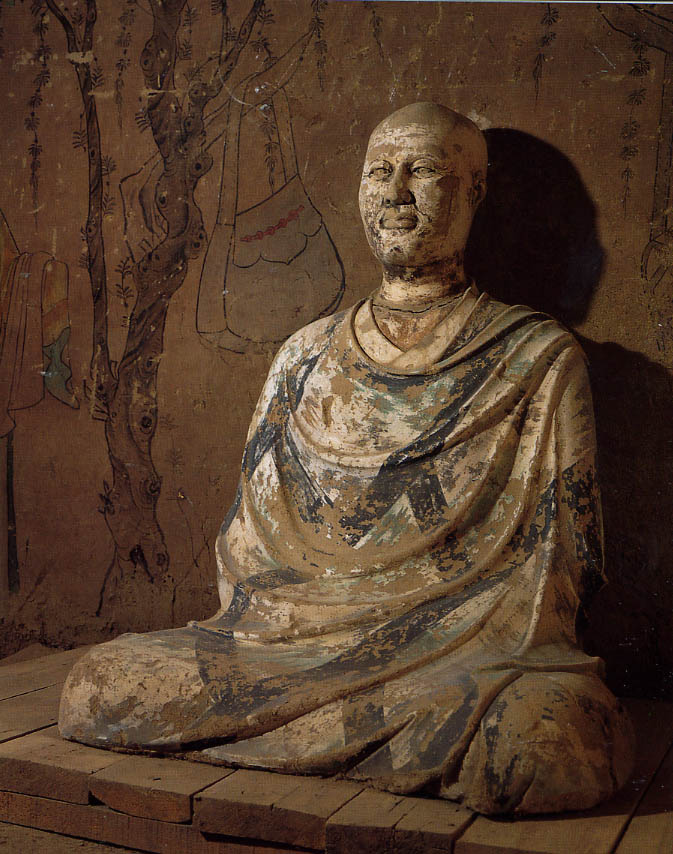
Once upon a time, there was a monk called Hongbian. He was Chinese, but he grew up in a city ruled by the Tibetan empire. So, like everybody else in the city, he wore Tibetan clothes, and learned to read and write the Tibetan language. Because he was from the wealthy Wu family, he quickly rose in the ranks, eventually becoming one of the most senior monks in Dunhuang. This brought him in contact with orders that came from the emperor of Tibet himself.
More than once, the Tibetan emperor commanded that the city of Dunhuang should make hundreds of copies of Buddhist sutras in Tibetan. The copying of these sutras was a massive undertaking, almost turning the whole city into a scriptorium — on which, see my previous posts here. Hundreds of (mostly Chinese) scribes copied the sacred Tibetan syllables onto loose-leaf pecha pages and scrolls. The result was a series of monumental volumes of the Perfection of Wisdom sutra, and many hundreds of scrolls of the Sutra of Aparamitayus (the manuscript Pelliot tibetain 999 links Hongbian to the latter).
Many of these mass-produced sutras still exist today, because quite a few of them were placed in the Dunhuang cave. In an exciting new development, scholars investigating the recently opened libraries of Central Tibetan monasteries (including Drepung) have found more volumes of the same sutras, which seem to have been shipped there from Dunhuang. We know this because the colophons contain the names of the same Dunhuang-based scribal teams.
So Hongbian’s home was one of the major scriptoria of the Tibetan Empire. He was still there when the Tibetan rulers were kicked out of Dunhuang in 848. A few years later, he rose to the eminent position of the head of the Buddhist sangha in the whole of Hexi (basically modern Gansu province). Around the same time, he (and other wealthy relatives) paid for the excavation of a large cave shrine in the Dunhuang cave site. It was actually the third cave that he had commissioned, and all three now formed three stories of a cave temple.
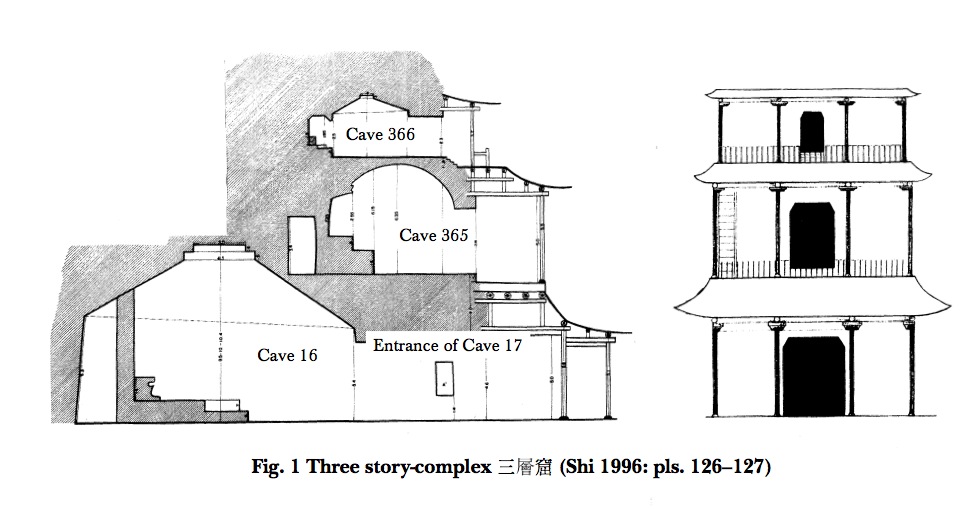
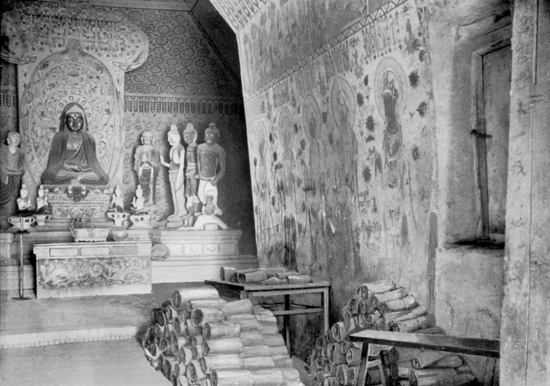
This large new cave (now known as Cave 16) contained a small antechamber (Cave 17). It might have been a meditation retreat. Perhaps it was just for the storage of supplies. In any case, after Hongbian’s death in 862, it was converted into a memorial shrine with a statue of the revered monk in meditation, perhaps with his ashes beneath the statue. An inscribed stone recording his achievements was also placed in the cave. Over the next hundred years, Cave 17 later came to be filled to bursting with manuscripts, and Hongbian’s statue was taken out and put in the cave above.
* * *
Going over this story of how Cave 17 came into being, it is surprising how little it features in the explanations for the manuscript hoard that we have looked at so far. This might be (as Yoshiro Imaeda suggested in a recent article) because the Tibetan aspect of the cave has been neglected. This might be because Dunhuang has been dominated by Sinologists, derspite the fact that the Tibetan manuscripts are nearly as numerous as the Chinese.
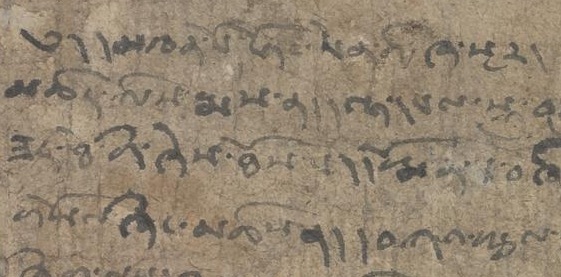
What about those massive volumes of Tibetan Perfection of Wisdom sutras found in the cave? These have been of so little interest to Chinese scholars in the 20th century that most of them remain in the stores of the Dunhuang city museum, only recently coming to the attention of a new generation of Chinese and Tibetan scholars. Yet they might be the key to understanding the manuscript hoard. And what about the collection of letters (in Tibetan) addressed to Hongbian? These represent Hongbian’s official responsibilities, and they may have been interred in the cave at the same time as the statue and stone inscription, or some years later. Here’s a detail from a letter addressed to “Khenpo Hongpen”:
So, were the first batch of manuscripts placed in the cave those that belonged to Hongbian himself? These could have been the ‘seed’ for future deposits of manuscripts, until the function of the cave gradually changed into a repository for manuscripts. Perhaps another early batch of manuscripts was deposited after the death of another famous figure from Dunhuang, the Lotsapa* (translator) Chodrup, whose Chinese name was Facheng, and whose family (like Hongbian’s) was Wu. This monk was a contemporary of Hongbian, who also worked during the last decades of Tibetan rule in Dunhuang, translating Chinese texts into Tibetan at the order of the Tibetan emperor. He was also involved in the mass-production of Tibetan Perfection of Wisdom sutras, as a senior editor. In the Dunhuang cave, we find nice copies of Chodrup’s finished translations as well as working notes that may even be in his own handwriting.
Is this a pattern? First Hongbian’s manuscripts are deposited, then a few years later those of his relative Facheng/Chodrup. And then, on the same model, the manuscripts and paintings collected by other monks, once they had passed away. I don’t want to overstate this, but even the pious monk Daozhen (who we talked about in the last post) might be part of this pattern. If Daozhen’s personal manuscript collection was interred after his death, this would also account for the evidence that Rong used for his idea that the cave represented the collection of a single monastery.
* * *
I don’t want to argue for a “funerary deposit” theory to displace the “sacred waste” and “monastic library” theories. After all, human life is organic and messy and rarely reducible to single explanations. Over 150 years, our cave went through several incarnations: storage closet (perhaps), funerary shrine, manuscript repository. The man who built the cave died, a statue of him was placed inside it, and then his letters and books, and those of other people too, and then so many manuscripts that his statue had to be taken upstairs. Other people, born long after the cave was first made, came and performed rituals there, and more manuscripts were deposited, until the cave was filled to the brim. And then it was closed, and then…
What I’m trying to say is, it’s probably better for us to think of this cave in terms of “multiple uses” rather than single, conclusive theories. But let’s always keep Hongbian in the picture. Nowadays, his statue has been put back in the cave, and he sits in meditation under the shade of the tree that was painted on the wall behind him over a thousand years ago. It seems right that Hongbian himself should also return to the centre of our discussion of the manuscripts in the cave.
* * *
References
This post could not have been written without this superb article by Yoshiro Imaeda, in which he does not put forward a new theory about the manuscript cave, but sensitively reviews what has been written in the past, especially in the light of the Tibetan manuscripts:
Yoshiro Imaeda. 2008. “The Provenance and Character of the Dunhuang Documents.” Memoirs of the Toyo Bunko 66: 81–102.
This article is also worth reading (and is available on JSTOR):
Ma Shichang. 1995. “Buddhist Cave-Temples and the Cao Family at Mogao Ku, Dunhuang.” World Archaeology 27.2: 303-317.
And for those who read Chinese:
Ma Shichang. 1978. “Guanyu Dunhuang cangjingdong de jige wenti” 關於敦煌藏經洞的幾個問題. Wenwu 12: 21-33, 20.
* * *
Images
1. Hongbian’s statue, back in Cave 17.
2. Pelliot tibétain 1200, a letter addressed to Hongbian.
* * *
Note:
* The spelling of this mysterious word in the Dunhuang documents is usually lo tsa pa.
 As he promised in his vow, Daozhen collected unwanted fragmentary or duplicate manuscripts, and used them to fill gaps in the Sanjie monastery’s library, or to repair incomplete works in that library. Thus according to Rong, the existence of so many incomplete manuscripts in the Dunhuang cave is due to Daozhen’s efforts in collecting manuscripts from elsewhere. Rong also pointed out that many of the manuscripts are not actually incomplete, and seem to have been originally stored in the cave in neatly catalogued bundles.
 early Tibet