
When I was working on the later chapters of Tibet: A History I started to explore the archives of India Office Library, where I found thousands of documents from British officials stationed in India, China, and occasionally Tibet itself, mostly from the first half of the 20th century. This is fascinating material, much of it still untapped, though those excellent historians of modern Tibet, Melvyn Goldstein and Tsering Shakya have made good use of it in their books.
One event from Tibet’s recent history that I would like to have said more about in my own book is the expulsion of all Chinese officials from Tibet in 1949. This dramatic move was made by the Tibetan government when they realised that the Chinese Communists were about to defeat the Nationalists and become the ruling power in China. At this point the Tibetans had come to a grudging acceptance of some diplomatic ties with the Nationalists, thawing the 13th Dalai Lama’s total freeze-out of China. But the Tibetan government was deeply mistrustful of the Communists, with their anti-religious idealogy.
So it was probably the idea that Communist officials would simply step in and take the place of the Nationalists in Tibet that prompted this mass expulsion.This effectively returned Tibet to the way things had been under the 13th Dalai Lama, when China had no official presence in Tibet at all. It was a drastic move and a strong reassertion of the declaration of independence that the Dalai Lama had made in 1913. So, what do the India Office archives tell us about it?
* * *
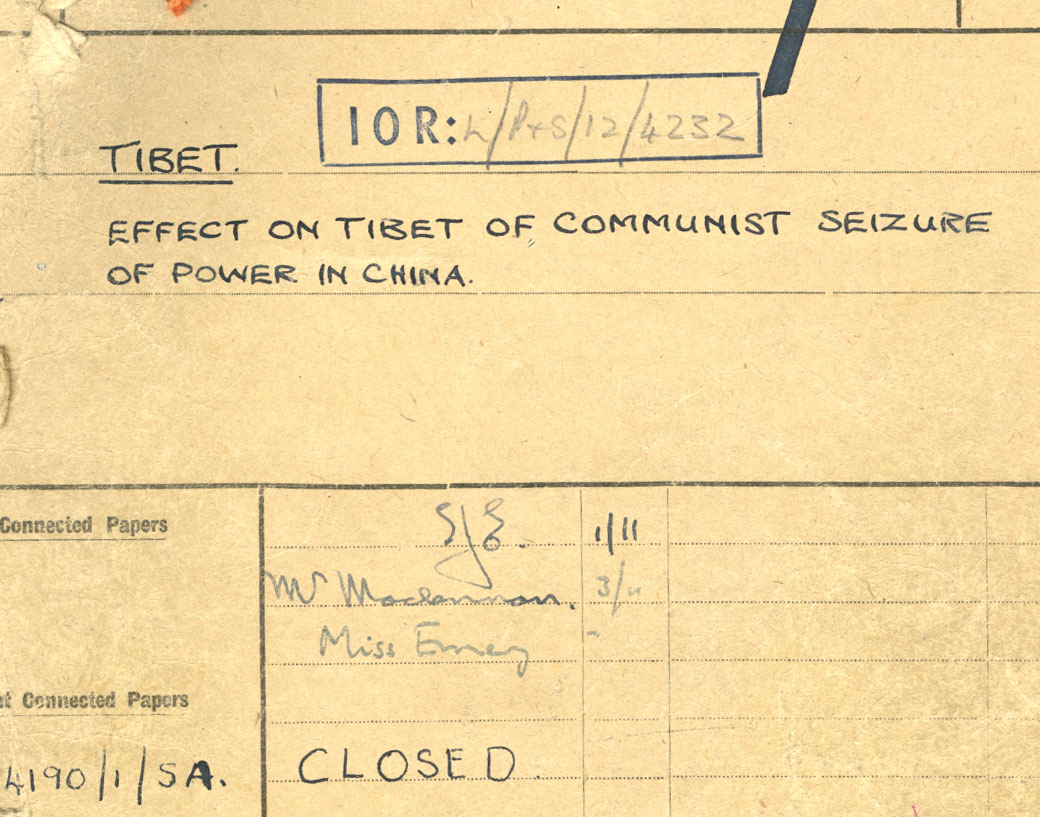
 Reading through the file titled “Effect on Tibet of Communist Seizure of Power in China” plunges you back into history, watching a situation unfold. I found it genuinely gripping to read the original reports and telegrams of British officials as they receive information, then try to make sense of it and react to it.
The first ripple that reaches the British High Commission in Delhi of this particular episode is when they hear about a Communist revolt in Tibet. This is July 23rd 1949, and the story comes from a Hong Kong newspaper. The newspaper suggests that the head of the Tibetan “State Department” — who is said to be pro-Communist and anti-Dalai Lama — has expelled the Chinese Nationalists from Tibet. This is a very twisted version of events, but not knowing any better, the High Commissioner duly passes this on to London. Two days later, he has got a better grip on the story, thanks to the Indian foreign secretary. There is no pro-Communist and anti-Dalai Lama faction in the Tibetan government at all; that, as one of the telegrams put it, was a “smokescreen”…
He told me that what had really happened in Tibet was that the Tibetan authorities wished to get rid of the Chinese Government Mission quickly in order to avoid the risk of a future Chinese Communist Government appointing a Chinese Communist Mission or alternatively of the present Mission transferring its allegiance to the Chinese Communists. The Tibetans had therefore asked the Government of India whether they would receive the Mission on its expulsion from Tibet.
So, the Indian government knew what was going on, having been in touch with Lhasa since July 17th and were a little bit late in informing the British (who, remember, had only given up their colonial position in India two years earlier). Anyway, the Indians now need the British to help with getting the deported Chinese from India to Canton, so from this point on the High Commissioner is kept fully informed. By July 28th the expulsion of the Chinese is common knowledge in Britain as well, as the Times publishes a brief article on it:
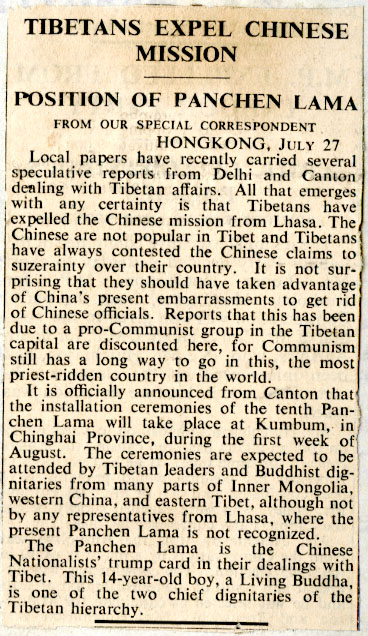 Apparently the Tibetan government had run out of patience waiting for a response from India, and had already expelled the Chinese officials. In Delhi, the British High Commissioner now goes to talk with his Chinese counterpart, the ambassador, who quickly declares that he is certainly no Communist himself. Probably true, as the ambassador was from the Nationalist (Kuomintang) party, who were at this point the sworn enemies of the Communists. And he goes on to say that he doubts that any of the Chinese expelled from Tibet are Communists either. With a clever, if slightly odd metaphor, he suggests that the Tibetans have acted rashly:
Fishing for red herring on a high plateau is too naive an act and politically very unwise.
The Chinese ambassador concludes by reminding his British counterpart that “Tibet is and always has been a part of China” (an interesting comment for anyone who wonders if Tibet would have retained its independence had the Communists not been victorious in 1949). The following week is taken up with the British trying to organize a passage for the expelled Chinese (who are still en-route to India). They are to be sent to Hong Kong, and from there to Canton.
* * *
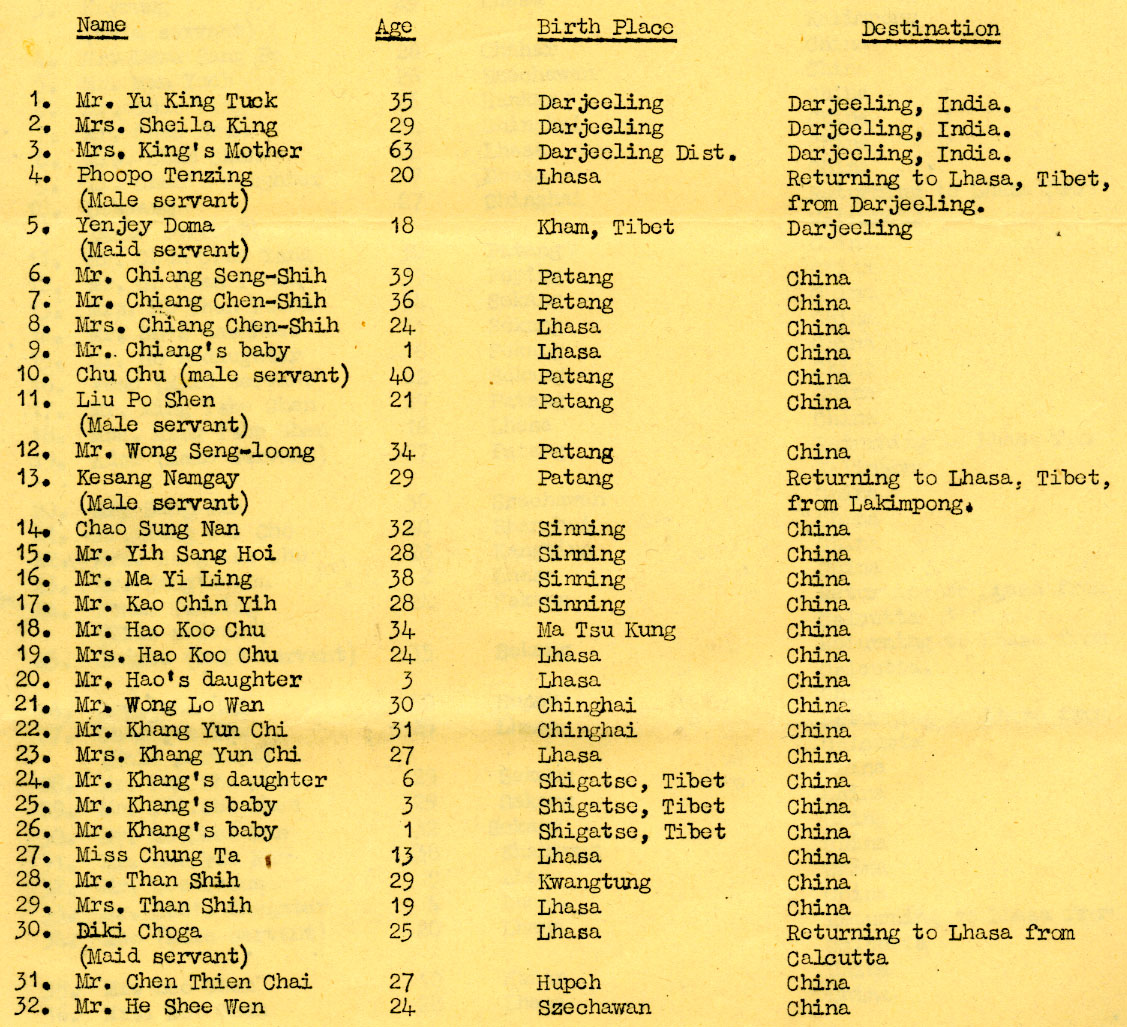
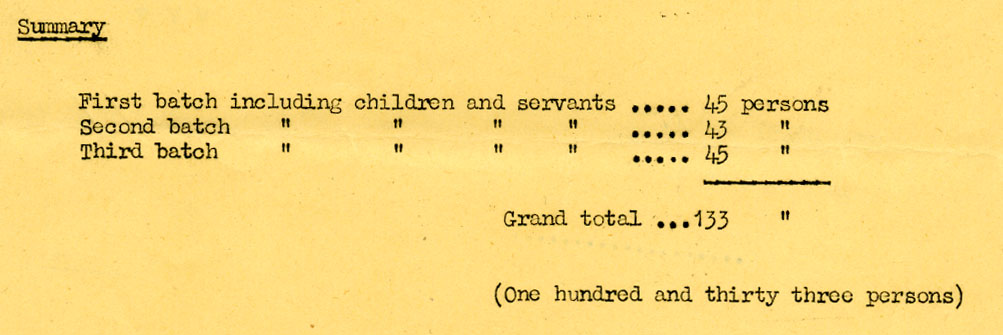
On the 11th August, the deported Chinese are all encamped at Yadong, near the Indian border, and the trade agent there has drawn up a list of every one of them, 133 people in total. This is a fascinating document. It gives the name, age, birthplace and destination of each of the deportees, suddenly changing our perception of them from a political problem to a group of real people. They are almost all families: wives, husbands, children and their servants. There are several babies, just 3 or 4 months old. There is an English woman married to one of the Chinese officials, and her mother, both born in Darjeeling and now returning there again. And there are Tibetans too, the servants of these families. The image below shows the first 32 people on the list:
After this, we hear no more of these 133 people. The British reports are now more concerned with the propaganda emanating from Communist radio stations in China. A Beijing radio programme on 6th September states that:
Tibetan authorities expelled Han people and Kuomintag personnel in Tibet at the instigation of the British and Americans, and their stooge the Indian Nehru Government.
A few days later the PLA is in Xining, according to a clipping from The Daily Worker (13th September) under the headline MONKS HAIL PEOPLE’S FORCES. Perhaps this journalist was not fully briefed on the Communist propaganda, for he writes that “Chinghai was formerly part of Tibet.” Anyway, in a matter of weeks the deported Chinese officials and their families were forgotten. As I leaf through the last documents in the file, I see the British now turning their attention to the urgent question of how to engage diplomatically with the victorious Chinese Communists and their stated aim of “liberating” Tibet.
I suppose the deportees were left to make their own way home from Canton. If you look at the list, you can see how many of them came from Sichuan and Qinghai (that’s Kham and Amdo in Tibetan terms), meaning a long overland journey back across war-torn China. Even if it’s hardly the most pressing issue of that chaotic time, I can’t help wondering how many of them made it back home.
* * *
Sources
The India Office Records file I have used here is L/P&S/12/4243: “Effect on Tibet of Communist Seizure of Power in China”. Documents therein run from February to December 1949.
Melvyn Goldstein writes about this episode briefly in A History of Modern Tibet, Volume I: 1913-1951 (pp.613-614). His account is based mainly on interviews. Interestingly, one of Goldstein’s sources says that the idea of the expulsion of the Chinese came from Ngapo, who later signed the agreement through which Tibet became part of China, and joined the Communist Party. Another of his sources states that the idea came from the British resident Hugh Richardson, but this was denied by Richardson himself (and the India Office files show that, if Richardson did make the suggestion, it was not with the knowledge of his masters).
Tsering Shakya writes in more detail about the episode in The Dragon in the Land of Snows (pp.5-11). His account is based on a wider range of sources, both oral and written. An authoritative source denies Ngapo’s involvement in the matter at all. Shakya also consulted the British Foreign Office documents held at the Public Record Office. I have not seen these, but I presume there is some overlap with the India Office Records.
Goldstein say that, “Another 300 to 400 individuals, mostly Chinese, who had been identified by Namseling as spies were photographed and expelled at the same time as the officials.” This is from his source Sambo (Rimshi), but these people were definitely not deported through India. They are probably the same group as those “Tibetans from the eastern part of the country” mentioned by Shakya (p.9). Thus they were probably sent eastward to China rather than via India.
 early Tibet