A Tibetan Book of Spells

itj401_1

Can monks do magic? Should they? We often picture monks (or at least the ideal of the monk) firmly in the setting of the monastery, either seeking enlightenment through study and meditation, or carrying out in the affairs of the monastery. But magic? Well, it seems that throughout most of the history of Buddhism the answer to the first question has been yes, and to the second usually why not? In fact, the  Buddhist canon contains enough spells to rival the repertoire of Merlin, Saruman and Harry Potter put together.

Let’s not make the mistake of thinking that this only applies to Tibetan Buddhism, through some insidious influence of shamanism (whatever that is). No, Indian, Chinese, Japanese monks have all mixed potions, cast spells and exorcised demons. There’s a story about Bodhiruci – an Indian monk who taught for many years in China – that nicely illustrates this. Once, when a Chinese monk spotted Bodhiruci casting a spell to make the water in a well boil, the monk started to pay special homage to him. But Bodhiruci stopped the monk and explained that all Indian monks learn these skills. (The story, from Daoxuan’s Further Lives of Eminent Monks, is retold in Richard McBride’s article.)

And let’s not think that this only applies to tantric Buddhism. Spells were being cast by Buddhists long before the tantras appeared. Indeed, the recitation of verses against disease or evil spirits goes right back to the beginnings of Buddhism. Mantras are found in the texts of the Sarvāstivadin sect and in the paritta texts of the Theravadins. (See Peter Skilling’s article.)

And there’s nothing mysterious, dubious or underhand about it. Buddhist monks have traditionally lived apart from, yet among lay people, who support their way of life. And ordinary people have turned to the monks for help with their everyday needs, whether serious calamities like illness, the complications of childbirth and spirit possession, or the questions that are answered by astrology and divination. Buddhist monks faced competition from the Brahmins in India, from the Bön and Shen in Tibet, and from the Daoists in China. They all had their spell techniques – and if they were to win the hearts and minds of ordinary people, the Buddhists would need spells too.

*  *  *
itj401_3

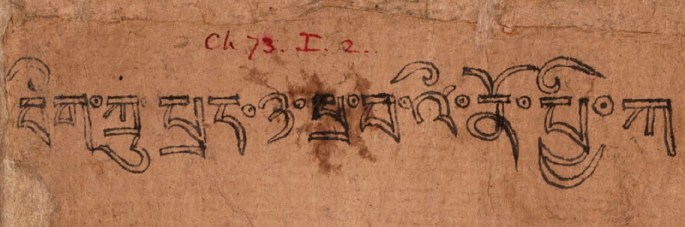
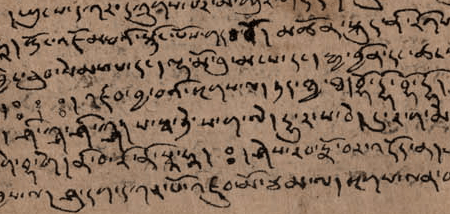
Spells are written to be used, of course, so it’s interesting to look at an actual book of spells that was owned by a Buddhist monk – one of our 9th or 10th century Dunhuang manuscripts, IOL Tib J 401. That funny writing at the top of this post, that looks like the “outline” effect of my old word processor is the cover of a book of spells, on which a monk has written his name in big letters. You can’t miss it: “This is the ritual manual of Bhikṣu Prajñāprabhā.” Well, through the twists and turns of interdependent origination, this is now the ritual manual of the British Library, and more generally, of everyone who has a web connection and an interest in such things.

The book has a handmade quality; it seems to have been stitched together from recycled paper (long pothi pages, folded in the middle). So what’s in it? Spells, spells and more spells. Just one of the rituals allows the adept to cast spells for the following purposes:

  • If you want a prophecy
  • To bring demons under your power
  • To pacify malignant people
  • To overcome wild animals
  • To cause a spring to come forth to alleviate thirst
  • To sharpen your insight
  • To create various valuable objects
  • To find a treasure
  • To cure an illness
  • To cure a severe illness up to the point of death
  • To cure an illness-ghost with a trap
  • To cut off curses and bad births
  • To reverse water, making it flow upwards
  • To make it flow downhill again
  • To cure madness
  • To avoid being bitten by a dog
  • To divide two lovers
  • To reconcile two friends
  • If you are unable to talk to others
  • If you want to be friendly with another person
  • To bind someone

This list gives us an idea of the many needs of ordinary people that could be addressed by the monk magician. Then there are the more complicated rituals that accomplish a single aim, like:

A fire puja (also called homa), which cures insanity. Fire pujas are found in many religious traditions in India, and they travelled with Buddhism to Tibet, China and Japan. In this spell the monk throws metal filings into the fire nine times – causing a dramatic series of flashes, I’m sure. Then five ritual daggers are stabbed into the ground as if pinning down a demon.

Thread-winding magic for “men with obstructed water” and “women with inverted wombs.” The monk knots and unknots the red thread several times while reciting mantras. In the end the thread is flung into the road – just as in the traditional Tibetan way of disposing of the thread cross.

A barley frog. People suffering from joint problems, swellings and the like were often thought to be afflicted by water spirits called Lu (a Tibetan cousin of the Indian Naga). In this ritual, barley flour is molded into the shape of a frog. Then a cavity is made in the top of the frog with a bamboo stick, and a special ointment prepared in the cavity. The ointment is then applied to the afflicted person’s body. The barley frog is then checked to determine the success of the ritual:

Lift up the frog, and if a golden liquid emerges from under it, they will definitely recover. If it is merely moist, then they will recover before too long. If there is only meat with gluey flour, they will be purified by the end of the illness. It is not necessary to do the ritual again. If there is only gluey flour, break it up and do the ritual again.

Prasena divination. This special kind of divination involves calling down a deity to answer questions put to it. In the ritual in this spell book the deity is called “the sky-soarer” or the Khyung (a Tibetan cousin of the Indian Garuda). The deity speaks through a “pure” (that is, pre-pubescent) child, or shows that child visions in a mirror, or on the flat of his own thumb. Though such rites of spirit-possession might seem “shamanic” they are described in Indian scriptures like the Amoghapāśa Sutra and the Questions of Subāhu, and prasena is apparently an Indian word, though no-one seems quite sure what it might mean (though Michel Strickmann had a good go at it). Prasena (often simply known as “pra”) has a long a fascinating history in Tibet, including being used in the quest for the present Dalai Lama after the death of his predecessor, for example (see Lama Chime Radha’s article).

*  *  *

Buddhist collections of spells like these always contain some reminder of the wider perspective of Buddhist aspirations. In our spell book, it seems that a certain level of spirtual attainment is necessary for the spells to be effective. And at the end of the spell book everything is tied back into the great themes of Buddhism with a prayer to the Mañjuśrī, the bodhisattva of wisdom:

In the supremely precious, jewelled land of Ultimate Emanated Bliss
The realm radiantly coloured like stainless gold
The youth with five locks is lovely to behold.
By making offerings and inviting this supreme spiritual friend
I pray that he will come because of his kindness for this place
And carry out the accomplishment of this adept’s rituals:

“I have been blinded by the net of darkness
Mañjuśrī come near and treat me with kindness.
Your discernment, like the fire at the end of an aeon
Clears away the mere appearance of darkness in the mind;
Please bestow it upon me.”

* * *

References
1. Cantwell, Cathy and Robert Mayer. 2008. Early Tibetan Documents on Phur pa from Dunhuang. Vienna: OAW.
2. Chime Radha, Lama. 1981. “Tibet.” In Carmen Blacker and Michael Lowe (eds), Oracles and Divination. London: Random House. 3-37.
3. McBride, Richard. 2005. “Dhāraṇī and Spells in Medieval Sinitic Buddhism.” JIABS 28.1: 85–114.
4. Skilling, Peter. 1992, “The Rakṣā Literature of the Śrāvakayāna.” Journal of the Pali Text Society 16: 109-182.
5. Strickmann, Michel (edited by Bernard Faure). 2002. Chinese Magical Medicine. Stanford, California: Stanford University Press.

*  *  *

See also: A Soldier’s Prayer

* * *

Note for readers of Tibetan: What is a no pyi ka?
The front cover of the spell book says bIg kru prad nya pra ba ‘I no pyi ka. I hope that most will agree that the name is probably Bhikṣu Prajñāprabhā, but what is a no pyi ka? I first came across the word in a poetical passage by Jigme Lingpa (at the beginning of his Pad ma dkar po) where he calls it “the essence of hearing, thinking and meditating” (thos bsam sgom pa’i snying po no pi ka). The term is much more common the Dunhuang manuscripts, and an interpretation was first suggested by Kenneth Eastman in 1983, when he noted that the Tibeto-Sanskrit glossary in Pelliot tibétain 849 glosses it as sgrub thabs – the Tibetan word that we usually consider a translation of the Sanskrit sādhana, a manual for ritual and/or meditation. Robert Mayer and Cathy Cantwell, in their 2008 book on Phurba manuscripts, suggest (with thanks to Matthew Kapstein) that the probable origin of all this is a Sanskrit term sādhanaupayika. Thus sādhanaupayika becomes nopayika becomes no pyi ka. This would be very neat because we thus get to the original Sanskrit term behind the Tibetan word sgrub thabs: sādhana = “accomplishment” = sgrub, while aupayika = “means” = thabs.
The Decline of Buddhism IV: Keepers of the flame

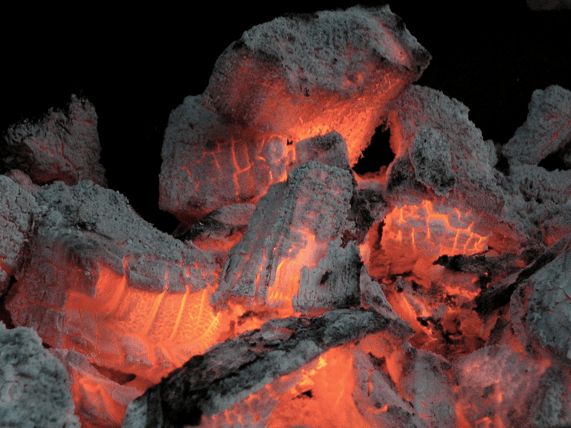
embers

Whether or not the Tibetan emperor Lang Darma really did persecute Buddhist monks and monasteries, as he is said to have done during his ill-fated reign in the 840s, there is no doubt that a catastrophic collapse did indeed occur in Central Tibet. As society fragmented, revolutions and civil wars broke out and the Buddhist monasteries were abandoned. In Central Tibet, monastic Buddhism was all but wiped out. It took over a century – a Dark Age for Tibetan Buddhism – till monks began to appear in Central Tibet again.

There’s a tradition that monastic Buddhism survived in Tibet thanks to a few heroic monks, keepers of the flame of the monastic lineage. According to an old Tibetan saying, during this dark age the embers of the Buddha’s teaching were kept in the East. The story is that several monks refused to renounce their robes, and instead hit the road as Buddhist refugees. After much travelling they ended up in Amdo in Tibet’s northeast, which had avoided the complete collapse of monastic Buddhism. These refugees had taken their books with them, including most importantly the books of the vinaya, the monastic code that is the heart of the tradition of monastic ordination. This ensured the survival of the ordination lineage through the dark age.

Tradition preserves the names of a few of these refugee monks who settled in Amdo.The chaotic flight and eventual resettling of these monks is summarized in a passage from Nelpa Pandita’s history:

Yo and Mar, with a Central Asian monk called Shakya Sherab acting as their servant, settled in the rocky cave of Anchung Namdzong. Tsang settled in the temple of Khangsar Yaripug. Kwa Ö Chogdragpa, returning from Nepal, heard the news and left on the road to the north with a mule-load of abhidharma texts, finally settling in the temple of Palzang Kharchag Drilbu. Lhalung Rabjor Maldrowa and Rongtön Senge Drag left Yerpa with many books of vinaya and abhidharma, fleeing to Nagshö. After that, Lhalung settled in the temple of Dashö Tsal and Rongtön settled in Jang Chajerong.

Most later histories also add that Lang Darma’s assassin, Lhalung Palgyi Dorje, fled to Amdo too. In any case, the crucial point is that the first three of these refugees (Yo, Mar and Tsang) passed on their ordination lineage to a young local fellow. This young man had been brought up in the local non-Buddhist traditions, but had developed some faith in Buddhism and decided to ask the refugee monks for ordination. With the help of two Chinese monks, the young man was ordained, and given the religious name Gewa Rabsel.

*  *  *

Apparently Gewa Rabsel became an important figure in the religious scene of Amdo, but we don’t really know much about him. He is said to have spent a significant portion of his life teaching at the monastic mountain retreat of Dentig, which still exists in a valley west of Lanzhou. Gewa Rabsel ordained many local Amdo monks, and later histories also make Gewa Rabsel the religious preceptor of the famous men who came from Central Tibet in search of a living ordination lineage. These men (their number various in the sources) were the ones who brought the ordination lineage back to Central Tibet, and gradually restored Samyé and many other old monasteries that had fallen into ruin.

The story is convincing in its general outlines. There certainly must have been refugee monks, there probably was a Gewa Rabsel, and the idea that the monastic lineage was brought back to Central Tibet from Amdo is convincing. But even the Tibetan historians had some doubts about it. The main problem is the idea of Gewa Rabsel ordaining the men who brought the monastic lineage back to Central Tibet. Considering that the refugee monks who ordained Gewa Rabsel  arrived in Amdo some time in the 840-50s, and the “men of Central Tibet” received their ordination from him some time in the 970-80s, Gewa Rabsel would have to have lived an unfeasibly long time.

In fact we don’t have to accept this part of the story, even if we stay with the traditional histories. Though some early historians, notably Butön, had Gewa Rabsel ordaining the men from Central Tibet, others were not so sure. Sönam Tsemo wrote in the 12th century of this ordination lineage: “Some say it was received from Lachen Gewa Sel. Some say it was received from Tülpa Yeshe Gyaltsen.” And Nelpa Pandita, in his 13th century history, argued that there couldn’t be a direct connection between Gewa Rabsel and the monks who brought Buddhism back to Central Tibet:

Now, between the iron bird year when the dharma was snuffed out and the earth bird year when the embers were fanned and dharma communities appeared in Central Tibet, nine year-cycles passed. For 109 years there were no monks in Central Tibet. Therefore to say that the six men of Central Tibet received their vows from Lachen Gongpa Sel is a deceptive explanation which is utterly wrong.

In truth, Nelpa Pandita argues, the men of Central Tibet were ordained by one Drum Yeshe Gyaltsen – a disciple of a disciple of Gewa Rabsel and  no doubt the same person as the Tülpa Yeshe Gyaltsen mentioned by Sönam Tsemo. Similarly, Gö Lotsawa in the Blue Annals also denies any connection between Gewa Rabsel and the six men of Central Tibet, although he does say that some other histories make that connection. So a longer, and more convincing lineage for the keepers of the flame looks like this:

  1. The refugees: Yo, Mar and Tsang
  2. Gewa Rabsel
  3. Yangong Yeshe Yungdrung
  4. Drum/Tülpa Yeshe Gyaltsen
  5. The men of central Tibet

*  *  *

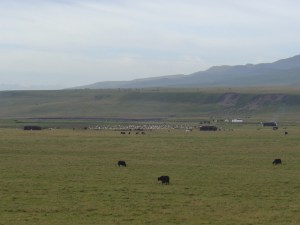
amdo-grasslands

So who was this Drum Yeshe Gyaltsen? He was a local Amdo man who was ordained by one of the students of Gewa Rabsel. He established a monastery in Amdo, which followed a fairly strict interpretation of the vinaya, banning agriculture and animal husbandry, as well as luxurious cushions or carpets. Interestingly, he also banned political activity and certain  funeral rituals involving the inscription of syllables (which could have been a good source of income for the monks).

Despite its strictness, Drum’s monastery seems to have been quite successful, and its ordination lineage became known as “the lineage of the ascetics” (tsüngyü). Why “ascetics”? Well, there was also another Amdo lineage known “the lineage of the scholars” (khégyü), which came from a monastery established by a monk called Nub Palgyi Jangchub and was much more lax in its discipline. It was mainly distinguished from Drum’s lineage by the fact the monks were allowed to meddle in politics. As a result, Nelpa Pandita says that the monks of this lineage “were of little use for religious training.” Nyangral’s history doesn’t mention the specific differences between the lineages, but does suggest that the split came about because of “a little bit of wordly activity.”

The difference between the approaches of the two lineages is illustrated in this amusing story about their two founders (from Nelpa Pandita’s history):

One day Drum went to the residence of Nub, and they talked a lot about the dharma. Then Drum said, “Let’s sleep; where shall I make my bed?” Nub replied, “Here, same as me.” Drum said, “They say you drink alcohol in secret. Can I stay in the attic?” Nubs replied angrily, “Ha! you’re so strict, it’s like you have wood for brains!” Thus Drum became known as “Wood-for-Brains”.

In the end, Drum had the last laugh. It was his lineage of ascetics that was passed down to the six men of Central Tibet and used to revive the monasteries there. The restoration of the temples, and the ordination of hundreds of new monks, set the scene for the “later diffusion” of Buddhism in Tibet – the visit of Atisha and the Kadam school that grew up around his teachings, the new scholasticism of Shalu monastery, and so on… This ordination lineage even survived into the 20th century in the Nyingma tradition as the Mindröling lineage, and in the Gelug tradition as the “Abbot’s lineage of Lachen”.

Apart from these survivals, it has to be said that the ordination lineage from Gewa Rabsel was ultimately eclipsed by new ones. In fact it had a rather controversial reputation, some people objecting to the fact that the refugee monks and Gewa Rabsel had performed all of three stages of ordination in a single ritual. Others defended this practice by pointing to the sublime nature of Gewasel and his preceptors, and the dire straits in which the monastic ordination found itself in the period of fragmentation.

Gewa Rabsel remains one of the culture heroes of Tibetan Buddhism, who kept the flame of the monastic lineage alive and passed it on so that it was eventually brought back to Central Tibet, where it lit the fires of a Buddhist revival. Let us also not forget Drum Yeshe Gyaltsen, the wooden-headed abbot who kept his monks free enough from politics to preserve a meaningful model of monasticism for the Tibetans of the generations to come.

*  *  *

See also:
The Decline of Buddhism I: Was Lang Darma a Buddhist?
The Decline of Buddhism II: Did Lang Darma persecute Buddhism?
The Decline of Buddhism III: Why should the secret mantra be kept secret?

Some thoughts on the dates of Gewa Rabsel…
Gewa Rabsel’s name has several variations: he is known as Gewa Rabsel or simply Gewa Sel, as Gongpa Rabsel or Gongpa Sel, and often merely by the honorific Lachen (“great lama” or “great soul”). His dates are not given in the earlier sources, but the Blue Annals states that he was born in a water mouse year, and died in a wood pig year, at the age of 84. Traditionally these dates are supposed to be equivalent to 952–1035, but this is skewed by the mistake made by all later Tibetan historians in dating the death of Langdarma a whole 60-year cycle too late, So we should move these dates back one cycle, giving us 892–975.

Even with those earlier dates, the connection with monks fleeing central Tibet in the 840s or 850s seems rather unlikely. If we move them back by one further sixty-year cycle to 832–915, Gewa Rabsel would have been a young man when the refugee monks arrived in Amdo. This does place him rather far from the revival of monastic Buddhism in Tibet at the end of the tenth century, but that’s not a problem if we follow the histories that don’t insist on a direct connection between Gewa Rabsel and the six men of Central Tibet.

And on the names of Yeshé Gyaltsen…
The name Tülpa (thul pa) Yeshé Gyaltsen given by Sönam Tsemo is probably a corruption of Dülwa (‘dul ba), and a “Dülwa Yeshé Gyaltsen” does indeed appear in some histories. So Tülpa and Dülwa Yeshé Gyaltsen were surely the same person. What about Drum Yeshé Gyaltsen? Since Drum (‘grum) is a clan name, while Dülwa an honorific indicating an expert in the vinaya, it’s likely that these names also refer to a single person.

As for Drum’s nickname “Wood-for-Brains”, this is shing klad can in Tibetan. Here I’m following Helga Uebach’s reading of Nelpa Pandita’s text, which actually gives shing glag can. The same story features in the Nyangral Nyima Özer’s history, where we have shing rlag pa can. (Note that in this version Nubs also gets a nickname, phag shing rta, which might be translated as “Pig Wagon”.) Finally, in the Sba bzhed (R.A. Stein’s version) we have phying klag can. Not at all conclusive I know, but I like Uebach’s solution.

*  *  *

References (Tibetan dharma histories)
1. Butön Rinchendrup: Chos ‘byung gsung rab rin po che mdzod. Beijing: Khrung go bod kyi shes rig dpe skrun khang. 1988. English translation in Obermiller, E. 1931-2. The history of Buddhism (Chos ḥbyung) by Bu-ston. I The Jewellery of Scripture, II The history of Buddhism in India and Tibet. Heidelberg: O. Harrosovitz. Reprint 1986, New Delhi: Sri Satguru Publications.
2. Gö Lotsawa Zhönupal: Deb ther sngon po. Chengdu: Si khron mi rigs dpe skrun khang. 1984. English translation in Roerich, G.N. 1949. The Blue Annals. Calcutta: Royal Asiatic Society of Bengal. (See p.67.) Also available here.
3. Nelpa Pandita: Ne’u chos ‘byungNel-pa Paṇḍita’s Chronik Me-tog Phreṅ-wa: Handschrift der Liberary of Tibetan Works and Archives, Tibetischer Text in Faksimile, Transkription und Übersetzung. Munich: Kommission für Zentralasiatische Studien, Bayerische Akademie der Wissenschaften, 1987. (The first quote is from pp.122-3 and the others from pp.128-9.)
4. Nyangral Nyima Özer: Chos ‘byung me tog snying po – facsimile in Schuh, Dieter. Die grosse Geschichte des tibetischen Buddhismus nach alter Tradition rÑiṅ ma’i chos byuṅ chen mo. Sankt Augustin: VGH Wissenschaftsverlag. (See p.445-6. Nyangral mentions another Amdo ordination lineage, called Me(rme), and unlike other sources, he apparently states that the both the ascetics’ and scholars’ lineages lasted and became famous in Central Tibet, though it isn’t very clear – see p.446.5.)
5. Sönam Tsemo: Chos la ‘jug pa’i sgo – in Sa skya bka’ ‘bum, vol.I (See p.318b).
6. T.G. Dhongthog Rinpoche: Sa skya’i chos ‘byung. New Delhi. 1977.

References (English works)
Davidson, Ronald M. 2006. Tibetan Renaissance: Tantric Buddhism in the Rebirth of Tibetan Culture. New York: Columbia University Press. (See Chapter 3 for an excellent account of this period based on a variety of historical sources.)

Also see here for a summary of the traditional story from the Berzin Archives.

Phagpa’s Arrow, or Buddhists vs Daoists

I think it might be fair to say that Tibetan Buddhism hasn’t often come into direct conflict with other religions. And although I’m all for the harmonious coexistence of religions, I find the few instances of head-on confrontation quite interesting. So let’s look at what happened once when Buddhism and Daoism came to blows.

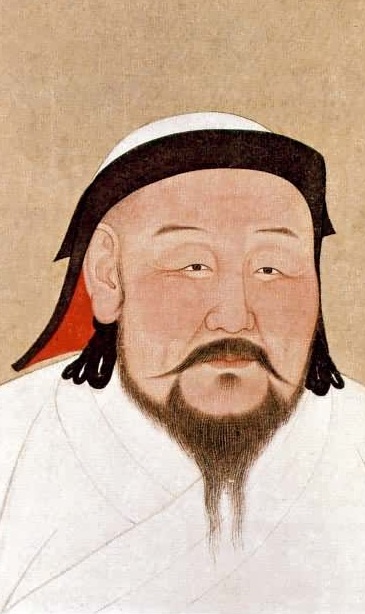
It was in the cosmopolitan court of Kubilai Khan, during the height of Mongol power. There was a new, vigorous school of Daoists, called Quanzhen. The school had been founded in the eleventh century, and by the twelfth it already had 4,000 monasteries and 20,000 priests. The school advocated an inner alchemy which rejected the use of elixirs, previously popular with Daoists, in favour of cultivating one’s inner nature (xing) and life-force (ming). More to the point, they were quite enthusiastic, shall we say, about propogating their religion.

During the 1250s, Quanzhen monks were roaming around China taking over small Buddhist monasteries and converting them to Daoist ones. Even worse, they were piling up the sacred books of these monasteries and burning them. They were also hanging around at the Mongol court, like everybody else, looking for patronage. It was here that the Daoists and the Buddhists started to squabble. Kubilai’s predecessor Mongke Khan convened two debates in 1255 and ’56 which the Buddhist side was represented by a mysterious monk called Namo. The second Karmapa, Karma Pakshi was at Mongke’s court at this time, and took part in the debate of ’56.

These were opening skirmishes. It was in the reign of Kubilai that the decisive debates took place. The monastery-occupying and scripture-burning activities of the Daoists had not abated. And now, adding insult to injury, they were also circulating printed copies of the Laozi huahu jing, a polemical text telling the story of how the found of Daoism, Laozi, travelled to India and invented Buddhism there as a lesser doctrine for the barbarians.

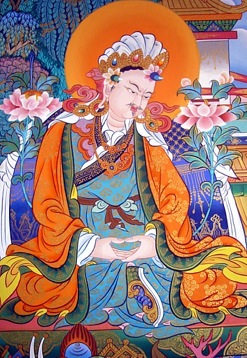
Kubilai’s imperial preceptor at this time was Chögyal Phagpa, the head of the Sakya school, and by the Khan’s command, ruler of Tibet. Phagpa was upset by the Daoists’ activities and asked the Khan to convene another debate. This time, the stakes would be higher – the losers would surrender their own scriptures to be burned.

We know that this debate really took place in the summer of 1258, thanks to Chinese and Tibetan historians. We also have Phagpa’s own account of it – “Verses on the Defeat of the Quanzhen Teachers” –  preserved in his collected works….

Urged by the Lord of Men himself,
Who possesses a great analytical mind
And increases merit and well-being everywhere,
The arrow transmitting the authentic scriptures,
Tipped with the vajra arrowhead of logic,
Was placed on the bow of analysis
And shot by the archer of inspired speech.

The Lord of Men is Kubilai, the secular parallel to the Lord of Sages, the Buddha. After offering his patron suitable praise, Phagpa characterizes himself as a sacred archer with an impressive extended metaphor. But did Phagpa’s arrow hit its target? He doesn’t tell us straight away, but instead goes on to desribe his Daoist opponent:

By striving on the path of the seer,
He has gained eyes of clairvoyance
And the powers of magic,
But due to the imprints of his countless previous lives,
He believes that the self exists in the material aggregates.
Thus he will never be a vessel
For the path to liberation.

This supreme teacher of the Quanzhen school,
Followers of the one they call Lao Jun,
Is well-versed in the texts of his tradition,
But has become completely intoxicated
By pride in his considerable fame,
And has looted and burned
Our books of scripture.

The name of the Daoist who went head to head with Phagpa is not preserved in any of the histories. A pity, since he was obviously well-known at the time. For Phagpa his first crime is philosophical: since he believes in the existence of a self, he will never understand Buddhism, the philosophy of nonself. His second crime is the pride that has led him to burning Buddhist books. So, who won?

Applying the elixir that transforms
The iron of a sound intellect
Into the golden teachings of the authentic scriptures,
I turned him into an upholder of the vows
Of the excellent yogic conduct of the Sage.

Ah, Phagpa won, and it seems his opponent, in the traditional way, converted to Buddhism. In fact, in the colophon Phagpa states that seventeen Daoist monks converted to Buddhism. By the way, did you see what Phagpa did with the metaphors in this verse? Rather sarcastically turning the Daoist tradition of alchemy against his opponent, Phagpa characterises his own Buddhist logical arguments as a kind of alchemy, transforming his opponents iron-like intellect into the golden Buddhist teachings. From archer to alchemist.

Phagpa ends by hoping the the news of his victory helps others turn to the Buddha’s path:

The learned enjoyed this very much,
And because of their enjoyment, news of this
Spread to the limits of the sky through the realms of men.
May this help all beings on the wrong path,
Or with no path, to enter the teachings.

What he doesn’t mention is that the after the debate, 45 Daoist scriptures were burned. Presumably these were the Daoist books kept at the Mongol court. That wasn’t the end of the problem. Another debate was convened in some decades larer, in 1281 (after Phagpa’s death). The Buddhists won again, and this time the entire Daoist canon (except for the Daodejing) was burned. And though that does seem to have been the end of Daoist influence at the Mongol court, it wasn’t the end of the Quanzhen school. They survived and remain to this day the largest school of monastic Daoism.

*  *  *

Colophon

For the sake of completeness, here’s the colophon to Phagpa’s verses:

In the past in China, the one called Tawo Shang Lao Jun was born after 82 years in his mother’s womb, and delighted in solitude. Striving for meditative absorption, he attained clairvoyance and magical powers. He gave advice on this path of his to students, and a religious system similar to the Śāṃkhya arose. His followers grew very numerous and came to be known as the Quanzhen school. Seeing that they were doing harm to the teachings of the Sūgatas, the Lord of Men Kubilai commanded a refutation this false system. On the 23rd day of the midsummer month of the male earth horse year (1258), Phagpa, having studied for a long time to achieve expertise in our own philosophical system, defeated seventeen [teachers] who became monks. This has been written as a commemoration.

*  *  *

References
1. Drogön Chögyal Phagpa. “Verses on the Defeat of the Quanzhen Teachers.” Sa skya bka’ ‘bum: 7.304.
2. Eskilden, Stephen. 2004. The Teachings and Practices of the Early Quanzhen Masters. New York: SUNY.
3. Tao-Chung Yao. 2004. “Quanzhen—Complete Perfection.” In Kohn, Livia (ed.), Daoism Handbook. (2 vols.) Leiden: Brill. II.567–593.

Images
1. Kubilai Khan, portrait (13th c?), National Palace Museum, Taipei.
2. Chögyal Phagpa, 18th century painting. Rubin Collection, HimalayanArt.com.

Buddhism and Empire III: the Dharma King

Among the most celebrated figures in Tibetan history are the “dharma kings” (chögyal in Tibetan) who supported Buddhism and helped it to take root in Tibet. And probably the most important of all the dharma kings is Tri Song Detsen. Prince Song Detsen was given the title Tri – meaning “throne” – when he came of age, and he wasted little time in curbing the anti-Buddhist movement that had taken root in recent years since the death of his father, the previous king.

Seeking Buddhist teachers, first from China, then from Nepal and India, he went about getting Tibet its first proper monastery. That monastery, Samyé, was built with the help of the Nepalese abbot Śāntarakṣīta and the tantric adept from modern Pakistan, Padmasambhava. The king also supervised the ordination of the first Tibetan monks, and a vast project for the translation of Buddhist scriptures into Tibetan.

That is the briefest of summaries of the traditional Tibetan view of Tri Song Detsen’s achievements. If we turn to the Dunhuang manuscripts, we find – for once – that they are much in agreement with that traditional view. Tri Song Detsen is celebrated in quite a few Dunhuang poems and prayers as a great Buddhist king. Most of these celebrations of the king have already been translated (see the References section below) but I recently came across one that seems to have been missed. And it’s really quite interesting indeed…

* * *

IOL Tib J 466 is a scroll with a long prayer of offerings to the buddhas, bodhisattvas, deities, dharma kings and patrons of Buddhism. First among the kings is, of course, Tri Song Detsen.

I make offering to the spiritual teachers of our own Tibet,
The great dharma kings, like the great king Tri Song Detsen,
He who has mastered the royal methods of fortune,
And rules the kingdom with the sword of the sky-gods,
The magically emanated lord Tri Song Detsen;
And to those teachers who have gone to nirvāṇa,
Including Dharmāśoka, Kaniṣkā, Śīla Atidāna and so on;
To all of these propagators of the teachings
I respectfully make the offering of homage.

I suspect that this prayer dates from not too long after the reign of Tri Song Detsen himself. Every aspect of the scroll – paper, ink, handwriting, and the arrangement of the text on the page – is similar to the sutras commissioned by the last Tibetan kings at the end of the Tibetan Empire in the 840s. So the scroll may have been written only a half-century after the end of Tri Song Detsen’s reign.

The prayer puts Tri Song Detsen right into the historical tradition of dharma kings. Dharmāśoka is of course the famous Aśoka, ruler of the great Mauryan Empire in the 3rd century BC, and patron of Buddhism. Some of the edicts that he had carved throughout his empire still survive, and confirm that he was, to some extent, a Buddhist king. He is said to have convened the third council of the Buddhist sangha to clear up some doctrinal issues. As for Kaniṣka, he was the ruler of the Kushan Empire, based in Gandhara in the 2nd century AD, and we have evidence from the coins made in his reign that he supported Buddhism (among other religions). He is also credited with organizing a Buddhist council for the compilation of a Sanskrit Buddhist canon.

Considering the importance of the councils that Aśoka and Kaniṣka are supposed to have convened, it’s not surprising that the debate between Indian and Chinese Buddhism organized by Tri Song Detsen is often considered to be another council – in the grand tradition of dharma kings.

Of the identity of the king called Śīla Atidāna I have no idea. The first part of his name means “moral conduct” and the second “supreme giving”. The extreme generosity of bodhisattvas in some Buddhist stories is sometimes called “supreme giving”. One of the most popular of these stories is that of Prince Vessantara, who gave away his wife and children to a cruel Brahman (perhaps we should translate atidāna as “extreme giving”). In the end of the story the family is reunited and Vessantara is crowned king. So it could be this king that is intended here. I welcome any alternative suggestions…

*  *  *

As well as associating Tri Song Detsen with this Indian tradition of dharma kings, the prayer highlights the divine and magical nature of Tibetan kingship. The king has “mastered the royal methods of fortune.” What I’ve translated here as “fortune” is the enigmatic word phywa. In later Tibet it refers to luck, fortune-telling and the like. During the time of Tibet’s imperial kings, it seems to have been the special possession of the kings, but it as a method rather than a personal quality.

In any case, there wasn’t much distinction between the kings and the gods. The prayer also says that Tri Song Detsen “rules the kingdom with the sword of the sky-gods.” What does this mean? The Tibetan kings were thought to be the descendents (literally!) of a race of gods who lived in the sky, and came down to earth to perform their kingly duty. Instead of dying, they ascended back to the sky – beamed up along a “sky-cord” made of light. Later generations, including Tri Song Detsen, were said to have lost the sky-cord connection. Nevertheless, they were still the children of the gods (lhasé). That sword is an interesting symbol of the king’s military power, something that is downplayed – if not totally ignored – by many later Buddhist historians. Did Tri Song Detsen really carry a sword said to be inherited from his divine ancestors?

So it seems to me that in this prayer Tri Song Detsen stands somewhere between the earlier vision of Tibetan kings as agents of the divine – with magical military power and special royal methods of prognostication – and ideal of the Buddhist king as a patron and practitioner of Buddhism above all else.

*  *  *

Tibetan text
IOL Tib J 466/3: 5r.9–12: bdag cag bod khams kyI dge ba’I bshes gnyen//rgyal po chen po khri srong lde brtsan lastsogs pa//chos kyI rgyal po chen po rnams la mchod pa//phyva’i rgyal thabs mnga’ brnyes shing//chab srId gnam gyI lde mtshon can//’phrul rje khrI srong lde brtsan dang//dar ma sho ka/ka ni skā/shI la a tI da ṇya lastsogs//ston pa mya ngan ‘das phyIn//bstan pa rgyas mdzad thams cad la//phyag ‘tshal bsnyen bkur mchod pa dbul//

References
1. Karmay, Samten. 1998. “King Dza / Tsa and Vajrayāna” in The Arrow and the Spindle: Studies in History, Myths, Rituals and Beliefs in Tibet. Kathmandu: Mandala Book Point.
2. Richardson, Hugh Edward. 1998. “The Dharma that fell from Heaven” in High Peaks, Pure Earth: Collected Writings on Tibetan History and Culture, Edited with an Introduction by Michael Aris. London: Serindia.

Images
1. Tri Song Detsen: detail of 20th c. painting, sourced from Wikipedia.
2. Coin of Kanishka, (c) The British Museum.
3. Sky-cord (OK, a tornado).

See also:
Buddhism and Empire I: A Soldier’s Prayer
Buddhism and Empire II: Portrait of a Monk