Tibetan Chan I: The Emperor’s Chan

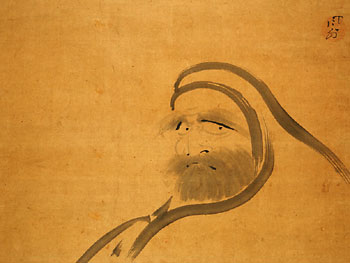
bodhidharma

Once upon a time, in the old days of Imperial Tibet, foreign Buddhist teachers flocked to Samyé monastery, the centre of the newly emerging Tibetan Buddhism. Indian, Nepalese, Chinese and Central Asian teachers all came to offer their religious wares to the Tibetans. This pleasantly nonpartisan period couldn’t last. By the late 8th century tension developed between the different groups of foreign teachers and their Tibetan disciples, particularly between the Indians and the Chinese. While the Indian teachers taught a graduated path in which the tantric and sutric teachings were carefully laid out as steps to enlightenment, the Chinese taught a method they called Chan (their pronunciation of the Sanskrit dhyāna, meaning “contemplation”). Chan, the forerunner of Japanese Zen, emphasized the result rather than the path, and a straightforward concept-free meditation rather than the multitude of methods offered by the Indian teachers.

When the tension between the Indian and Chinese camps threatened to erupt into violence (in fact, some of the Chan disciples actually wounded themselves in protest and threatened suicide), the Tibetan emperor Trisong Detsen called for the situation to be resolved in a formal debate. The debate would decide which nationality, and which teaching method, would henceforth be supported by the monarchy, and which would be banned from Tibet. The Indian side chose Kamalaśīla, a leading light in scholastic Indian Buddhism and the graduated path. The Chinese side chose a monk known as Moheyan, an influential Chan master from Dunhuang. The debate resulted in a decisive win by the Indian side. The Chan teachers were sent back the China, and Chan was never seen again in Tibet.

That, at least, is the traditional Tibetan story. As is so often the case, the manuscript evidence tells another story. Tibetan Chan is represented in dozens of manuscripts, some of them translations from Chinese Chan, others apparently composed in the Tibetan language. The handwriting and formats of many of these manuscripts suggests that Tibetan Chan continued through to the 10th-century at least. Some manuscripts, like the huge concertina manuscript Pelliot tibétain 116, have been quite thoroughly studied by modern scholars. Others, like the one I want to introduce here, have not.
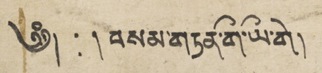
ITJ709 bsam gtan gi yi ge

The manuscript IOL Tib J 709 is a collection of nine Chan texts, starting off with the teachings of Moheyan himself, and continuing with the words of other Chan masters, including one with the Tibetan name Jangchub Luwang (byang chub klu dbang). Most interesting of all is the very last text in the collection, called The Chan Document (bsam gtan gi yi ge). The first line of this text says that “it appeared under the neck seal of the Divine Emperor Trisong Detsen.” Considering that Chan is supposed to have been banned by this very emperor, what are we to think of this?

Well, we know a little bit about the “neck seal”. Another Dunhuang manuscript (IOL Tib J 506) describes “the neck seal of the Divine Son”, the Divine Son (lha sras) being another title for the emperor. Unlike ordinary seals, which featured a single image, the neck seal contained several images: a mountain, the sun and moon, the ocean, a banner and a swastika (g.yung drung). The name “neck-seal” may indicate that the seal hung round the neck of the emperor, and was therefore only used by the emperor himself. Therefore the suggestion is that The Chan Document (and the very name is suggestive of a royal edict) was written under the personal authority of the king.

ITJ709 mgur gi phyag rgya

So, what can we say about the nature of these Chan teachings that had the approval of the Tibetan emperor?

Like several other Tibetan Chan texts, The Chan Document calls its teachings “the great yoga” or Mahāyoga, which just happens to be the name of a class of tantric scripture and practice that was very popular at Dunhuang. This is really quite strange, and could mean several things. Ken Eastman wrote that these texts must have been written by “members of a Chan lineage who were attempting to disguise their teachings with the name of Mahāyoga.” But this seems unlikely, as there is no other attempt to disguise that these are Chan teachings from China. This particular collection of Chan texts even includes a Tibetan-Chinese glossary of Chan terminology. I have argued, in an article written with Jacob Dalton, that some practitioners in Sino-Tibetan areas like Dunhuang actually combined the techniques of tantric Mahāyoga and Chan. There is evidence for that in certain manuscripts, though not in the one we’re looking at here. Here Mahāyoga, “the great yoga”, really does just seem to be another name for Chan.

One striking thing about the kind of Chan that appears under the king’s approval is that it is not the radical Chan that advocates only one method: non-conceptualization. As it says in the last line, “simultaneously blocking [concepts] with a single antidote will not be helpful.” There seems to have been a debate within Tibetan Chan between those who advocated the single antidote of non-conceptualization and those who employed a variety of practices. Another text in the same collection (IOL Tib J 709/4) states argues that Chan can include many different methods: “While doctors may use various methods depending on the illness, the science [of medicine] remains the same.” This debate reflects the situation within Chinese Chan in the eighth century, when the master Shenhui was attacking the notions of many methods and gradual realization. Over the following centuries the single method and sudden realization became Chan orthodoxy in China and Japan.

So, if The Chan Document really was personally authorised by Trisong Detsen, we can say that he supported the version of Chan that allowed for a variety of methods. This authorized Tibetan Chan would of course be much more open to accepting the Buddhist practices taught by other schools, including the teachers of Indian scholastic Buddhism. It is not the kind of Chan presented by Moheyan in the stories of the Samyé debate, but it is much closer to the Chan taught by the real Moheyan (this we can see from other manuscripts containing Moheyan’s teachings, which have been discussed in the articles by Katsumi and Gomez referenced below).

Even if we accept if that The Chan Document really was personally authorised by Trisong Detsen, some important questions remain. Did Trisong Detsen authorise The Chan Document before or after the Samyé Debate? Or was there really no debate as such, just a series of royal consultations and edicts on what was acceptable or otherwise in the Chan teachings? In any case, The Chan Document may be our most important piece of evidence for the Tibetan emperor’s interest and involvement with the teachings of Chan.
ITJ709 flower


References
1. Eastman, Kenneth M. 1983. “Mahāyoga Texts at Tun-huang” in Bulletin of Institute of Buddhist Cultural Studies (Ryukoku University) 22: 42–60.
1. Gomez, Luis O. 1983.”The Direct and Gradual Approaches of Zen Master Mahāyāna: Fragments of the Teachings of Moheyan” in Gimello, Robert M. and Peter N. Gregory (eds), Studies in Chan and Hua-yen. Honolulu: University of Hawaii Press: 393–434.
2. Katsumi, Okimoto. 1977. “bSam yas no shūron (3), nishu no makaen ibun [The Religious Debate of bSam yas (3), Two Writings by Moheyan]” in Nihon chibetto gakkai kaihō 23: 5–8.
3. Kimura, Ryūtoku. 1976. “Tonkō shutsudo chibetto bun shahon Stein 709 [The Dunhuang Tibetan Manuscript Stein 709]” in Nihon chibetto gakkai kaihō 22: 11-13.
4. Ueyama, Daishun. 1983 “The Study of Tibetan Ch’an Manuscripts Recovered From Tun-huang: A Review of the Field and its Prospects” in Lai, Whalen and Lancaster, Lewis (eds), Early Ch’an in China and Tibet. Berkeley: Berkeley Buddhist Studies Series. 327–349.
5. van Schaik, Sam and Jacob Dalton. 2004. “Where Chan and Tantra Meet: Buddhist Syncretism in Dunhuang” in Susan Whitfield (ed), The Silk Road: Trade, Travel, War and Faith. London: British Library Press. 61–71.

Tibetan sources
Anonymous. Dba bzhed [Accounts of Ba]. In Wangdu, Pasang & Hildegarde Deimberger. Dba’ bzhed: The Royal Narrative concerning the bringing of Buddha’s Doctrine to Tibet. Vienna: Verlag der Österreichischen Akademie der Wissenschaften.

Also in this series:
Tibetan Chan II: the teachings of Heshang Moheyan
Tibetan Chan III: more teachings of Heshang Moheyan
Dharma from the sky II: Indian or Chinese dharma?

Red sky

In the last post we looked at the story of the earliest appearance of the dharma in Tibet. According to the story, a casket fell out of the sky onto the roof (or before the feet) of the early king Lhatotori. What Lhatotori found when he opened the casket differs in the various accounts, but is usually includes a well-known sutra, the Karaṇḍavyūha. This sutra is dedicated to the bodhisattva Avalokiteśvara, the embodiment of compassion in the world, and introduced the six syllable mantra of Avalokiteśvara that was to become so popular in Tibet: Om maṇi padme huṃ (see my earlier post).

The casket is usually also said to include a more obscure text which is known by a strange variety of names. In the later histories, and the canonical versions of the prayer, the name of the prayer is the fully Tibetan Spang skong phyag brgya pa (The 100 Salutations Repairing Breaches). However in earlier histories like Sönam Tsemo’s Introduction to the Dharma, Butön’s Dharma History and the Maṇi Kambum the name of the prayer is Pang kong phyag rgya pa (The Pangkong Mūdras). Here the first two syllables appear not to be Tibetan, but rather approximations of syllables from another language. Some other early histories, including Nyangral Nyima Özer’s Essence of Flowers and the Accounts of Ba give yet another name: Mu tra’i phyag rgya (The Mūdras of the Mūdras!).

The text itself as preserved in the Tibetan canon is a prayer of homage and confession beginning with a hundred and eight homages directed toward a variety of buddhas, dharma texts and objects, and the sangha of bodhisattvas and arhats. It ends with prayers of offering, confession, and aspiration. This is not an unusual sort of text, so why has it been called by so many different names?

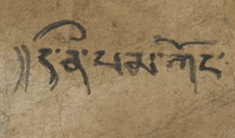
IOL Tib J 315

Thankfully we can make sense of this confused situation with the help of the Dunhuang manuscripts, for this prayer seems to have been rather popular before the 11th century. It usually appears in manuscipt collections of prayers that were probably put together for group recitation in monasteries. The fullest title given in the Dunhuang versions is Pam kong brgya rtsa brgyad (IOL Tib J 315.1/4). In other versions it is shortened to Pām kong brgya rtsa (Pelliot tibétain 184) and simply Pang kong (Pelliot tibétain 98).

The first part (pam/pang kong) is certainly a transcription, and it sounds much more like a transcription of a Chinese term than a Sanskrit one. The kong is very likely Chinese gong 供 which in Buddhist Chinese means an act of worship or offering, equivalent to the Sanskrit pūja. I have not found such a clear match for the pam/pang part, but one possibility is ban 昄, meaning ‘extensive’.

The Tibetan part of the title in the Dunhuang manuscript (brgya rtsa brgyad) means ‘one hundred and eight’, which makes perfect sense in that the prayer contains a hundred and eight homages. Therefore the alteration of this in the histories and canonical versions to phyag (b)rgya pa looks like a corruption.

It appears that the other strange version of this title, Mu tra’i phyag rgya (The Mūdras of the Mūdras), was an attempt to make the text seem more Indian and less Chinese by replacing the pang kong part with the Sanskrit word mūdra. But since that word mūdra was just a translation of the (already corrupted) second part of the title, the result was not at all convincing.

The most convincing early title of our text (Pam kong brgya rtsa brgyad) suggests a text either translated from Chinese, or composed in a Sino-Tibetan culture like that of Dunhuang. If we can draw a moral from this little philological enquiry, it may be that the presence of a Chinese text along with more well-known Indian ones in Lhatotori’s casket is emblematic of the mixed sources from which early Tibetan Buddhism was made. While Chinese Buddhist sources never truly featured as importantly as Indian ones, they were there, and China was certainly not spurned as a source of authentic dharma before the 11th century (notwithstanding a certain debate at Samyé), as it often would be later.

See also
Dharma from the Sky I: Legends and history
Dharma from the Sky III: Self-appointed Buddhas

Tibetan sources
1. Anonymous. Dba bzhed [Accounts of Ba]. In Wangdu, Pasang & Hildegarde Deimberger. Dba’ bzhed: The Royal Narrative concerning the bringing of Buddha’s Doctrine to Tibet. Vienna: Verlag der Österreichischen Akademie der Wissenschaften. [p.25]
2. Anonymous. Ma ṇi bka’ ‘bum [Maṇi Kambum]. The Punakha redaction edited by Jamyang Samten. New Delhi, 1975. [vol.I (e), ff.100b.3, 184a.3]
3. Bsod nams rtse mo. Chos la ‘jug pa’i sgo [An Introduction to the Dharma]. In Sa skya bka’ ‘bum. [vol.I, p.50a.6]
4. Bu ston rin chen grub. Chos ‘byung gsun rab rin po che mdzod [History of Buddhism]. Beijing: Khrung go bod kyi shes rig dpe skrun khang. 1988. Translation in Obermiller, E. 1931-2. The history of Buddhism (Chos ḥbyung) by Bu-ston. I The Jewellery of Scripture, II The history of Buddhism in India and Tibet. Heidelberg: O. Harrosovitz. Reprint 1986 New Delhi: Sri Satguru Publications. [p.183]
5. Nyang ral nyi ma ‘od zer. Chos byung me tog snying po sbrang rtsi’i bcud [Essence of Flowers]. In Schuh, Dieter. Die grosse Geschichte des tibetischen Buddhismus nach alter Tradition rÑiṅ ma’i chos byuṅ chen mo. Sankt Augustin: VGH Wissenschaftsverlag. [f.173b.4]

And many thanks…

Blogisattva Awards 2008To the organizers and jurors of the 2008 Blogisattva Awards, who awarded this post and the one that precedes it “Best Multi-Part Blog Post”!

Dharma from the sky I: Legends and history

Blue sky

We ‘modern’ historians are inclined to place much of the material that makes up traditional Tibetan histories into the category of legend. We might want to explore the possibility that actual historical occurrences may lie behind the legends. On the other hand we may want to argue that the legends should be treated as valid in their own right, as part of the construction of Tibetan historical identity (perhaps in this case we might think of ourselves as ‘post-modern’ historians). Rather than pursuing that particular argument here, I want to suggest that ‘traditional’ Tibetan historians did not themselves accept all of the legendary material that was handed down to them in their own historical tradition. Indeed the debate about how appropriate it might be to apply the principles of rational thought to these legends existed in Tibet for centuries.

A case in point is the story of the first appearance of Buddhism in Tibet, a story that goes back at least as far as the Pillar Testament (i.e. 11th-12th centuries). The story is that a casket containing Buddhist books fell from the sky and landed on the roof of the Tibetan royal palace. This was during the reign of King Lhatotori, who is said to have ruled five generations before the first historically dated Tibetan king, Songtsen Gampo, which would take us back to the fifth century (though the traditional histories date him much earlier). Neither the king nor anyone else in Tibet was able to read these heaven-sent texts. The king resealed the casket and gave it a name, the Secret Potency (gnyan po gsang ba). The casket then remained untouched in the palace until it was reopened by Songtsen Gampo, so that the texts could be translated.

Now, there was an argument between Tibetan historians about whether this story of the books falling from the sky was a historical fact. The opinion that it was not was put forth by the 13th-century Tibetan scholar Nelpa Paṇḍita. He argued that the books, rather than falling from he sky, were brought to Tibet by an Indian scholar and a Khotanese translator. According to Nelpa Paṇḍita, when the two men presented the King Lhatotori with the books, they discovered that he could neither read them nor understand their meaning. Realizing the futility of their mission, they returned to from whence they came. Nelpa Paṇḍita suggests that the story about the casket falling from the skies was simply made up by the Bönpos (the pre-Buddhist religious of Tibet) based on their reverence for the sky.

Although this alternative account never replaced the story of the books falling from the sky, many later Tibetan histories gave both versions. However, the Fifth Dalai Lama, for one, clearly felt that the original version of the story ought to be defended. In his 17th-century work Song of the Spring Queen he launched a highly personal criticism against Nelpa Paṇḍita, and defended the original legend:

Nelpa Paṇḍita’s belief that it is absurd for a casket to fall from the sky is proof of his stupidity. In the auspicious circumstances in which the teachings were first discovered, the magical activities and compassion of noble individuals go beyond thought.

It is interesting to see that the Great Fifth (as he was often known) specifically defends the irrationality of the story. What is at stake is clearly whether one should depend primarily on rational “thought” (Tib. bsam) in assessing historical accounts, in particular those accounts which treat of the foundations of Tibetan Buddhism.

From the point of view of rational thought, Nelpa Paṇḍita’s version of the story is quite credible. If the kingdoms of Central Tibet did have any contact with Buddhism and Buddhist texts before the expansions of the 7th century, it would have been through the agency of individuals making the journey to Tibet from neighbouring Buddhist regions. Some of these individuals, whether merchants or missionaries, may have brought books with them. This is the opinion of the 20th-century Tibetan historian W.D. Shakabpa, who in his Tibet: A Political History favours Nelpa Paṇḍita’s version of the story. In his opinion, the king told his ministers that the books had fallen from the sky because he didn’t want them to know that they had come from India.

In any case, I think this shows that the debate about the role of rationality in assessing historical facts is very much a part of the Tibetan historical tradition. It’s also clear that the historian who wonders what real occurrences might lie behind historical legend is not a creature found only in our ‘modern’ historiography.

See also
Dharma from the Sky II: Indian or Chinese dharma?
Dharma from the Sky III: Self-appointed Buddhas

References
Shakabpa, Tsepon W.D. 1967. Tibet: A Political History. New Haven: Yale University Press. [pp.24-25]

Tibetan sources
1. Bka’ chems ka khol ma [The Pillar Testament]. Kan su’i mi rigs dpe skrun khang. 1989. [p.91]
2. Ngag dbang blo bzang rgya mtsho (The Fifth Dalai Lama). Dpyid kyi rgyal mo’i glu dbyangs [Song of the Spring Queen]. Available as THDL e-text. [section 3.2]
3. Nel pa paṇḍita / Helga Uebach. Nel-pa Paṇḍita’s Chronik Me-tog Phreṅ-wa: Handschrift der Liberary of Tibetan Works and Archives, Tibetischer Text in Faksimile, Transkription und Übersetzung. Munich: Kommission für Zentralasiatische Studien, Bayerische Akademie der Wissenschaften, 1987. [folios 7a4–7b3]

And many thanks…

Blogisattva Awards 2008To the organizers and jurors of the 2008 Blogisattva Awards, who awarded this post and the one that follows it “Best Multi-Part Blog Post”!

Buddhism and Empire I: a soldier’s prayer

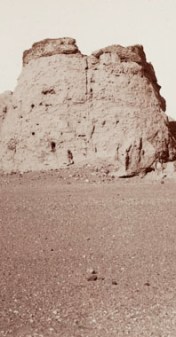
Miran fort Most of the sources we use to study Tibetan Buddhism during the time of the Tibetan empire are officially sanctioned: translations, royal edicts, monastic library lists and the the like. There are far fewer sources revealing how Buddhism was practised by ordinary Tibetans during the empire. Here is one such source: a soldier’s document from the Tibetan fort of Miran (Tibetan name: Nob chung) on the edge of the Lopnor desert.

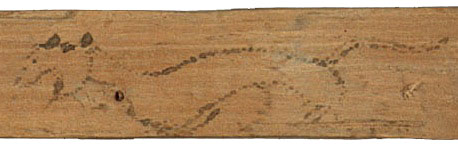
Tibetan soldiers in Central Asia used wooden documents as much as paper ones. Wood was used for baggage tags, requisition notes, even for short letters. Usually these documents are small rectangular pieces of wood which we call woodslips. In some rare cases, we also find Buddhist texts on these woodslips. The one pictured here (IOL Tib N 404) contains a prayer and a brief dhāraṇī spell of the deity Uṣṇiṣasitātapatra.

The first thing scribbled on the woodslip is a prayer for refuge to the three jewels, with particular reference to avoiding hell (na rag). Then Uṣṇiṣasitātapatra is mentioned, followed by a short version of one of her dhāraṇī spells.

IOL Tib J 404

The role of dhāraṇīs in the popularization of Buddhism in Tibet is rarely mentioned, but they were hugely popular in the early period. The Dunhuang collections contain at least 40 manuscript copies of the Uṣṇiṣasitātapatra dhāraṇī alone. Perhaps we should say a little more about what a dhāraṇī is. Somewhat confusingly, the word can refer to two things:

  1. Dhāraṇī spells: a sequence of Sanskrit syllables, akin to a mantra, but usually longer; in fact dhāraṇī spells can be several pages long.
  2. Dhāraṇī sūtras: scriptural texts presenting one or more dhāraṇī spells. These usually set out the background of the spell—how and why it was taught by the Buddha—and explain the uses of the spell, which is usually to guard against various calamities, from illness to demons, enemies, death and rebirth in hell.

Sometimes, as with this woodslip, the spell was copied without the sūtra, presumably so that it could be carried around and recited when needed. Considering the many uses of dhāraṇī spells, it’s not surprising that soldiers of the Tibetan empire might have carried spells around with them for their protective properties. Of course, many would have memorized the spells, and this woodslip may have served more as an aide-memoire than a permanent record.

Finally, it’s worth turning over this particular woodslip, as the other side contains a charming picture of an animal. The species is a little hard to make out: a tiger, a dog or perhaps the ubiquitous marmot, found scampering throughout Central Asia? Suggestions please…

IOL Tib J 404 verso