The red-faced men III: The red-faced women

Nomad woman

Sometimes it’s good to be wrong. It can make the questions you were asking more interesting. In the last two posts I’ve been discussing the characterization of the early Tibetans as ‘the red-faced men’. Although the Tibetan term itself (gdong dmar can) does not specify a gender, I have been using the masculine noun. My reasoning was that the term as we find it in the original Khotanese texts derived from encounters with the Tibetan army, so I came to the conclusion that the red face decoration was applied primarily by soldiers going into battle. So much for ‘the red-faced men’.

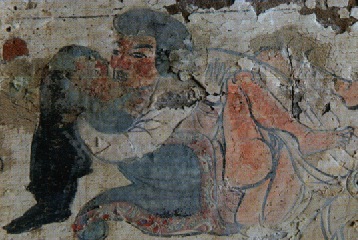
In fact, recent archaeological evidence that I have only just now become aware of (thanks to Kazushi Iwao) clearly shows that red face decoration was worn in civilian life, and by women as well as men. In 2002, the archeaologist Xu Xinguo excavated tombs in Guolimu, a village near Delingha in Qinghai Provice (Amdo), and discovered two beautifully painted coffin boards. The wooden boards, which are believed to date from the time of the Tibetan Empire, were painted with numerous scenes from everyday life, including hunting, oath-taking and funeral rites. Many of the people featured in the painting, both men and women, have faces decorated with red.
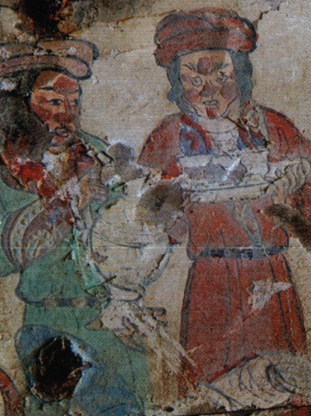
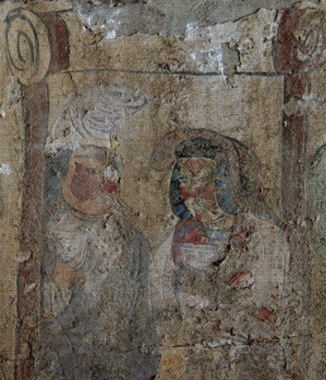
From Wenwu 2006.7 (3)

From Wenwu 2006.7 (2)

The people depicted here are probably the Azha, who were brought into the Tibetan Empire in the 7th century. But this red face painting was not just an Azha tradition; we know that it was practised in the Tibetan court itself. The Chinese Tang Annals say that Princess Wencheng, who came to marry the Tibetan King Songtsen Gampo in the 7th century, introduced various new customs to the Tibetan court (which is portrayed by the Chinese historians, not entirely fairly, as quite uncivilized). One of her innovations was to stop the Tibetans from painting their faces red.

As the princess disliked their custom of painting their faces red, Songtsen ordered his people to put a stop to the practice, and it was no longer done. He also discarded his felt and skins, put on brocade and silk, and gradually copied Chinese civilization.

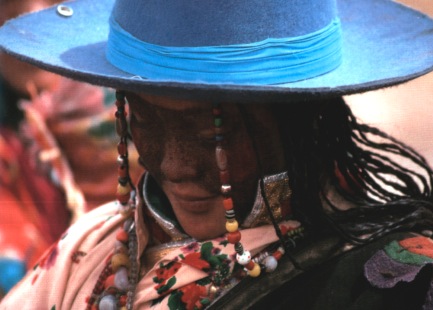
It may well be that the practice originated in the nomadic tribes of the northeast and western Tibet, and was later adapted by the Central Tibetans. Amazingly, even today a similar custom of red face painting is practised by the nomads of western Tibet. Here it is only the women who paint their faces, using a preparation made from boiled whey. The pictures here were taken by Melvyn Goldstein and Cynthia Beall, who lived with the nomads of the Changtang region for over a year from 1986-88. Goldstein and Beall observed that while nomads said that the red face makeup was used to protect the skin from sunburn, it was only used by younger women and particularly when they wanted to look good. Thus it was primarily decorative. The patterns of decoration used by these women are strikingly similar to those depicted on the ancient coffin covers.
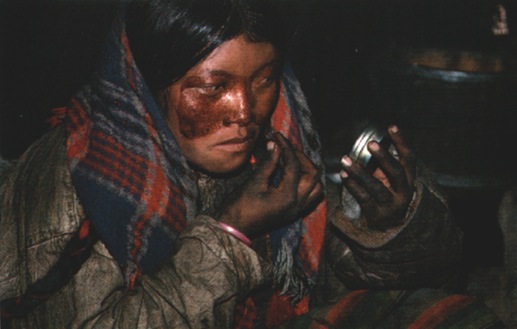
Nomad woman applying red face makeup

So it seems that the practice of red face painting (by men and women) might have originated in Tibet’s northeast and west, and then been adopted by the early Tibetans, who later abandoned it during or after the Imperial period. Some of the western nomads, however, preserved the custom, although only among women.

And so it is simply incorrect to translate the Tibetan term gdong dmar can as ‘the red-faced men’. I should, and from now on will, use ‘the red-faced people’ or ‘the red-faced ones’. Being wrong can indeed be very interesting!

*  *  *

See also
The Red-Faced Men I: warriors with painted faces
The Red-faced Men II: China or Tibet?

References
1. Bushell, S.W. 1880. “The Early History of Tibet: From Chinese Sources”. Journal of the Royal Asiatic Society 1880: 435-535. [p.445]
2. China Heritage Project. 2005. “New Discoveries in Qinghai”. China Heritage Newsletter 1 (online journal).
3. Goldstein, Melvyn and Cynthia Beall. 1990. Nomads of Western Tibet: The Survival of a Way of Life. London: Serindia Publications.
4. Luo Shiping. 2006. “A Research about the Drawing on the Coffin Board of Tubo located at Guolimu, Haixi, Qinghai Province”. Wenwu 2006.7: 68-82.
5. Yong-xian Li. 2006. “Rediscussion on the Bod-Tibetan Zhemian Custom”. Bulletin of the Department of Ethnology 25: 21-39.

Images
1. Pictures of nomad women from Goldstein and Beall 1990: 57, 89.
2. Details from the Guolimu coffin boards from Luo Shiping 2006.
The red-faced men II: China or Tibet?

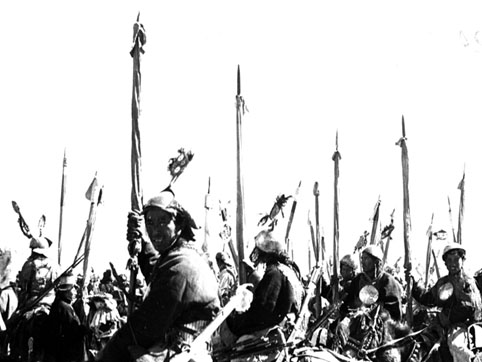
Tibetan warriors

In the illuminating discussion which followed my last post, it transpired that I was not quite correct in saying that Tibetans have always understood “the land of the red-faced men” to be Tibet (thank you, ‘Dab’). In fact no less an authority than the great historian Büton (1290-1364) suggested that in one particular source it referred China:

In the Accounts of Ba it is said that the land of the red-faced men is China.

Well, the Accounts of Ba is one of our oldest Tibetan histories, and we should pay attention to what it says. When we look into the Accounts of Ba we do indeed find a mention of a prophecy about Buddhism coming to the land of the red-faced men. A version of this story appears in both the Accounts of Ba as published by Gönpo Gyaltsen in 1980 (Sba bzhed) and the older version published by Pasang Wangdu and Hildegarde Diemberger in 2000 (Dba bzhed).

Let’s look at the oldest version of the story. While Trisong Detsen is still young and has yet to establish Buddhism in Tibet, two members of the Ba clan, Ba Selnang and Ba Sangshi, are sent to China to receive dharma texts from the Chinese emperor (this is before the invitation of Śāntarakṣita and Padmasambhava to Tibet). While they are travelling, an astrological expert in Bumsang predicts their arrival and identifies them as bodhisattvas. So by the time Ba Selnang and Ba Sangshi arrive at the Chinese court, the rumour that they are bodhisattvas has preceded them, and they get quite a reception. I quote from the Wangdu/Diemberger Accounts of Ba:

The Chinese emperor said [to Ba Selnang and Ba Sangshi]: “You are the two bodhisattvas who should have arrived at around this time according to the expert in astrological science in Bumsang. Even Kim Hashang prostrated to you. The Buddha prophesied that a spiritual master for the practice of the holy dharma would appear in a time close to the final 500 year [period of the dharma] in the land of the red-faced men. According to your behavior, you are certainly the prophesied ones.”

It is possible to see from this passage what made Butön think that the land of the red-faced men was supposed to be China. There is some ambiguity about whether the emperor is linking the prophecy to Ba Selnang and Ba Sangshi’s appearance in Tibet or to their arrival in China. I would certainly argue that the former was intended rather than the latter. Fortunately I can draw on the support of another great Tibetan historian here.

Pawo Tsuglag Trengwa (1504-1564/6) was the author of the most important Tibetan historical work yet to be translated into English: A Scholar’s Feast (Mkhas pa’i dga’ ston). As a historian, Pawo was notable for his critical approach to his sources and his use of neglected and early source material. Rather than just accept Butön’s statement, he went back to look at the Accounts of Ba, and this was his conclusion:

According to the all-knowing Butön, the Accounts of Ba state that the country of the red-faced men is China. But in the Accounts of Ba it is said that when Ba Selnang and Ba Sangshi were sent to China to receive the dharma, an expert in divination said: “Emanations of bodhisattvas looking like this will come as messengers,” and he drew a picture. So when [Ba Selnang and Ba Sangshi] arrived they were given a great reception by the [Chinese] emperor. [The emperor] said, “There is a prophecy that a bodhisattva will appear in the land of the red-faced men who will be a source of the dharma. I am certain that it is you,” and he gave them 1,000 volumes of dharma. So it is very clear that the land of the red-faced men is indeed Tibet.

* * *

See also
The Red-Faced Men I: warriors with painted faces
The Red-faced Men III: the red-faced women

References
1. Obermiller, E. 1931-2. The history of Buddhism (Chos ḥbyung) by Bu-ston. I The Jewellery of Scripture, II The history of Buddhism in India and Tibet. Heidelberg: O. Harrosovitz. Reprint 1986 New Delhi: Sri Satguru Publications. [p.108]
2. Wangdu, Pasang & Hildegarde Deimberger. Dba’ bzhed: The Royal Narrative concerning the bringing of Buddha’s Doctrine to Tibet. Vienna: Verlag der Österreichischen Akademie der Wissenschaften. [pp.48-50]

Tibetan sources

1. Bu ston rin chen grub. Chos ‘byung gsun rab rin po che mdzod [History of Buddhism]. Beijing: Khrung go bod kyi shes rig dpe skrun khang. 1988.
2. Dpa’ bo gtsug lag ‘phreng ba. Chos ‘byung mkhas pa’i dga’ ston [A Scholar’s Feast]. Varanasi: Vajra Vidya Library. 2003. [pp.167-8]
3. Sba bzhed [The Accounts of Ba]. Mgon po rgyal mtshan (ed.). Mi rigs dpe skrun khang. 1980, 1982. [p.7]