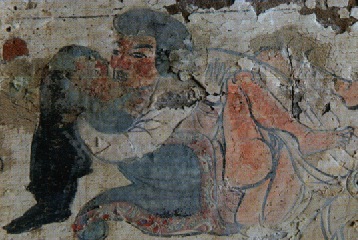
According to traditional Tibetan history, the Tibetan Empire collapsed as a result of a chain of events that started with a persecution of Buddhism by the king Lang Darma. The story is that Lang Darma ordered that all the monasteries be closed, and that all monks should disrobe. One monk, a Lhalung Palgyi Dorjé, took it upon himself to prevent the dharma from being entirely effaced from Tibet by assassinating the emperor. The story is nicely told in Shakabpa’s Political History:
Lhalung Palgye Dorje set out for Lhasa, wearing a black hat and a black cloak with a white lining. He smeared charcoal on his white horse and concealed his bow and arrow in the long, flowing sleeves of his cloak. When he reached Lhasa he left his horse tied near a chorten (stupa) on the banks of the river and walked into the city. He found King Lang Darma ang his courtiers reading the inscription of the treaty-pillar located in front of the Jokhang Temple. Prostrating himself before the King, the monk freed his bow and arrow without being detected and then, standing up, he fired an arrow straight at the King’s heart. While the King was in his death throes and the people around him thrown into confusion, Lhalung escaped to the river bank. Mounting his horse, he forced it to swim across the river to wash the charcoal away and then, reversing his cloak so only the white lining showed, he returned to Yerpa by a devious route.
At Lang Darma’s death, it was vital to appoint the next king, but there were two claimants to that position. Both claimants had their own supporting factions, which led to more instability. Fighting between the two factions led to an even greater catastrophe–a uprising against the imperial cult itself. The royal tombs were sacked, Central Tibet descended into chaos, and the outer territories fragmented into independent kingdoms. The Tibetan Empire, which had achieved much in its few centuries of existence, had come to and end. Lang Darma is blamed for this chain of events, and has become one of the great villians of Tibetan history, and of Tibetan popular culture too, as Shakabpa points out:
A number of folk tales have since sprung up about Lang Darma. He was supposed to have had horns on his head and a black tongue. To hide his horns, he arranged his hair in two plaits, tied in a raised knot on either side. No one supposedly knew this at the time, unless it was his hairdresser. It is said that this is the origin of the practice for the Tibetan lay officials to plait their hair in this manner. It is also said that some Tibetans, when they scratch their heads and put out their tongues on meeting high-ranking persons, do so to show that they have neither horns nor black tongues.
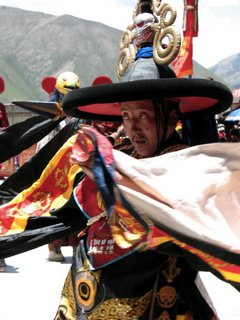
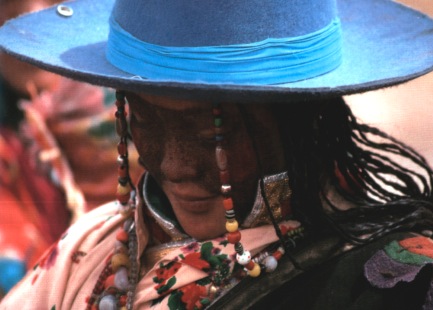
These stories and customs are fun, and the traditional dances based on them are impressive (see the picture below). But some modern scholars have wondered whether Lang Darma really persecuted Buddhism at all. Some have suggested that rather than persecuting Buddhism, Lang Darma simply reduced government support to the monasteries as his empire became financially overstretched. At least one has argued that the whole story of the assassination is a later fabrication. The most thoroughgoing attempt to overturn the traditional story has been made by the Japanese Tibetologist Zuihō Yamaguchi. His rather brilliant article has a complicated argument, relying much on the Chinese historical sources which do not mention any assassination. For now let’s just look at one interesting aspect of Yamaguchi’s argument: his contention that Lang Darma was in fact a fervent Buddhist.
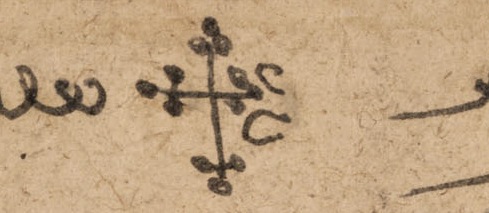
 Yamaguchi uses a Dunhuang manuscript, Pelliot tibétain 134, as evidence that Lang Darma was really a Buddhist. The manuscript contains an aspirational prayer (mönlam) for the king upon his accession to the throne of the Tibetan Empire. According to Yamaguchi, the prayer states that Lang Darma has already made many offerings to the sangha, is particularly devoted to the Prajñāpāramitā sutra.
I think in some cases Yamaguchi’s translation seems to be stretched to show that Lang Darma was already an active Buddhist before he became king. When we look at the original manuscript, there are indeed many references to good Buddhist deeds, deeds that it is hoped Lang Darma will carry out during his kingship, but nothing clearly showing that he has already carried them out. For example, Yamaguchi translates one passage like this:
May the fact that we worship and chant the sūtra that you yourself recited, the Prajñāpāramitā, lead to all living beings obtaining the teachings of the Mahāyāna and obtaining the seeds of enlightenment.
He takes this as evidence for Lang Darma’s devotion to the Prajñāpāramitā. But I believe the passage would be better translated like this:
May the offering and hearing of the sutras, the personal teachings [of the Buddha] such as the Prajñāpāramitā, lead to all existing living beings obtaining the teachings of the Mahāyāna and obtaining the seeds of enlightenment.
Readers of Tibetan can make their own judgement (see the Tibetan text at the end of this post) but as far as I can see there’s nothing here about the king having recited the sutra himself. The part that Yamaguchi translated as “that you yourself recited” (zhal nas gsungs) actually refers to the fact that the sutras are the teachings of the Buddha, as we see in other Dunhuang Buddhist texts (like IOL Tib J 66). So, this prayer looks to me like a reference to the traditional practice of Tibetan kings acting as patrons for the writing and recitation of sutras. It is after all an aspirational prayer, representing the aspirations of the Tibetan Buddhist sangha for the new king. It functions both as an expression of devotion to the new king and as a reminder of his duties as a good Buddhist king (chögyal).
Yamaguchi has more evidence: a reference in an old catalogue (the Pangtangma) to a treatise called Analysis of the Difficult Points of the Madhyamaka, written by a certain King Pal Dünten. Now, U Dünten is the real name of Lang Darma, which is really a kind of nickname. If the king really wrote a philosophical treatise on that most difficult of subjects, could he really have become a persecutor of Buddhism? Perhaps this really does clinch Yamaguchi’s argument for a Buddhist Lang Darma. Yet the attribution of Buddhist philosophical texts to kings is not quite convincing. Several such texts are attributed to Trisong Detsen too, but would he really have had the time to write them? Isn’t it more likely that such texts were ordered by the king, and ghostwritten by a scholar?
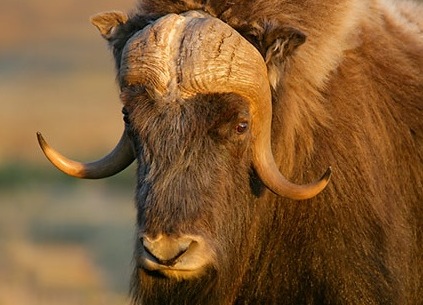
And what about the contemporary Chinese sources, like the Tang Annals, which describe Lang Darma as “fond of wine, enjoying hunting, amorous, brutal and cruel”? The first part of his nickname, Lang, means “ox” and is supposed to have described his ox-like build. This fits with the rather brutish character described in the Tang Annals. But the second part of the name, Darma, is an old Tibetan way of transcribing the word dharma. So the contradictory images of Lang Darma are right there in his name. Now I must end this post, still without an answer to the question with which it began.
* * *
References
1. Karmay, Samten G. 2003. “King Lang Darma and His Rule”. In Tibet and Her Neighbours: A History, ed. Alex McKay. London: Hansjörg Mayer: 57-66.
2. Petech, Luciano. 1994. “The Disintegration of the Tibetan Kingdom”. In Tibetan Studies, edited by Per Kværne. Oslo: The Institute for Comparative Research in Human Culture. 649–659.
3. Richardson, Hugh. 1971. “Who was Yum-brtan?” In Études tibétaines dédiées à la mémoire de Marcelle Lalou, edited by Ariane MacDonald. Paris. 433–43. Republished in High Peaks, Pure Earth, edited by Michael Aris. London: Serindia Publications.
4. Scherrer-Schaub, Cristina A. 2000. “Prières pour un apostat: fragments d’histoire Tibétaine”. Cahiers d’Extrême-Asie 11: 217-46.
5. Shakabpa, Tsepon W.D. 1967. A Political History of Tibet. New Haven: Yale University Press.
6. Yamaguchi, Zuihō. 1996. “The Fiction of King Dar-ma’s Persecution of Buddhism”. In Du Dunhuang au Japon: Études chinoises et bouddhiques offertes à Michel Soymié,edited by Jean-Pierre Drège: 231–58. Geneva: Droz.
Tibetan texts
Dkar chag ‘phang thang ma / Sgra sbyor bam po gnyis pa. Beijing: Mi rigs dpe skrun khang. 2003.
Manuscripts
Pelliot tibétain 134, ll. 39-40: zhal nas gsungs pa’I mdo sde/ shes rab gyI pha rol tu phyIn pa la stsogspa mchod cIng phlags pa yang srog cagso ‘tshal gyIs theg pa chen po’I chos thoste//byang chub kyI sa bon thob par gyur cIg/
And a note on Lang Darma’s name…
As mentioned above, Glang Dar ma is a nickname, and is not found in any of the pre-11th century documents (though he is known as Khri or Lha sras Dar ma). The king’s proper name was U’i dun/dum brtan, a rather unusual name which is confirmed by the Dunhuang manuscripts. As for the nickname Glang (“ox”), there are two possibilities, both found in Tibetan histories: (i) that it refers to the year of his birth, the ox year 809, or (ii) that it refers to his ox-like build. Since some of the earliest sources that use the name Glang for the king give his birthdate as 803 (not a year of the ox), Yamaguchi decided that the second option must be the correct one. As for Dar ma, we do find it in several Dunhuang manuscripts from the imperial period with the meaning of dharma or dharma text. According to Yamaguchi it can also mean “youth” but I haven’t seen this meaning attested in the Dunhuang texts.


 early Tibet