The red-faced men II: China or Tibet?

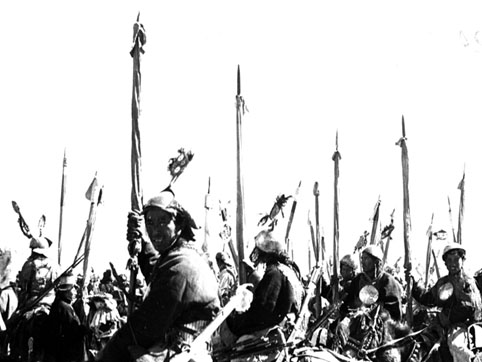
Tibetan warriors

In the illuminating discussion which followed my last post, it transpired that I was not quite correct in saying that Tibetans have always understood “the land of the red-faced men” to be Tibet (thank you, ‘Dab’). In fact no less an authority than the great historian Büton (1290-1364) suggested that in one particular source it referred China:

In the Accounts of Ba it is said that the land of the red-faced men is China.

Well, the Accounts of Ba is one of our oldest Tibetan histories, and we should pay attention to what it says. When we look into the Accounts of Ba we do indeed find a mention of a prophecy about Buddhism coming to the land of the red-faced men. A version of this story appears in both the Accounts of Ba as published by Gönpo Gyaltsen in 1980 (Sba bzhed) and the older version published by Pasang Wangdu and Hildegarde Diemberger in 2000 (Dba bzhed).

Let’s look at the oldest version of the story. While Trisong Detsen is still young and has yet to establish Buddhism in Tibet, two members of the Ba clan, Ba Selnang and Ba Sangshi, are sent to China to receive dharma texts from the Chinese emperor (this is before the invitation of Śāntarakṣita and Padmasambhava to Tibet). While they are travelling, an astrological expert in Bumsang predicts their arrival and identifies them as bodhisattvas. So by the time Ba Selnang and Ba Sangshi arrive at the Chinese court, the rumour that they are bodhisattvas has preceded them, and they get quite a reception. I quote from the Wangdu/Diemberger Accounts of Ba:

The Chinese emperor said [to Ba Selnang and Ba Sangshi]: “You are the two bodhisattvas who should have arrived at around this time according to the expert in astrological science in Bumsang. Even Kim Hashang prostrated to you. The Buddha prophesied that a spiritual master for the practice of the holy dharma would appear in a time close to the final 500 year [period of the dharma] in the land of the red-faced men. According to your behavior, you are certainly the prophesied ones.”

It is possible to see from this passage what made Butön think that the land of the red-faced men was supposed to be China. There is some ambiguity about whether the emperor is linking the prophecy to Ba Selnang and Ba Sangshi’s appearance in Tibet or to their arrival in China. I would certainly argue that the former was intended rather than the latter. Fortunately I can draw on the support of another great Tibetan historian here.

Pawo Tsuglag Trengwa (1504-1564/6) was the author of the most important Tibetan historical work yet to be translated into English: A Scholar’s Feast (Mkhas pa’i dga’ ston). As a historian, Pawo was notable for his critical approach to his sources and his use of neglected and early source material. Rather than just accept Butön’s statement, he went back to look at the Accounts of Ba, and this was his conclusion:

According to the all-knowing Butön, the Accounts of Ba state that the country of the red-faced men is China. But in the Accounts of Ba it is said that when Ba Selnang and Ba Sangshi were sent to China to receive the dharma, an expert in divination said: “Emanations of bodhisattvas looking like this will come as messengers,” and he drew a picture. So when [Ba Selnang and Ba Sangshi] arrived they were given a great reception by the [Chinese] emperor. [The emperor] said, “There is a prophecy that a bodhisattva will appear in the land of the red-faced men who will be a source of the dharma. I am certain that it is you,” and he gave them 1,000 volumes of dharma. So it is very clear that the land of the red-faced men is indeed Tibet.

* * *

See also
The Red-Faced Men I: warriors with painted faces
The Red-faced Men III: the red-faced women

References
1. Obermiller, E. 1931-2. The history of Buddhism (Chos ḥbyung) by Bu-ston. I The Jewellery of Scripture, II The history of Buddhism in India and Tibet. Heidelberg: O. Harrosovitz. Reprint 1986 New Delhi: Sri Satguru Publications. [p.108]
2. Wangdu, Pasang & Hildegarde Deimberger. Dba’ bzhed: The Royal Narrative concerning the bringing of Buddha’s Doctrine to Tibet. Vienna: Verlag der Österreichischen Akademie der Wissenschaften. [pp.48-50]

Tibetan sources

1. Bu ston rin chen grub. Chos ‘byung gsun rab rin po che mdzod [History of Buddhism]. Beijing: Khrung go bod kyi shes rig dpe skrun khang. 1988.
2. Dpa’ bo gtsug lag ‘phreng ba. Chos ‘byung mkhas pa’i dga’ ston [A Scholar’s Feast]. Varanasi: Vajra Vidya Library. 2003. [pp.167-8]
3. Sba bzhed [The Accounts of Ba]. Mgon po rgyal mtshan (ed.). Mi rigs dpe skrun khang. 1980, 1982. [p.7]
The red-faced men I: Warriors with painted faces

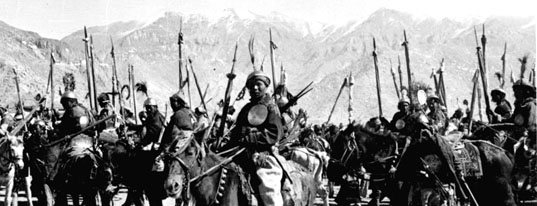
Tibetan mounted warriors

Tibetan histories present the Tibetans before their conversion to Buddhism as violent and unlearned, without writing, law or the civilizing effect of the dharma, and possessing a number of unsavoury customs, including blood sacrifices and painting their faces red with ochre or vermilion. The description of the Tibetans as ‘red-faced men’ came to be a signifier of all of this pre-Buddhist barbarity, and of the civilizing effects of Buddhism. In the early 10th century Nub Sangye Yeshe wrote of early Tibet: “These kingdoms at the borderlands, these lands of the Tibetans, the red-faced barbarians.” A couple of centuries later the Sakya patriarch Sönam Tsemo quoted the following prophecy (spoken by the Buddha) in his history of the dharma:

“Two thousand five hundred years after my parinirvāṇa, the true dharma will be propagated in the land of the red-faced men.”

In Sönam Tsemo’s time, the date of the Buddha’s passing was thought to be around 2130 BC, which is indeed around 2,500 years before the introduction of Buddhism to Tibet in the mid-7th century. After Sönam Tsemo this prophecy continued to appear in many Tibetan histories. So, where did this characterization of the early Tibetans as ‘red-faced men’ come from? If the Tibetans did have the custom of painting their faces with ochre or vermilion before going into battle, then the first impression that their enemies—such as the Central Asian kingdoms—formed of these newcomers would have been of terrifying ‘red-faced men’.

As for the prophecy, Sönam Tsemo said that it was from a scripture called The Enquiry of the Goddess Vimala. Now this surely must be the same text as the one found in the Tibetan canon called The Enquiry of Vimalaprabhā, a Khotanese text that was translated into Tibetan. Cast in the form of a prophecy, it deals with the fears of the Khotanese Buddhists under the onslaught of the Tibetan war machine in the 7th century, and their hopes for a saviour. (FW Thomas whimsically suggested that the The Enquiry of Vimalaprabhā was the Khotanese Romance of its age and that its heroine was Khotan’s Joan of Arc!) The prophecy about the dharma being propagated in the land of the red-faced men does not in fact appear here, but the Tibetan warriors are constantly referred to as ‘red-faced men’.

It does then seem that we have the Khotanese to thank for the enduring image of the early Tibetans as ‘red-faced men’. This is only one instance of the cultural influence of Khotan upon Tibet, an influence that was later almost entirely forgotten by the Tibetans themselves. After the 10th century Khotan became part of the Islamic world, and its influence on Tibetan Buddhism ended. The Tibetans gradually forgot even the location of the place called Khotan (or rather Liyül in Tibetan), often confusing it with distant Nepal. In an odd parallel, many later Islamic geographies seem to have confused the location of Tibet with Khotan.

As a postscript to this discussion, I couldn’t ignore the much-quoted prophecy attributed to Padmasambhava which also speaks of Buddhism coming to the ‘red-faced men’, often interpreted uncritically as a reference to Native Americans:

When the iron bird flies and horses run on wheels the Tibetan people will be scattered like ants across the face of the world, and the dharma will come to the land of the red-faced man.

I have never seen a reliable reference to the source of this prophecy (presumably it ought to be from a treasure text) and I’d be happy to be put right if anybody is able to point out a source. However, even if there is something like this prophecy in a genuine Tibetan source it should be pointed out that Tibetans would always have understood the phrase ‘red-faced men’ to refer to themselves.

*  *  *

See also
The Red-faced Men II: China or Tibet?
The Red-faced Men III: the red-faced women

References
1. Thomas, F.W. 1935. Tibetan Literary Texts and Documents, Part I: Literary texts. London: Royal Asiatic Society.
2. Vogel, Claus. 1991. “Bu-ston on the date of the Buddha’s Nirvana. Translated from his History of the Doctrine (Chos-‘byung). In The Dating of the Historical Buddha. Göttingen: Vandenhoeck and Ruprecht.

Tibetan Sources
1. Dri ma med pa’i ‘od kyis zhus pa [The Enquiry of Vimalaprabhā]. Q.835.
2. Gnubs sangs rgyas ye shes. Bsam gtan mig sgron / Rnal ‘byor mig gi bsam gtan [A Lamp for the Eyes of Contemplation]. Leh, Ladakh: S. W. Tashigangpa, 1974.
3. Bsod nams rtse mo. Chos la ‘jug pa’i sgo [An Introduction to the Dharma]. In Sa skya bka’ ‘bum, vol.I.

Image
Photograph of Tibetan soldiers in ceremonial costumes supposed to represent Imperial-period Tibetan soldiers. Taken by Lt. Col. Ilya Tolstoy and Capt. Brooke Dolan in 1942-3. See Rob Linrothe’s site.

The Temple of the Hat: pillars and treasures

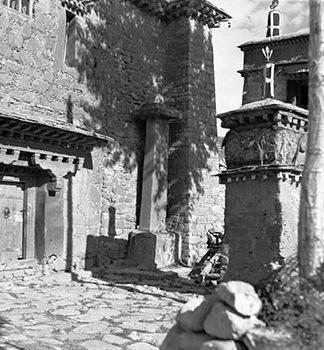
The eastern pillar at the Temple of the HatThe Temple of the Hat (Zha’i lha khang) is a small temple about 50 miles northeast of Lhasa, founded by the monk minister Nyang Tingdzin Zangpo, a significant figure in Tibetan religious history. Nyang was one of the first Tibetans to be ordained as a monk after the completion of Samye temple. He acted as guardian to the young prince who later became King Senaleg (who ruled between 799 and 815).

Later religious history includes Nyang as one of the 25 disciples of Padmasambhava, and even more importantly, as the recipient (along with King Trisong Detsen) of the Seminal Heart (Nyingtig) teachings of Dzogchen from Vimalamitra. These teachings are said to have been concealed in the Temple of the Hat and rediscovered in the eleventh century.

The inscriptions of the pillars placed on each side of the entrance to the temple have no bearing on the Dzogchen tradition. They both record the words of Senaleg, expressing gratitude for the services offered by Nyang and promising recompense for those services:

Bandé Tingdzin, has been loyal from first to last, and from my childhood until I obtained the kingdom he took the place of a father and mother and acted with devotion to my welfare.

The two pillars are of different dates. The pillar to the west of the temple entrance is the earlier, probably dating to 804–5, while the pillar to the east of the entrance is dated to 812. At the end of the west pillar inscription it is stated that a detailed document of this edict was written and placed in the archives while a sealed copy was been placed in a special enclosure, perhaps in the temple or even within the pillar itself. The last part of the edict states the procedures for re-opening the enclosure (presumably if there was a need to check or update the edict), and for resealing and re-depositing the edict.

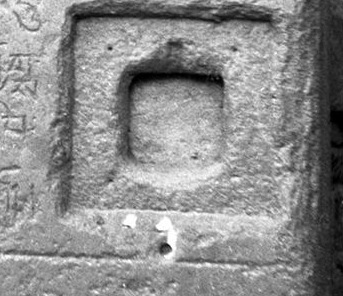
The seal socket in the eastern pillarNow, the depositing of edicts in special rooms and the procedures for opening and resealing them seem to prefigure the later hidden treasure (terma) tradition. The Dzogchen texts which were were said to have been hidden here at the Temple of the Hat by Nyang Tingdzin Zangpo are part of the collection known as the Vima Nyingtig, perhaps the earliest of the hidden treasures. According to an early history, The History of the Seminal Heart, these texts were rediscovered by a certain Denma Lhungyal in the late 10th or early 11th century. Apparently the treasure texts were hidden in three places in the temple: (i) inside its storeroom or treasury, (ii) in the gate house or vestibule, and (iii) in a hole inside one of the pillars.

As Ronald Davidson has pointed out, the old imperial and temple archives were undoubtedly opened up when monks returned to Central Tibet in the late 10th and 11th centuries. They probably found something in these old archives.

References

1. Davidson, Ronald. 2005. Tibetan Renaissance. New York: Columbia University Press. p.215.
2. Karmay, Samten 1988. The Great Perfection. Leiden: Brill. pp.210–211
3. Richardson, Hugh. 1985. A Corpus of Early Tibetan Inscriptions. London: Royal Asiatic Society. pp.43–63

Tibetan sources
Snying thig gi lo rgyus [The History of the Seminal Heart], in Bi ma snying thig, part 3, 83a–83b. (Klong chen pa dri med ‘od zer. Snying thig ya bzhi. 11 vols. New Delhi: Trulku Tsewang, Jamyang and L. Tashi. 1970.)

Images:
1. Photograph of the two pillars at the Temple of the Hat, by Hugh Richardson.
2. Photograph of the seal socket in the east pillar, by Hugh Richardson.
These images are copyright of the Pitt Rivers Museum, Oxford. See their website: The Tibet Album.