Dharma from the Sky III: Self-Appointed Buddhas

The Tibetan manuscripts found when the sealed cave in Dunhuang was opened in 1900 are still the oldest in the world. But many of them are not as old as we once thought. When the manuscripts were first studied it was assumed that they all dated from the time when the Tibetans ruled Dunhuang, between 786 and 848. It’s a reasonable assumption which is, unfortunately, completely wrong. Certainly some manuscripts do date from this time, but many don’t. We now know that the Tibetan language continued to be used in and around Dunhuang long after the fall of the Tibetan empire, right up to the time the cave was sealed up at the beginning of the eleventh century.

At first it might seem disappointing that we can’t pick up a Dunhuang manuscript and assume that it was produced during the Tibetan empire. But does dating something later necessarily make it less interesting? I don’t think so. Look at the tantric manuscripts for instance. What’s been emerging from recent studies on these is the continuity between what was practised at Dunhuang in the 10th century and the emerging Nyingma traditions of the next few centuries. These manuscripts don’t tell us much about Buddhism in the Tibetan imperial period, but what we get instead is a glimpse into Tibet’s “dark age” when the Nyingma traditions were in their infancy.

*  *  *

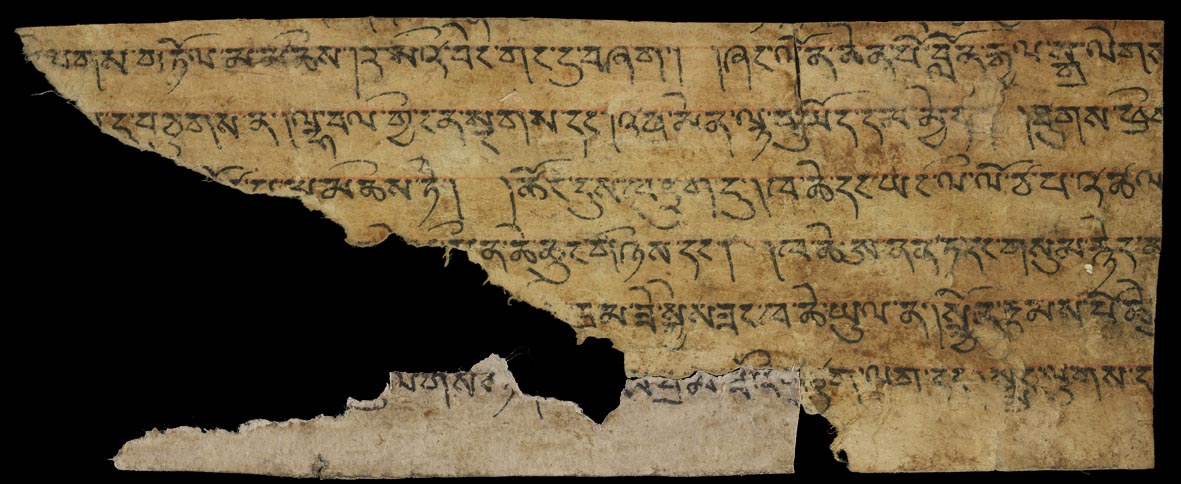
Let’s look at a manuscript that is widely assumed to have been written in the time of the Tibetan Empire. I think that it was perhaps not, and that giving it a later date might allow us to understand it better. Found on the scroll IOL Tib J 370, the text was first studied by Hugh Richardson, who translated its title as “The Dharma that Came Down from Heaven.” It tells of the activities of the great emperors Songtsen Gampo and Tri Song Detsen in bringing Buddhism to Tibet, and then goes on to lament a decline in  Buddhism values in Tibet.
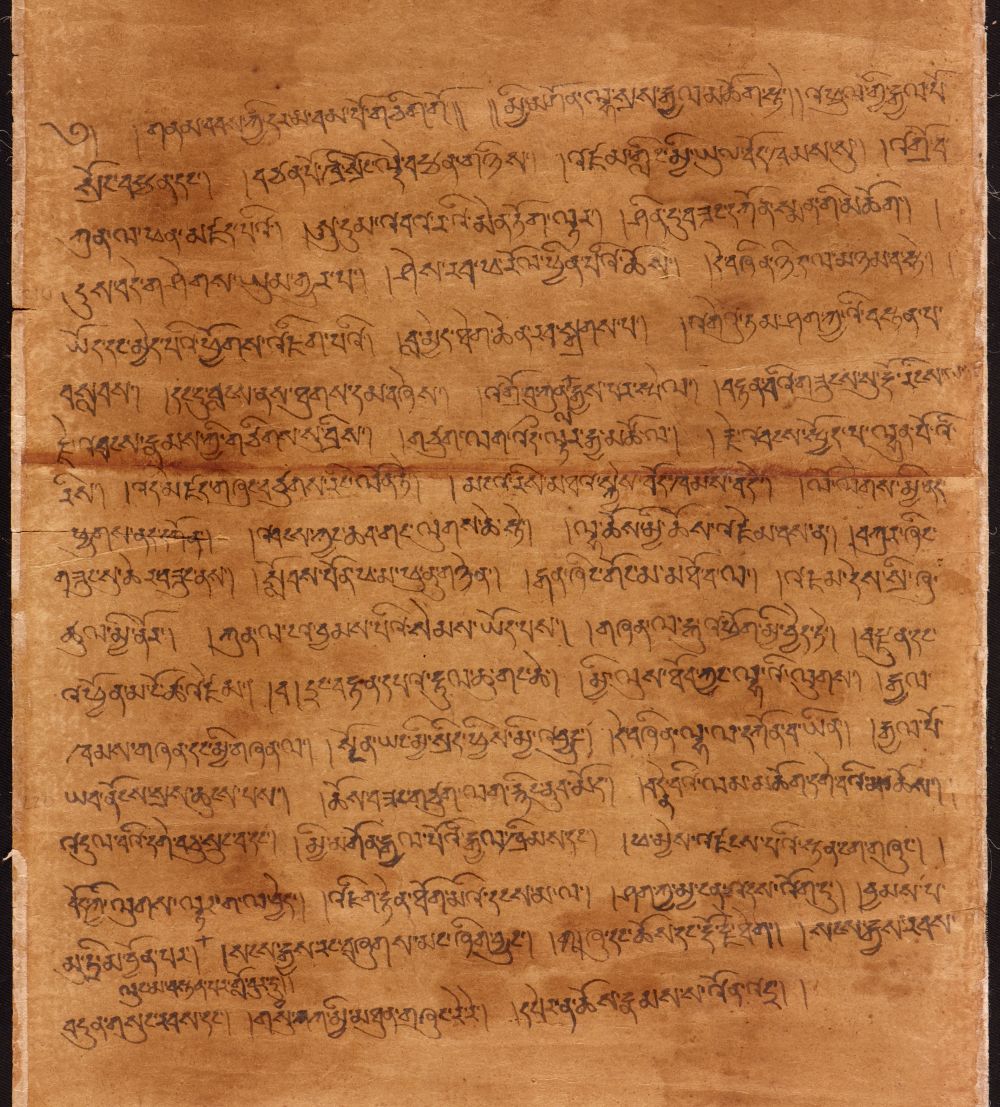
It’s a fairly short poem, and apparently not complete, breaking off before the end. Quite why it’s called “The Dharma that Came Down from Heaven” is not clear. Though as Rolf Stein, another great Tibetologist who studied this text, pointed out, the Tibetan word dar ma didn’t mean the teachings of the Buddha in general, but more specifically, a book of Buddhist teaching. So the reference is to a book that fell from heaven — a familiar theme in the later Tibetan tradition that tells of the first appearance of Buddhism in Tibet when books fell on the roof of an ancient emperor (something I wrote about here a while ago). A better translation of the title would be “The Scripture that Fell from the Sky”.

Both of these scholars assumed that the poem dated to the imperial period. In some ways, I can see why. The language is archaic. Yet looking at the scroll itself, I think it was certainly written in the tenth century. For one thing, the handwriting style does not match anything produced in the imperial period. For another, the way the text is written on the back of a Chinese scroll at the end of a series of scriptures and prayers, and in a different handwriting from the texts that precede it, is similar to other scrolls produced in the late 10th century.

*  *  *

If we date this poem to the post-imperial period, something that puzzled both Richardson and Stein suddenly becomes much easier to understand. As I mentioned, at the end of the poem the author laments the decline of Buddhism. Both Richardson and Stein thought that this was a reference to a ban on Buddhism in the mid-eighth century, which was overturned by Tri Song Detsen when he declared that Buddhism was to be Tibet’s state religion. But this assumption didn’t help either scholar to interpret the end of the poem, which they struggled with unsuccessfully.

Now, if the poem was written later than was previous thought, the decline of Buddhism described at the end of it could be the one that happened at the end of the Tibetan empire. With that in mind, let’s have another go at translating the troublesome last lines:

Because the king died and his son was young, the good religion and the old learning declined. How can we practice in the Tibetan way the supreme path of truth, the religion of virtue? Or the adherence to the ten virtues of the Vinaya and the royal laws of the kings, protectors of men? Or the orally taught systems of the wise ancestors?

In between Śākyamuni, who manifested first in this world, and Maitreya, who [is next] to come after he passes away into nirvana, there are suddenly a great many self-appointed buddhas appearing without authentification. Each of them has a different system which is not in accord with the zhu, the dharma or the vajrayāna, i.e. the three [systems] of the seven [past] generations of buddhas. The dharmas are like seeds…

This translation is nowhere near perfect, but I hope it gets closer to what the author is trying to say. It doesn’t look like this is about the ban on Buddhism in the eighth century. It looks more like a complaint about the decline of Buddhism after the reigns of the great Buddhist emperors, when the empire was beginning to fall apart. The author here is concerned about people calling themselves buddhas and teaching something that is unrecognisable as the dharma. So the decline is not a decline in numbers, but in standards.

Interestingly, this new reading of the poem makes it very similar to another poem about the dark age in the manuscript Pelliot tibétain 840, which I wrote about in a previous post. That poem also begins by celebrating the great Buddhist emperors before going on to talk about a decline in standards:

From the Divine Son Darma on down,
And from his descendent Ösung on down
In general the dharma spread and flourished,
Spread and flourished excessively, it’s said,
So that everyone born as a human wanted to accomplish it.

Perhaps when our poem says, “Because the king died and his son was young” it is also referring to Darma and his son Ösung, who was very young when his father died in 842. The later tradition blames the decline of Buddhism very much on Lang Darma, but a close study of the sources suggests that it was only after his death that things started to go wrong for the empire, and for Buddhism as a state religion.

As for those “self-appointed buddhas” that our poem decries, there are ample references to such characters in writings from the next couple of centuries (the 11th and 12th). We have, for example, reports of a Newari called Karudzin who “put a meditation hat on his head, stuck some feathers in it, dressed in fur, made the announcement at Samye, ‘I am Padma,’ and taught innumerable wong teachings.” Then there was the fellow who called himself “Buddha Star-King”, who became famous in Western Tibet until he was bested in a magical contest by the translator Rinchen Zangpo. On them, see Dan Martin’s excellent articles, listed below.

*  *  *

That mysterious title, referring to dharma books falling from the sky, might be interpreted differently as well. Perhaps it isn’t, as Richardson and Stein thought, the first ever reference to the legend of how Buddhism first arrived in Tibet. Perhaps it is instead a sarcastic allusion to the teachings of the self-appointed buddhas, which seem to have dropped out of nowhere. I wonder if the metaphor in the broken-off last sentence might have explained the title.

So, does dating the poem in IOL Tib J 370 to the tenth century rather than the early ninth make it less interesting? We lose a contemporary account of the Tibetan imperial period, but we gain a vivid portrayal of the challenges facing Buddhism in Tibet’s dark age. It’s a portrayal informed by a nostalgia for the past era of the Buddhist emperors, and overlapping with this, fears of what will happen to Buddhism in Tibet without imperial regulation. But like the similar poem in Pelliot tibétain 840, the elegant and literary way in which these fears are expressed shows (perhaps unintentionally) that at least some Tibetans remained highly literate and well versed in Buddhism.

*  *  *

See also

Dharma from the Sky I: Legends and history

Dharma from the Sky II: Indian or Chinese dharma?

*  *  *

References

1. Hugh Richardson. 1998 (originally published 1977). “The Dharma that Came Down from Heaven”: A Tun-huang Fragment. In High Peaks, Pure Earth. Chicago: Serindia. 74-81.

2. R.A. Stein. 1985 “Tibetica Antiqua IV: La tradition relative au début fr bouddhisme au Tibet.” BÉFEO 74: 83-133.

Both Richardson’s and (especially) Stein’s are well worth reading and contain many more insights about this text that I haven’t covered here.

3. Dan Martin. 1996. “Lay Religious Movements in 11th- and 12th-Century Tibet: A Survey of Sources.” Kailash 18.3-4: 23-55.

4. Dan Martin. 1996. “The Star King and the Four Children of Pehar: Popular Religious Movements of 11th- to 12th-Century Tibet. Acta Orientalia 49.1-2: 171-195.

*  *  *

Tibetan text

rgyal po yab nongs sras chungs pas// chos bzang gtsug lag rnying bub mod// bden ba’i lam mchog dge ba’i chos// ‘dul ba’i dge bcu srung ba dang// myi mgon rgyal po rgyal khrims dang// pha myes ‘dzangs pa’i stan ngag gzhung// bod kyi lugs ltar ga la byed// ‘jig rten thog ma’i dangs ma la// shag kyi mya ngan ‘das ‘og du// byams pa mu tri ma byon par// (lung ma bstan par glo bur du//) sangs rgyas rang bzhugs man zhig byung// -g-zhu dang chos dang rdo rje theg// sangs rgyas rabs bdun gsung rabs dang gsuM ka myi mthun gzhung re re// dper na chos rnams sa ‘on ‘dra//

And unresolved questions…

1. The thing that I still can’t make out is that triad of zhu / chos / rdo rje theg. Richardson suggested reading the first word as gzhung, but the scribe actually wrote a /g/ and then crossed it out, and his or her spelling is not that bad. And why should the vajrayāna be separate from the dharma?

2. I’m aware that “self-appointed buddhas” as a translation of sangs rgyas rang bzhugs is not uncontroversial. I have taken bzhugs with its connotation of assuming a position, as in the term for enthronement, khri la bzhugs. But rang bzhugs could be translated in other ways.
Tibetan Chan IV: The Great Debate

Why does history get written? I think we’d all agree that the motives for creating history are mixed, and just as complex as the uses it gets put to after it’s written. Though most of Tibet’s histories are histories of religion, it would surely be naive to imagine that the motives of their authors were wholly religious. After all, the union of religion and politics (chösi zungdrel in Tibetan) was not just a fact of life in Tibet, it was an ideal, a dearly-held expression of the uniqueness of Tibet’s culture.

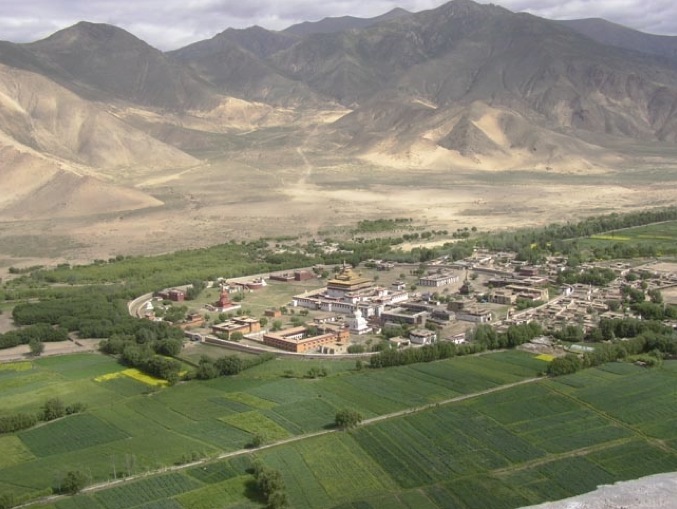
So how does this apply to the story of the great debate between Chinese and Indian Buddhism that is supposed to have taken place at Samyé monastery under the aegis of the emperor Tri Song Detsen? The debate is certainly presented in religious terms, as a battle between two interpretations of the Buddhist scriptures. On the Chinese side, the Chan approach of the single method: the realization of the nature of mind leading to instant enlightenment. On the Indian side, the gradual approach of the six perfections leading to a gradual awakening in ten stages.

The classic account of the debate and the source for all later Tibetan historians, is the Testament of Ba. And this, even in the earliest form available to us, is clearly not a disinterested account. It gives the proponent of the Chinese view a brief paragraph to defend his position, followed by pages and pages of the proponents of the Indian view. And most of the refutation of the Chinese approach is spoken by a Tibetan nobleman from the Ba clan. But hang on, isn’t the Testament of Ba all about the Ba clan? Well, it certainly seems to have been put together by people from that clan, and it certainly places the Ba clan in the middle of the action in the story of how Buddhism came to Tibet.

I don’t think it’s much of an exaggeration to say that the story of early Tibetan history is the story of the Tibetan clans. Before Tibetan history began to be recorded, the clans were contesting with each other. During the Tibetan empire, the clans were in theory united under the emperors, but in truth, they continued to contest with each other, and this was one of the major factors in the ultimate failure of the empire. And after the empire fell, the fighting between the clans created what the historians called “the age of fragmentation.”

As for the Ba clan, they were deeply involved in the imperial court and often in competition with the Bro clan for the top ministerial positions. They seem to have played some part in the conspiracy against the Buddhist emperor Ralpachen, leading to his assassination and the enthronement of the deeply unpopular Langdarma. Given that Langdarma came to be blamed for the collapse of monastic Buddhism in Tibet, and the inception of the age of fragmentation, it seems that the Ba clan had some PR work to do if they wanted to demonstrate their credentials as supporters of the revered Buddhist emperors. And that’s what the Testament of Ba does, quite successfully.

*  *  *

So where does the story of the debate fit into this? Obviously it puts the representatives of the Ba clan at the side of the greatest Buddhist emperor. It may also be a not-so-subtle attack on another major clan, the Dro, the clan that most frequently crops up in the Ba clan’s power struggles. And as the empire began to fall apart the first  civil war was between the governor of Tibet’s northeastern territories (who was from the Dro clan) and a general who wanted to set himself up as a local warlord (from the Ba clan). The governor sided with the new Chinese power in the region, and the general was, after committing some appalling brutalities, eventually executed. For more about this see here and here.

So we shouldn’t be surprised if the old enmity between Ba and Dro finds expression somewhere in the Testament of Ba. Perhaps in the story of the debate? Consider the evidence:

1. There’s a Chinese manuscript from Dunhuang (Pelliot chinois 4646) that tells another debate story. As in Testament of Ba, the Chinese side is represented by the Chinese monk Moheyan, but the proponents of the other view are only mentioned as “Brahmin monks.” This manuscript also talks about “discussions” by letter over several months, rather than a staged debate. And the biggest difference is that it ends with the Tibetan emperor giving his seal of approval to the Chinese teaching:

The Chan doctrine taught by Mahayana is a fully-justified development based on the text of the sutras; it is without error. From now on the monks and laity are permitted to practise and train in it under this edict.

But what is most relevant to us is that it mentions that Moheyan was invited by one of Tri Song Detsen’s queens, the one from the Dro clan. The Chinese author of the text makes this quite clear.

2. A Tibetan manuscript from Dunhuang (Pelliot tibétain 996) gives us an account of a lineage of Chan masters. It begins with an Indian master who travelled to the Silk Road city of Anxi.* Here’s a translation of the beginning, which gives an idea of the tone of the work:

The master Artenhwer, an instructor who knew the path of the sameness of all phenomena travelled to Anxi from India, for the sake of sentient beings. There he gathered three hundred students, and taught them how to enter the Mahāyāna. He received divine food offerings from the sky, which satiated his three hundred students. At over a hundred years old he passed away in the posture of nirvana. Then the king of Anxi struck the body and said “If the master came to explain the dharma to multitudes of sentient beings, why did he only teach a few words?” And, having died, the master rose again for three days and taught the dharma to the king of Anxi and the Chinese prince of Gazhou.

The lineage of this Artenhwer gets passed down to a Chinese monk called Man Heshang. And he is supported by Trisumjé, the delön (the minister responsible for the northeastern marches of the Tibetan empire) — this is almost certainly a famous Tibetan minister from the Dro clan who lead the negotations for to the 823 Sino-Tibetan peace treaty. Later in this Chan lineage there’s a Tibetan master called Puk Yeshé Yang, who is supported by a monk from, once again, the Dro clan.

So, is it reasonable to suggest that the Chan teachers like Moheyan were known to have the patronage of the Dro clan? That would certainly make the story of the debate in the Testament of Ba very useful in their struggle with the Dro. Not only does it place them at the centre of the narrative of the transmission of Buddhism to Tibet, it’s also one in the eye for the Dro clan and their favourite Chan teacher.

*  *  *

This rivalry might answer a question posed by Matthew Kapstein: why is Testament of Ba generally well disposed towards Chinese Buddhism, except in the story of the debate? Earlier in the Testament of Ba we hear about a member of the Ba clan travelling to China receiving teachings from the Korean Chan teacher known as the Reverend Kim. While later Tibetan historians tended to present the debate as a rejection of Chinese Buddhism per se, the Testament of Ba, especially in its earliest known forms, suggests more specifically a rejection of Moheyan’s brand of meditation practice.

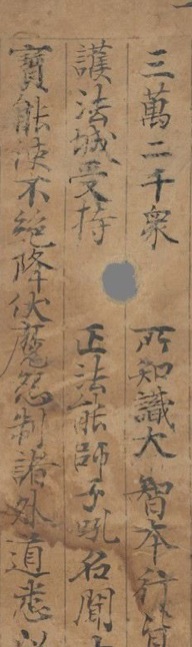
That’s enough for now. I won’t go into the question of whether the debate actually happened, although the very different version in the Chinese text certainly suggests that we might be better off thinking of a series of discussions, mostly by exchanges of letters, rather than a debate. And the author of 10th century Lamp for the Eyes of Meditation, which is all about how to rank the simultaneous and gradual methods, fails to mention any debate. And many, if not all, of the Tibetan Chan manuscripts from Dunhuang date from after the Tibetan empire, and thus well after when the debate was supposed to have happened, suggesting that the decline of Chan in Tibet happened slowly, and for other reasons.

*  *  *

See also…

Tibetan Chan I: The Emperor’s Chan
Tibetan Chan II: The teachings of Heshang Moheyan
Tibetan Chan III: More teachings of Heshang Moheyan

*  *  *

A note on places and people…

So where is Anxi (An se in the Tibetan text)? Most people, following Lalou, have identified it with the great northern Silk Route city of Kucha. But this might not be right. Anxi was the name of the Chinese command centre for its western territories. This was in Kucha until the late 680s, when that city was taken by the Tibetan army, and the Chinese moved the Anxi commandery to Qocho (Ch. Gaochang). By my calculations, separating each member of the lineage by 25 years, Artenhwer should have been around in the first half of the 8th century, by which time Anxi may have referred to Qocho.

As for Artenhwer (A rtan hwer), this looks like a Tibetan transliteration of a Chinese transliteration of a foreign name, so finding the original may be a hopeless task. Flemming Faber identified it as the popular Persian name Ardasir, but as far as we know, there was no Buddhism in Persia by this time. It certainly doesn’t sound particularly Indian. Turkic perhaps? Any informed answers or wild guesses great appreciated…

And Dro Trisumjé? Hugh Richardson considers the identification of Pelliot tibétain 996’s Trisumjé with the army commander Dro Trisumjé doubtful. But it doesn’t seem at all unlikely to me that bde blon Trisumjé mentioned in Pelliot tibétain 996 might have later held the role of army commander (dmag gi mchog). His involvement in the Sino-Tibetan treaty involves the same region that fell under the rule of the bde blon. A letter written by a Chinese officer to a Zhang Khri sum rje (Pelliot tibétain 1070 — see Demiéville’s Concile de Lhasa, pp.280-290) says that he chose Dunhuang as his residence and founded a temple there. Roberto Vitali has argued that this is Dro Trisumjé, and that he must have lived in Dunhuang before 810, when, due to a promotion to the rank of minister and general of the northeast army, he would have moved to a major prefecture like Guazhou. Though Vitali didn’t consider Pelliot tibétain 996, the fact that Trisumjé held the post of bde blon only strengthens his case.

*  *  *

And some Tibetan…

From the beginning of Pelliot tibétain 996 (f.1r):

$//mkhan po nam ka’I snying po’i dge ba’i bshes nyen gyI rgyud mdor bshad pa// dge ba’I bshes nyen yang/ chos mnaym pa nyId kyI lam rIg pa’/ mkhanpo a rtan hwer/ sems can gyI don du rgya gar yul nas/ yul an ser gshegs te/ slob ma sum brgya bsdus nas/ theg pa chen po’i don la cI ltar ‘jug pa’I sgo bshad/ lha’I zhal zas nam ka las blangs te/ slobs sum brgya tshIm bar byas so/ lo brgya lon nas/ ner ban thabs su dus las ‘das so/ de nas an se’I rgyal pos lus brda+bs te/ mkhan pos sems can de snyed la chos bshad na/ bdag la tshIg ‘ga’ yang ma bstan par gshegs sam zhes smras pa dang/ tshe ‘das te zhag gsum lon ba slar bzhengs te/ an se’I rgyal po kwa c[u’]I wang chos bshad nas dus la ‘das so/

*  *  *

References

Hugh Richardson wrote about the rivalry between Dro and Ba as a background to the debate in:
1. Hugh Richardson. 1998. “Political Rivalry and the Great Debate at Bsam-yas.” In High Peaks, Pure Earth. London: Serindia: 203-206. (Unlike most articles in this collection, this one had not previosly been published.)

This is the earliest extant version of the Testament of Ba is the Dba’ bzhed:
2. Pasang Wangdu and Hildegard Diemberger. 2000. The Royal Narrative  Concerning the Bringing of Buddha’s Doctrine to Tibet. Wien: Verlag  der Osterreichischen Akademie der Wissenschaften.

That is, apart from a manuscript fragment from the 9th or 10th century:
3. Sam van Schaik and Kazushi Iwao. “Fragments of the Testament of Ba from Dunhuang”. Journal of the American Oriental Society 128.3  (2008 [2009]): 477–487.

The classic work on the Chinese text on the debate (or discussions), the Dunwu dacheng zhenglie jue 頓悟大乘政理決 is:
4. Paul Demiéville. 1958 (republished in 2006). Le Concile de Lhasa. Paris: Institute des hautes études chinoises.

Later Demiéville found another version of the text in the Stein collection, Or.8210/S.2647. As for the Tibetan Chan lineage in Pelliot tibétain 996, this was studied and published even earlier, in 1939, by Marcelle Lalou (surely the first person to discover the existence of Tibetan Chan among the Dunhuang manuscripts):
5. Marcelle Lalou. 1939. “Document tibétain sur l’expansion du Dhyāna chinois.” In Journal Asiatique October-December 1939: 505-523.

On the involvement of the Ba clan with the assassination of Ralpachen (or, if you follow his ingenious argument, actually of Langdarma) see:
6. Zuiho Yamaguchi. 1996. “The Fiction of King Dar-ma’s Persecution of Buddhism”. In De Dunhuang au Japon. Geneva: Librairie Droz. 231-258.

On the battle between two members of Dro and Ba in Amdo/Hexi, see:
7. Luciano Petech. 1994. “The Disintegration of the Tibetan Kingdom”. In Tibetan  Studies, edited by Per Kværne. Oslo: The Institute for Comparative  Research in Human Culture.

On Dro Trisumjé, and other aspects of clan rivalry during the Tibetan empire, see pages 18, 21-22 of:
8. Roberto Vitali. 1990. Early Temples of Central Tibet. London: Serindia Publications

and this too:
9. Roberto Vitali. 2004. “The role of clan power in the establishment of  religion (from the kheng log of the 9-10 century to the  instances of the dByil of La stod and gNyos of Kha rag).” In The  Relationship between Religion and State : (chos srid zung ‘brel), in  Traditional Tibet, edited by Christoph Cuppers. Nepal, Lumbini  International Research Institute.

And finally, Matthew Kapstein’s discussion of the attitude towards Chinese Buddhists in the Testament of Ba is on pages 34-35 of:
10. Matthew Kapstein. 2000. The Tibetan Assimilation of Buddhism. Oxford  University Press, 2000.

What Are Those Monks Doing?

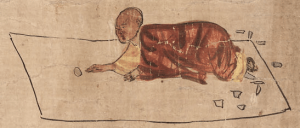
I’d like to share something with you that’s puzzled me for some time. I first came across this illustration a few years ago. It’s in the Dunhuang manuscript Or.8210/S.8555. Click on the image or the number to see the whole thing, then come back here if you have any ideas.

What do you see? My first impression was that this looks like a stoning, with three monks throwing rocks at the fourth, prostrate monk. Are we looking at a punishment? I’m not sure the Vinaya sanctions this kind of thing. And it does look like the fourth monk has removed his shoes and is performing prostrations on a mat. While the other monks are throwing stones at him. Really? Why?

*  *  *

It was only recently, when I looked at the back of the manuscript, that I started to think I might have solved this puzzle. There’s a single line of Chinese writing, saying “Lotus Sutra, seventh fascicle”. Now, this could be nothing to do with the picture. I’m all too familiar with scrolls that have been reused for notes, writing exercises and, of course, idle doodles. But this picture is more than a doodle. Surely it means something.
Well, have a look at this verse from Chapter 10 of the sutra:

If when a person expounds this sutra
there is someone who speaks ill and reviles him
or attacks him with swords and staves, tiles and stones,
he should think of the Buddha and for that reason be patient.

Could that be the scene depicted here? I thought so, but then came across an even better bit of text in Chapter 20, which is a story about a bodhisattva called Never Disparaging:

This monk did not devote his time to reading or reciting the scriptures, but simply went about bowing to people. And if he happened to see any of the four kinds of believers far off in the distance, he would purposely go to where they were, bow to them and speak words of praise, saying, “I would never dare disparage you, because you are all certain to attain Buddhahood!”

Proving that you can’t please all of the people all of the time, there were some who were offended by this behaviour:

Among the four kinds of believers there were those who gave way to anger, their minds lacking in purity, and they spoke ill of him and cursed him, saying, “This ignorant monk – where does he come from, presuming to declare that he does not disparage us and bestowing on us a prediction that we will attain Buddhahood? We have no use for such vain and irresponsible predictions!”

The four kinds of believer, by the way, are monks, nuns, lay men and women. The story seems to be aimed against those Buddhists who didn’t hold with the Lotus Sutra’s doctrine that everyone will attain Buddhahood eventually.

Many years passed in this way, during which this monk was constantly subjected to curses and abuse. He did not give way to anger, however, but each time spoke the same words, ‘You are certain to attain Buddhahood.’ When he spoke in this manner, some among the group would take sticks of wood or tiles and stones and beat and pelt him. But even as he ran away and took up his stance at a distance, he continued to call out in a loud voice, “I would never dare disparage you, for you are all certain to attain Buddhahood!” And because he always spoke these words, the overbearing arrogant monks, nuns, laymen and laywomen gave him the name Never Disparaging.

So, the key phrase there is, “some among the group would take sticks of wood or tiles and stones and beat and pelt him.” Though in the end the bodhisattva runs away and continues not disparaging his tormentors from a safe distance, note that he begins by bowing to them. So here we have all the elements of our illustration. And I think, perhaps, the puzzle is solved.

*  *  *

Of course the tormentors in our picture are not monks, nuns, laymen and laywomen, but just monks. But I don’t think that’s a deal-breaker. What’s interesting is the clothing of the monks. I assume this reflects the context in which the picture was made, that is, Dunhuang in the 9th or 10th centuries (I suspect). From which it appears that the monks at Dunhuang wore robes similar to those that Tibetan monks wear nowadays.

*  *  *

Incidentally, those nasty people who threw the stones, tiles and the like got their comeuppance. They had to spend an awfully long time in the deepest hell. The Buddha, who is the narrator of course, tells us this, and he also reveals that the bodhisattva Never Disparaging was the Buddha himself in a former life. And those nasty people? Well, even hell doesn’t go on forever, and at the end of the chapter the Buddha reveals that they are here now, among his audience. Anyhow, I think the story of Never Disparaging complements nicely this season’s messages of goodwill, tolerance and the like. Best wishes to all for Christmas and New Year. You are certain to attain Buddhahood!

*  *  *

References

The translations here are from Burton Watson, The Lotus Sutra (New York: Columbia University Press, 1994). I haven’t delved into the complexities of the text itself, and the sharp-eyed will notice that I didn’t address the question of whether either Chapter 10 or 20 falls within the seventh fascicle (juan qi) of the Sutra. Of course, to do this we must look at the different canonical versions of the sutra (Burton Watson’s translation is based on the most popular one, attributed to Kumarajiva), and then the several versions in Dunhuang that are not clearly related to the canonical versions. And that’s assuming that we are only looking at Chinese versions. All I have been able to ascertain at this point is that the Tibetan version the story of Never Disparaging appears in Chapter 19, falls under fascicle 11 (bam po bcu gcig pa) in the Peking Kanjur version. Any further thoughts are most welcome.

The Abbot, or Ironing out History’s Wrinkles

Picking through a manuscript collection piece by piece can be painstaking work, but it’s rarely boring. I never cease to be amazed by the mere fact that these ancient things were written, used and reused by very different people who held them in their hands in a very different place and time.  And then there are the occasional magical moments, when you come across something really fascinating that nobody else has noticed before.

This happened to me a few months ago when I was compiling a catalogue with Kazushi Iwao. We were sifting painstakingly through the main series of Chinese manuscripts in the British Library, to see whether there were any Tibetan manuscripts in there that had been overlooked.  We came across something that looked sort of familiar… Something about Rasa (the old name of Lhasa) … something about a Brahmin called Ananta.

Aha! The penny dropped. This was part of the story of how Buddhism was introduced to Tibet by the tsenpo Tri Song Detsen. It looked very similar to the version of that story in an important and early Buddhist history called  The Testament of Ba. A quick check of that text revealed that yes, this was a fragment of the Testament of Ba.

Now this was exciting (to us at least) because nobody knows when the Testament of Ba was written. Though everyone agrees that it’s an early history, the oldest manuscript that’s been found is from the 12th or 13th century (this version is called the Dba’ bzhed). The fragment we’d found could well be from the 9th century, taking us to only a short while after the actual reign of Tri Song Detsen.

*  *  *

The fragment tells the story of how the abbot Śāntarakṣita was invited to Tibet by Tri Song Detsen. This was the first stage of the tsenpo’s adoption of Buddhism, overturning the anti-Buddhist policies of his ministers. But when the abbot arrived in Lhasa, Tri Song Detsen had second thoughts, and was worried that this foreigner might be bringing black magic or spirits with him. So the abbot was confined to the Jokhang temple, and interviewed by a minister.

Since the abbot didn’t speak Tibetan, an interpreter had to be found. After a search, a fellow called Ananta was discovered. He was in Tibet because his father had been convicted of a serious crime in Kashmir and had been exiled. So Ananta became the interpreter as the abbot was questioned for three months about his doctrines. Eventually the minister assured Tri Song Detsen that the abbot posed no threat, and he was allowed to begin his task of establishing Buddhism in Tibet.

Now I don’t know about you, but that story doesn’t seem the most auspicious starting-point for Buddhism in Tibet. Later historians didn’t think so either. Even the oldest version of the Testament of Ba changes the language slightly, so that instead of the abbot being confined in the Jokhang (the Tibetan word bcugs is the same used in legal documents for imprisonment) he’s politely “asked to stay” there.

In later versions of the Testament (like the Sba bzhed), the suspicions about the abbot are placed in the minds of the ministers, instead of the Tri Song Detsen himself. This absolves the tsenpo from harbouring bad thoughts about the saintly abbot. This more polite version was the one used by the historian Butön in his famous history of Buddhism. He also dropped the figure of Ananta, with his shady past, from this part of the narrative. And some other historians simply ignored the whole interrogation-of-the-abbot episode.

*  *  *

Personally, I like the early version of the story, and probably for the same reason that the Tibetan Buddhist historians were uncomfortable with it. It has wrinkles in it that get in the way a seamless narrative of the introduction of Buddhism to Tibet by glorious kings, monks and yogins. It seems more like a record of what “really happened” than a pious story meant to inspire the faithful. You might not agree, and I’m sure that this preference down to my own cultural conditioning. But perhaps you’ll agree that our little manuscript discovery has helped us to see how this particular wrinkle was gradually smoothed out by generations of historians. Which is quite interesting whether you prefer your history wrinkled or smooth.

*  *  *

References
1. Sam van Schaik and Kazushi Iwao. “Fragments of the Testament of Ba from Dunhuang”. Journal of the American Oriental Society 128.3 (2008 [2009]): 477–487.
2. Pasang Wangdu and Hildegard Diemberger. 2000. The Royal Narrative Concerning the Bringing of Buddha’s Doctrine to Tibet. Wien: Verlag der Osterreichischen Akademie der Wissenschaften.

Images
1. Statue of Śāntarakṣita. Photograph by Matthieu Ricard, (c) Getty Images (click on image for link).
2. The two fragments together: Or.8210/S.9498(A) and Or.8210/S.13683(C).

*  *  *

Update: Transcriptions of the fragments are now available on the OTDO website here and here. And the images of the fragments, along with the other fragments that they were glued together with, can be seen on the IDP website here and here.

*  *  *

Pasang Wangdu and Hildegard Diemberger’s translation of the Dba’ bzhed

The mKhan po sent a messenger to prostrate in front of the bTsan po and to inquire about whether he should meet him immediately. [He was] asked: “Please, stay at Pe har for a while.” The bTsan po suspected that there could be some black magic and evil spirits (phra men) from lHo bal [in the doctrine of the mKhan po]” Then [the bTsan po] ordered Zhang blon chen po sBrang rGya sbra (sgra) legs gzigs, Seng ‘go lHa lung gzigs and ‘Ba’ Sang shi, “You three ministers, go to Ra sa Pe har (vihāra) to meet A tsa rya Bo dhi sa twa and prostrate in front of him. Then investigate whether I need to suspect the presence of black magic and evil spirits from lHo bal or not.” The three arrived at Ra sa Pe har (= vihāra). There was no translator. So, in six market-places it was ordered that each chief merchant (tshong dpon) had to search for a translator from Kashmir (Kha che) or Yang le. In the lHa sa market three people were found, namely, two Kashmiri lHa byin brothers and the Kashmiri A nan ta. The two lHa byin brothers were unable to act as translators except for some language of trade. As far as A nan ta is concerned: he was the son of the Brahman sKyes bzang who had commited a serious crime and had been sent into exile in Tibet because according to the law of lHo bal Kashmir (lHo bal kha che) Brahmans could not be executed. [A nan ta] had studied the Brahman sacred scriptures (gtsug lag), grammar (sgra) and medicine, and was therefore able to translate the language of the doctrine.

(Pasang and Diemberger 2000: p.43-45)