
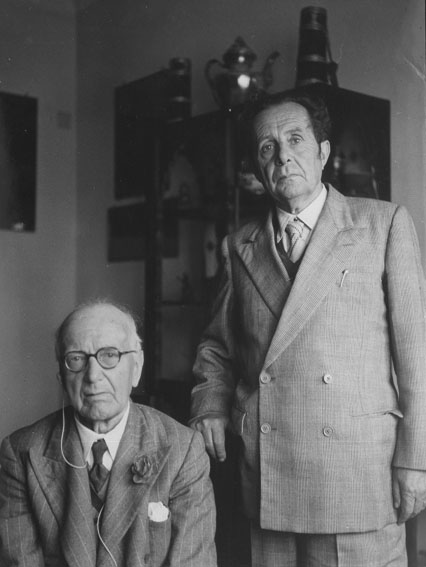
A few years ago I came across this photograph in the archives of the British Library. It is a portrait of two early European scholars of Tibet: F.W. Thomas and Giuseppe Tucci. It was taken in 1955 by Tucci’s photographer and partner Francesca Bonardi. Before I saw the photo I wasn’t aware that these two knew each other, or that Thomas had ever travelled to Italy. The meeting of these very different personalities is a rather intriguing event.
Guiseppe Tucci (1894-1984) was arguably the foremost non-Tibetan scholar of Tibetan history and culture (such types are still known by the ungainly neologism Tibetologist, which like the similarly ugly Buddhologist is a term likely to cause faint mirth in the uninitiated) in the first half of the twentieth century.
 Tucci was a natural linguist, learning Hebrew and Latin in his childhood, before turning to Sanskrit, Tibetan and Chinese. Tucci was an explorer, making several expeditions to Western Tibet in the 30s, where he collected the materials (manuscripts, paintings and statues) for his scholarly work. And Tucci was a prolific writer. Among his many publications the Indo-Tibetica series and the two huge volumes of Tibetan Painted Scrolls are still essential reading.
In early life Tucci was a supporter of Mussolini and the philosophy of fascism, and in 1937 he was sent by the Italian Government to Japan, to strengthen cultural ties between Japan and Italy. Here he lectured and published extensively on Zen, spiritual liberation, and the art of war. After his return to Italy and the defeat of Mussolini, Tucci abandoned this vein of work, and his interest in fascist philosophy and Zen, returning to Tibetan studies.
In the mid 50s, when the photograph with Thomas was taken, Tucci had just made two expeditions to Nepal and was about to embark of on series of archaeological digs in Pakistan, Afghanistan and Iran. He was also very active in public life, one of his achievements being the founding of the Istituto italiano per il Medio ed Estremo Oriente (IsMEO) in Rome. Several brief biographies are available online (see the references below).
* * *
The career of Frederick William Thomas (1867-1956) was, in contrast, conducted in the universities and libraries of England. He was a student of classics, and then a fellow at Trinity College, Cambridge at the end of the 19th century and a professor at Balliol College, Oxford in the 30s. These two Oxbridge stints bookended his job as librarian for the India Office Library, where he worked for thirty years. It was here, where he had the responsibility of sorting through the thousands of Tibetan manuscripts brought back from Central Asia by Aurel Stein, that Thomas found the raw materials for his most important scholarly work.
 Thomas had little interest in the Buddhist materials from Dunhuang, and his work focused on early Tibetan history (letters, military communiqués and the like) and folklore. Most of this work was put together and published by Thomas after he retired to a cottage in Oxfordshire, where he worked in a damp and chilly study (at least he complained often in his letters that it was so). Here he put together his great 4-volume series of historical texts Tibetan Literary Texts and Documents from Chinese Turkestan, collected narrative texts in Ancient folk-literature from North-Eastern Tibet, and a study of the extinct Nam language (his equally pioneering work on the Zhangzhung language still remains unpublished).
The photo with Tucci was taken the year before Thomas’s death. According to the Dictionary of National Biography:
To his last years Thomas retained the lean and athletic figure of the strenuous sportsman. His manner was keen and affable, and he enjoyed speaking in learned company. He celebrated his retirement by undertaking a tour of India in 1938 which would have taxed the strength and energies of the most intrepid traveller. He retained the full scope of his great intellectual powers to the end, although deafness at the last diminished his social enjoyment.
* * *
Tucci is still, no doubt, the preëminent scholar of his time, but those of us interested in the early history and culture of Tibet still owe Thomas a great debt. It is a pity that his works are so difficult to find, apart from in the major libraries. As an attempt to make Thomas’s work more available, I’ve been trying to get his major unpublished and out-of-print catalogues up on the IDP website. You can see his work on the documents about Dunhuang from vol.II of Tibetan literary texts and documents here, and his unpublished card catalogue slips of the Tibetan manuscripts Aurel Stein found in the Tangut/Mongolian regions of Etsingol and Kharakhoto here.
I see these two figures in quite different settings: Tucci striding across the dry and desolately beautiful landscapes of Western Tibet, Thomas bent over his desk in damp, verdant Oxfordshire. Tucci, the scholar “in the field”, Thomas the “armchair scholar”. One thing they had in common was that they both published their major works before 1959, when when the Tibetan diaspora changed forever the relationship between Westerners and Tibetans, and the nature of scholarship on Tibet.
* * *
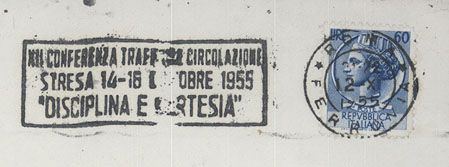 (The stamp and postmark from the envelope containing the photograph, marked October 1956. On the back of the photo, Francesca Bonardi wrote: “Con tanti cari auguri dal Prof. Tucci e da.”)
* * *
Some online resources:
- On Tucci and his manuscript collections (IsIAO)
- Wikipedia on Tucci
- A blog about Tucci
- A Tucci biography
- F.W. Thomas in the Dictionary of National Biography
- Wikipedia on Thomas (with an incomplete bibliography)
See also:
Gustavo Benavide. 1995. “Guiseppe Tucci, or Buddhology in the Age of Fascism” In Donald. S. Lopez (ed.), Curators of the Buddha: The Study of Buddhism Under Colonialism. Chicago and London: University of Chicago Press.

 early Tibet