In the previous post I looked at the the earliest Dzogchen manuscripts in existence (as far as we know). These two Dzogchen texts appear to reject any kind of structured practice, and yet they exist in the extraordinarily rich Dunhuang collection, containing prayers, manuals for rituals of offering, confession and so on, meditation manuals, and many other things which clearly fall into the category of structured practice. So, we may well ask ourselves, what was going on? Were people practising, or not? Do we really imagine that among the population of tantric practitioners around Dunhuang there were few hip Dzogchenpas secretly scorning the efforts of the rest? I doubt it.
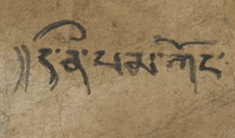
Fortunately we don’t have to rely on speculation here. There are in fact a number of texts from Dunhuang that explain exactly how Dzogchen relates to tantric practice. The Questions and Answers on Vajrasattva is a series of questions and answers, an early FAQ, on tantric practice. In particular, it is concerned with the practice of a level of tantra known as Mahāyoga (“the great yoga”). It was written in the earlyish 9th century by a Tibetan called Nyen Palyang and is preserved in several Dunhuang manuscripts, including IOL Tib J 470.
Now Nyen Palyang clearly had a view of tantric practice that was very close to what we find in the Dzogchen texts. He writes:
This mind itself which is without basis or root
Is, like the sky, not purified by cleansing.
Because enlightenment is free from production,
Enlightenment does not come from cause and effect.
But this is a treatise on tantric practice, in particular, on the practice of visualizing a deity. So the next question Palyang posits is how do we receive the blessing from the deity if the above is true? He answers his own question in this way:
When dirty water becomes clear,
No effort is required for the reflections of the sun and moon to appear.
Similarly, if one transforms one’s own mind through yoga,
No accomplishment is required for the conquerors’ blessings to arise.
The author is keen to get the message across that the practice of deity yoga is emphatically not to be abandoned, but any concept of the practice of yoga as the cause for enlightenment is to be abandoned. Pelyang constantly refers to nonduality, freedom from effort, and the primordial and spontaneous presence of the enlightened mind, using terms familiar from Dzogchen texts, such as awareness (rig pa) and spontaneous presence (lhun gyis grub). The term Dzogchen appears here too. Pelyang poses the question—if there is no cause and effect, how does a yogin obtain accomplishments? The answer is this:
When, as in the example of a king appointing a minister,
The accomplishments are granted from above, this is the outer way.
When the kingdom is ruled having been offered by the people,
This is the way of the unsurpassable, self-arisen Dzogchen.
Leaving aside the interesting political metaphor, what is striking here is that Dzogchen is clearly being presented as a way (tshul) of practicing Mahāyoga. The same applies to the term Atiyoga: there is a note appended to a point in the main text where the following answer is given to the question of how one should perform deity yoga, here called “approach and accomplishment” (bsnyen bsgrub):
In the ultimate approach and accomplishment no subject or object is perceived;
Because there are no difficulties or effort here, this is the supreme approach and accomplishment.
The note underneath the second line states that this is “an explanation of the view of Atiyoga.”
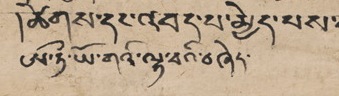
The Questions and Answers on Vajrasattva is not an isolated case. Another text from Dunhuang, a long tantric treatise on various topics arising out of deity yoga (IOL Tib J 454) makes it clear that the deity is simply the awareness (rig pa) of one’s own enlightened mind or bodhicitta (byang chub sems). The idea of buddhas and buddhahood is also firmly brought back to the practitioner’s own primordially pure mind:
One’s own mind is primordial purity and buddhahood, and to comprehend that this mind is primordially purity and buddhahood is to be accomplished as a buddha, to see the face of the buddha, to hold the buddha in one’s hands.
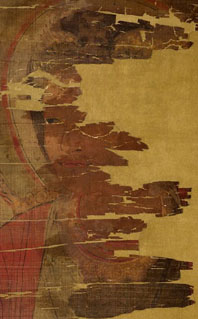
Finally, there is a brief account of how Padmasambhava taught the meditation on the deity Vajarakīlaya to his students in the manuscript Pelliot tibétain 44, which states:
[Padmasambhava] taught the secret bodhicitta that is included within Atiyoga, and the sādhanas of Vajrakīlaya in accordance with the Mahāyoga texts. He showed that meditation on Vajrakīlaya is the state of reality, and then they meditated on the nonduality of objects and minds within the uncreated bodhicitta.
We are in a better position now to understand how the two Dzogchen texts that I mentioned in the last post coexisted with the vast amount of practical instructions on ritual and meditation practice that are also found in the Dunhuang collections. The texts I’ve quoted here make it plausible that at the time of these manuscripts (9th to 10th centuries) Dzogchen/Atiyoga was primarily a view applied to the practice of deity yoga.
“But what,” you may ask (adopting for the moment the Tibetan question-and-answer method), “about those Dzogchen texts that don’t refer to tantric practice at all, but just talk about nonduality and the uselessness of any practice? Like, for example, your Dunhuang text by Buddhagupta?”
Well, that’s an interesting example. You may remember from the last post that much of Buddhagupta’s Dunhuang text was re-used in another work by none other than Nyen Palyang, author of The Questions and Answers on Vajrasattva. Palyang also wrote several Dzogchen texts that don’t mention deity yoga, or any other practices at all.
Now, I don’t want to draw sweeping conclusions from this limited source material, but this seems to have been a common pattern: to write Mahāyoga commentaries or treatises alongside short instructional texts on the nonconceptual aspect of Mahāyoga practice. Other authors and translators of early Dzogchen texts (like Mañjuśrīmitra and Vimalamitra for instance) also wrote commentaries on Mahāyoga tantras. So it seems that writing (or studying) these early Dzogchen texts didn’t preclude the practice of deity yoga. In fact the point of the the Dzogchen view was to apply it to these practices.
“So, was this the original form of Dzogchen?” I suspect that ‘original’ (like ‘authentic’) is word that seems simple until you start to ask what we really mean when we use it. Let’s leave this question till next time…


 early Tibet