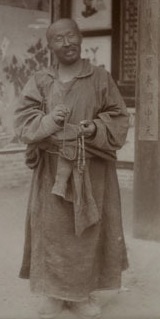
Padmasambhava II: the dark Padmasambhava

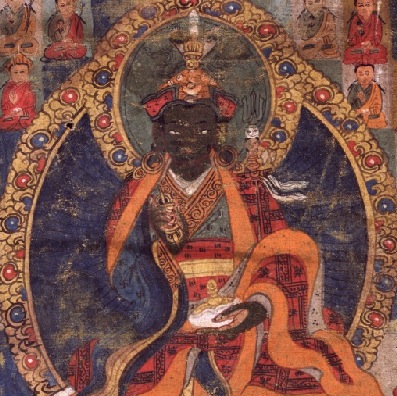
Recently browsing the excellent Himalayan Art website, I came across this 17th century painting of Padmasambhava, or as the inscription has it, “the honoured Mahāguru of all the Conquerors”, also known as Guru Rinpoche. The composition is unusual: the central figure is surrounded by 356 small Padmasambhavas, their clothes in recurring sequences of different colours that gives the whole painting a striking geometric pattern.
But what is more striking to anyone familiar with the usual depictions of Padmasambhava is the colour of the central figure. His skin is dark brown, apart from the palms of his hands, which are pink. This is not a representation of Padmasambhava I’ve ever seen before, even though in his other manifestations he does appear in other colours — and I’ll come to that in a minute.

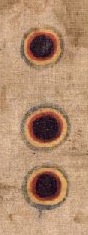
There is a four line verse written on the back of the painting, in nice cursive writing, punctuated with the double circles that indicate these verses come from the tradition of rediscovered texts, or terma. I would think then, that this form of Padmasambhava is a special terma tradition. The verses are full of the imagery of Dzogchen, the “great perfection,” and three rainbow circles – tiglé – corresponding to Padmasambhava’s body, speech and mind, are painted on the other side of the main figure.

The verses seem to be referring to Padmsambhava as Padmarāga – meaning “lotus-hued.” According to the dictionaries, this can refer to the ruby, to something bedecked with rubies, or something ruby-coloured.But wait, surely that should be Padmarāja: “Lotus King”?
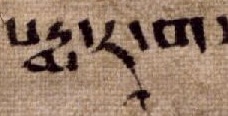
Anyway, I’d better explain why I’m going on about a 17th century painting on this website, where I generally stand politely behind an invisible line drawn across the boundary of the 10th and 11th centuries. What this painting reminded me of, when I came across it first, was a tantric text discovered in the Turfan basin of Eastern Central Asia, written in Turkic. (In what comes below, I rely on the work of Georg Kara and Peter Zieme, since I don’t read Turkic.)

The manuscript, actually a series of fragments, is part of a group of manuscripts, all tantric sādhanas (meditation instructions) found in Turfan and dating to the 13th and 14th centuries. By this time the Mongols had taken over Eastern Central Asia and the Mongol influence is clear enough here. One of the tantric texts, a Cakrasaṃvara maṇḍala, has a lineage that goes through Indian siddhas like Saraha, Luipa, Tilopa and Naropa, before coming to Tibet with Mal Lotsawa, and then going through the five patriarchs of Sakya, ending with Phagpa.
It was Phagpa, of course, who is said to have been given the rulership of Tibet by Khubilai Khan and to have acted as the Khan’s spiritual preceptor, granting numerous empowerments, including Cakrasaṃvara.

Why is the text in Turkic then? Well the Uighur Turks once ruled Turfan (which is at the northeast of the Takalakan desert) as well as Dunhuang itself. Like almost everybody else, they fell under Mongol rule in the 13th century. As the more established culture, the Uighurs became the teachers of their conquerors, influential in the fields of literature, science, military affairs, and of course, religion. The Mongols, who had no writing system of their own, used Uighur scribes, and many Turkic words (including Buddhist concepts) were adopted into the Mongolian language

*  *  *

The tantric text that concerns us here is a sādhana of Avalokiteśvara. The meditator is instructed in self-visualization as Avalokiteśvara, as one would expect. More surprisingly, the meditator is instructed visualize Padmasambhava (padma sanbaua baxšï) above his head. Now, Padmasambhava is described as having the form of a teacher of yoga (yogačari), wearing bone ornaments and dancing on a lotus throne. Furthermore his skin is described as black (qara) and shiny.

Here is a Padmasambhava who is very much the Indian mahāsiddha – yet quite unfamiliar. The form looks a little like one of the classic “eight manifestions” of Padmasambhava transmitted in the Nyingma tradition, known as Light Rays of the Sun (Nyima Özer), but he is always painted with orange or yellow skin, like the sunbeams of his name. Then there is the form known as Dorjé Drolö, also known as the wrathful guru, who has dark red or brown skin, but also has other wrathful features like three eyes, and always rides a tiger.

So none of these known forms fits our Turkic Padmsambhava. Is this perhaps a form of Padmasambhava once transmitted in the Sakya tradition, whose roots go back to the tantric Buddhism of early Tibet? The colophon tells us that this text was printed by a certain Upasi Böri Buqa in 1336. An earlier version also found in Turfan dates to 1276, which is just a couple of years after the period when Phagpa was resident at the court of Khubilai — he returned to Tibet in 1274.

*  *  *

And so… I’m not going to try to offer any conclusions here, but I hope others might find these rare manifestations of Padmsambhava interesting as well.

*  *  *

References
1. Kara, Georg and Peter Zieme. 1976. Fragmente tantrischer Werke in uighurischer Übersetzung. Berlin: Akademie Verlag.

Images
1. Padmasambhava, 1600-1699, Collection of Moke Mokotoff. (c) Himalayan Art
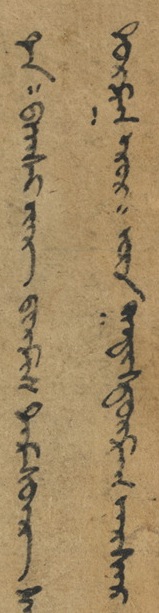
2. British Library manuscript Or.8212/109 (Uighur tantric text — but not the one discussed here, which is in Berlin).

See also
Padmasambhava I: the early sources.
Buddhism and Empire III: the Dharma King

Among the most celebrated figures in Tibetan history are the “dharma kings” (chögyal in Tibetan) who supported Buddhism and helped it to take root in Tibet. And probably the most important of all the dharma kings is Tri Song Detsen. Prince Song Detsen was given the title Tri – meaning “throne” – when he came of age, and he wasted little time in curbing the anti-Buddhist movement that had taken root in recent years since the death of his father, the previous king.

Seeking Buddhist teachers, first from China, then from Nepal and India, he went about getting Tibet its first proper monastery. That monastery, Samyé, was built with the help of the Nepalese abbot Śāntarakṣīta and the tantric adept from modern Pakistan, Padmasambhava. The king also supervised the ordination of the first Tibetan monks, and a vast project for the translation of Buddhist scriptures into Tibetan.

That is the briefest of summaries of the traditional Tibetan view of Tri Song Detsen’s achievements. If we turn to the Dunhuang manuscripts, we find – for once – that they are much in agreement with that traditional view. Tri Song Detsen is celebrated in quite a few Dunhuang poems and prayers as a great Buddhist king. Most of these celebrations of the king have already been translated (see the References section below) but I recently came across one that seems to have been missed. And it’s really quite interesting indeed…

* * *

IOL Tib J 466 is a scroll with a long prayer of offerings to the buddhas, bodhisattvas, deities, dharma kings and patrons of Buddhism. First among the kings is, of course, Tri Song Detsen.

I make offering to the spiritual teachers of our own Tibet,
The great dharma kings, like the great king Tri Song Detsen,
He who has mastered the royal methods of fortune,
And rules the kingdom with the sword of the sky-gods,
The magically emanated lord Tri Song Detsen;
And to those teachers who have gone to nirvāṇa,
Including Dharmāśoka, Kaniṣkā, Śīla Atidāna and so on;
To all of these propagators of the teachings
I respectfully make the offering of homage.

I suspect that this prayer dates from not too long after the reign of Tri Song Detsen himself. Every aspect of the scroll – paper, ink, handwriting, and the arrangement of the text on the page – is similar to the sutras commissioned by the last Tibetan kings at the end of the Tibetan Empire in the 840s. So the scroll may have been written only a half-century after the end of Tri Song Detsen’s reign.

The prayer puts Tri Song Detsen right into the historical tradition of dharma kings. Dharmāśoka is of course the famous Aśoka, ruler of the great Mauryan Empire in the 3rd century BC, and patron of Buddhism. Some of the edicts that he had carved throughout his empire still survive, and confirm that he was, to some extent, a Buddhist king. He is said to have convened the third council of the Buddhist sangha to clear up some doctrinal issues. As for Kaniṣka, he was the ruler of the Kushan Empire, based in Gandhara in the 2nd century AD, and we have evidence from the coins made in his reign that he supported Buddhism (among other religions). He is also credited with organizing a Buddhist council for the compilation of a Sanskrit Buddhist canon.

Considering the importance of the councils that Aśoka and Kaniṣka are supposed to have convened, it’s not surprising that the debate between Indian and Chinese Buddhism organized by Tri Song Detsen is often considered to be another council – in the grand tradition of dharma kings.

Of the identity of the king called Śīla Atidāna I have no idea. The first part of his name means “moral conduct” and the second “supreme giving”. The extreme generosity of bodhisattvas in some Buddhist stories is sometimes called “supreme giving”. One of the most popular of these stories is that of Prince Vessantara, who gave away his wife and children to a cruel Brahman (perhaps we should translate atidāna as “extreme giving”). In the end of the story the family is reunited and Vessantara is crowned king. So it could be this king that is intended here. I welcome any alternative suggestions…

*  *  *

As well as associating Tri Song Detsen with this Indian tradition of dharma kings, the prayer highlights the divine and magical nature of Tibetan kingship. The king has “mastered the royal methods of fortune.” What I’ve translated here as “fortune” is the enigmatic word phywa. In later Tibet it refers to luck, fortune-telling and the like. During the time of Tibet’s imperial kings, it seems to have been the special possession of the kings, but it as a method rather than a personal quality.
In any case, there wasn’t much distinction between the kings and the gods. The prayer also says that Tri Song Detsen “rules the kingdom with the sword of the sky-gods.” What does this mean? The Tibetan kings were thought to be the descendents (literally!) of a race of gods who lived in the sky, and came down to earth to perform their kingly duty. Instead of dying, they ascended back to the sky – beamed up along a “sky-cord” made of light. Later generations, including Tri Song Detsen, were said to have lost the sky-cord connection. Nevertheless, they were still the children of the gods (lhasé). That sword is an interesting symbol of the king’s military power, something that is downplayed – if not totally ignored – by many later Buddhist historians. Did Tri Song Detsen really carry a sword said to be inherited from his divine ancestors?

So it seems to me that in this prayer Tri Song Detsen stands somewhere between the earlier vision of Tibetan kings as agents of the divine – with magical military power and special royal methods of prognostication – and ideal of the Buddhist king as a patron and practitioner of Buddhism above all else.

*  *  *

Tibetan text
IOL Tib J 466/3: 5r.9–12: bdag cag bod khams kyI dge ba’I bshes gnyen//rgyal po chen po khri srong lde brtsan lastsogs pa//chos kyI rgyal po chen po rnams la mchod pa//phyva’i rgyal thabs mnga’ brnyes shing//chab srId gnam gyI lde mtshon can//’phrul rje khrI srong lde brtsan dang//dar ma sho ka/ka ni skā/shI la a tI da ṇya lastsogs//ston pa mya ngan ‘das phyIn//bstan pa rgyas mdzad thams cad la//phyag ‘tshal bsnyen bkur mchod pa dbul//

References
1. Karmay, Samten. 1998. “King Dza / Tsa and Vajrayāna” in The Arrow and the Spindle: Studies in History, Myths, Rituals and Beliefs in Tibet. Kathmandu: Mandala Book Point.
2. Richardson, Hugh Edward. 1998. “The Dharma that fell from Heaven” in High Peaks, Pure Earth: Collected Writings on Tibetan History and Culture, Edited with an Introduction by Michael Aris. London: Serindia.

Images
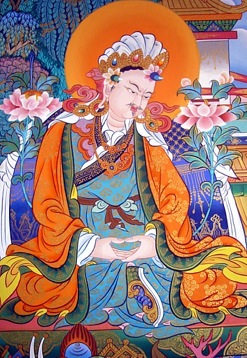
1. Tri Song Detsen: detail of 20th c. painting, sourced from Wikipedia.
2. Coin of Kanishka, (c) The British Museum.
3. Sky-cord (OK, a tornado).

See also:
Buddhism and Empire I: A Soldier’s Prayer
Buddhism and Empire II: Portrait of a Monk

Rama in early Tibet

The British Library exhibition on the Rāmāyaṇa has reminded me of one of the most surprising finds from the Dunhuang library cave: a group of manuscripts telling this classic Indian story in Tibetan. Most people know something of story of the Rāmāyaṇa, which tells of how King Rāma’s wife Sītā was abducted by the demon Ravāṇa and rescued with the help of the monkey king Hanumān and his army. The first Rāmāyaṇa is attributed to the poet-sage Vālmīki and is thought to date back to the middle of the first millenium BC. Since then, many other versions of the story have appeared in India and beyond, most recently in that hugely popular television series of the 1980s. Rāma was accepted into the Buddhist world as well, in a jātaka story which tells of Rāma’s banishment from the kingdom by his father.

Anyway, the Tibetan Rāmāyaṇa is found in several manuscripts from Dunhuang, which suggests that it enjoyed some popularity this area, far from India but connected to it by the trading routes we call the Silk Road. This version is a retelling of the Indian tale, though it differs in several ways from the Indian versions. It is a condensed retelling of the original story in which many episodes are drastically shortened, making it short enough, perhaps, for a travelling storyteller to relate at one sitting.

Although it is a shortened version, some parts of the Tibetan Rāmāyaṇa are not found in any of the Indian versions (at least as far as I know). An slightly odd addition to the original is the theme of letter-writing. For example, when Hanumān travels to find Sītā, he takes a love letter written by Rāma, and Sītā sends back a love letter in reply. In another episode, Rāma chides Hanumān for forgetting to correspond regularly. A crestfallen Hanumān apologizes: “I should have continually enquired by letter after your health.”

Now, I am not sure that letter-writing was a feature of ancient or medieval Indian culture (perhaps someone more knowledgeable will contest or confirm this). On the other hand, polite enquiries about the health of the addressee are indeed common among the Tibetan letters found at Dunhuang. High ranking Tibetans sent letters back and forth, sometimes containing no more than polite enquiries after the health of the recipient. This social practice explains why Hanumān committed a faux pas when he neglected to send a continual steam of letters to Rāma.

So, if it’s not Indian, where does this version of the Rāmāyaṇa story come from? Some have suggested Khotan, a great little Silk Road kingdom. It’s true that there are a couple of Khotanese manuscripts containing fragments of the stary of Rāma. However, while this Khotanese Rāmāyaṇa contains some of the same elements as the Tibetan story, it also differs from the Tibetan in many ways. There is no letter-writing in the Khotanese version, and the whole story is given a Buddhist moral at the end. The narrative of the Tibetan Rāmāyaṇa, on the other hand, shows no interest in Buddhism at all.

In fact, the Tibetan Rāmāyaṇa seems generally less moralistic than the classic version, in which Rāma and Sītā are ultimately estranged due to Rāma’s suspicion of Sītā’s infidelity. The Tibetan version has a happy ending, in which Rāma’s apology is accepted by Sītā: “They were happier than before. King Rāma, Queen Sītā, husband and wife and the sons together with a large retinue lived happily in the palace Old Earth.” In the end, one can’t help feeling that the reason for the popularity of this version of the Rāmāyaṇa was simply that it’s a great story.

*  *  *

Manuscripts
The manuscripts of the Rāmāyaṇa are: IOL Tib J 737.1 (A), IOL Tib J 737.2 (B & C), IOL Tib J 737.3 (D), Pelliot tibétain 981 (E), Pelliot tibétain 983 (F). In de Jong’s works, these manuscripts are referred to only by the letters A to F, which I have given in brackets after the shelfmarks.

References
1. Bailey, H.W. 1940. ‘Rāma’, (I) BSOAS 10.2 (1940): 365–376; (II) BSOAS 10.3: 559–598.
2. de Jong, J.W. 1971. ‘Un fragment de l’histoire de Rāma en tibétain’ in Études tibétaines dédiées à la mémoire de Marcelle Lalou. Paris: Librairie d’Amérique et d’Orient.
3. de Jong, J.W. 1977. The Tun-huang Manuscripts of the Tibetan Ramayana Story’, Indo-Iranian Journal 19.
4. Kapstein, Matthew. 2003. ‘The Indian Literary Identity in Tibet’, in Literary Cultures in History: Reconstructions from South Asia, edited by Sheldon Pollock. Berkeley: University of California Press.
5. Thomas, F.W. 1929. ‘A Rāmāyaṇa Story in Tibetan from Chinese Turkestan’ in Indian Studies in Honor of Charles Rockwell Lanman: 193–212. Cambridge, Mass: Harvard University Press.

Images
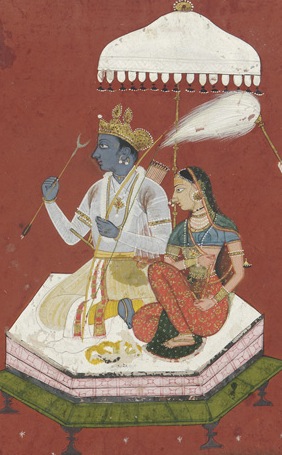
1. British Library manuscript Add. MS 15296(1), from the Rāmāyaṇa exhibition at the British Library. See this site for images of the manuscript.
2. The manuscript IOL Tib J 737.2, containing part of one version of the Tibetan Rāmāyaṇa.

Teachers, Students, and Notes

Manuscripts are interesting things. Well, I think so, and over the last year one of the main purposes of this website has been to make this point. Printed books can be objects of beauty, but more often they are just the means by which we get the text itself. And we know that a printed book is one of several hundred, or thousand, or ten thousand almost identical copies. Every manuscript, by contrast, is unique. A manuscript can contain anything from hastily scribbled notes to a fine copy of a revered scriptural text. Every manuscript is different from every other, differing in the circumstances of its creation and in the idiosyncrasies of its creator.

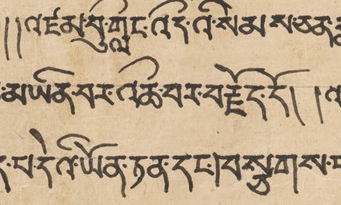
Although each of the Tibetan Dunhuang manuscripts is unique, we can put them in some sort of order, arranging them so that at one end of the scale we have the thousands of carefully copied and corrected sūtras which were the products of organized scriptoria working during the Tibetan imperial period. Here variations are at a minimum and have been eradicated as much as possible in the editorial process…

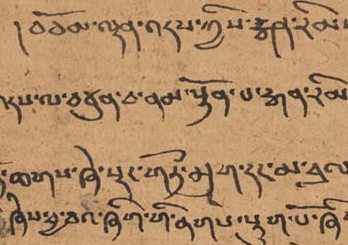
In the middle of the scale are the manuscripts that have been copied carefully, but outside of the scriptorium and usually without revisions. Most of these would have been for personal use, and contain texts like short treatises, prayers and rituals. Handwritings are individual and sometimes quite stylish….

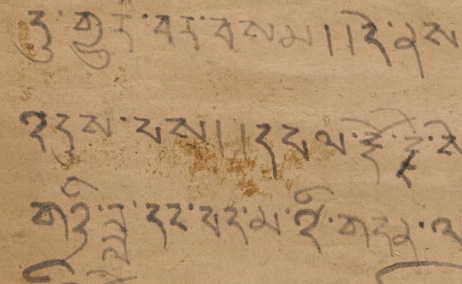
At the other end of the scale there are  manuscripts that are much more scruffy. The individual letters are poorly formed, as if by children, and the spelling varies quite noticeably more than in most of the Tibetan Dunhuang manuscripts….

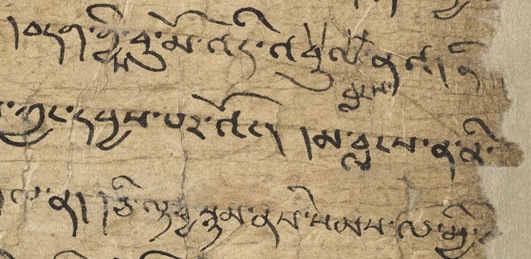
The initial temptation is to leave this last type of manuscript well alone, and spend one’s time with more beautiful specimens. However, forced to confront them in my cataloguing work, I had to think about why these people wrote Tibetan so very badly. One possibility is that these weren’t Tibetans, that they had only just learned Tibetan in order to be able to write and understand Tibetan Buddhist prayers and practices.

Another possibility – one that doesn’t exclude the first – is that these manuscripts came out of teaching situations. Most of us will be familiar with taking down notes from some kind of lecture or talk, and with the fact that some people are better note-takers than others. A student might be particulary quick with a pen, and copy nearly every word, or only manage only the most general sort of summary. Taking notes is still important in a variety of teaching situations, including Buddhist ones. But it was even more important before the widespread use of printing made textbooks available. In a manuscript culture, the only textbooks students would own were the ones they wrote themselves.

*  *  *

Dunhuang, the source of our manuscripts, was in its heyday one of the great centres of Buddhist practice, art, scholarship and translation. Situated on the edges of the Chinese and Tibetan cultural spheres, and at the eastern end of the Silk Route, it received a huge cultural input. From the eighth to the tenth centuries, Dunhuang was home to Buddhist communities of Chinese, Tibetan, Khotanese and Turkic monks.  There was also a steady flow of eminent teachers passing through Dunhuang. Chinese Buddhists would stay awhile as they began their pilgrimages to India, and Indians and Tibetans would stop off on their way into China.

For example, in the Stein collection we have a kind of passport (IOL Tib J 754) for a Chinese monk who was on a pilgrimage to visit Nālandā in India. The manuscript contains a series of letters of introduction written in Tibetan, apparently in the tenth century. The Chinese monk passed through the Tibetan areas southeast of Dunhuang before arriving there.  We also have a long scroll (Pelliot tibétain 849) that ends with an account of the journey from India to China – via Tibet – of an Indian teacher called Devaputra. The scroll also contains some written notes perhaps taken by a Tibetan student of this Devaputra.

Another fascinating manuscript is a phrasebook with a series of bilingual conversations in Khotanese and Sanskrit (Pelliot 5386). Among these conversations are some that speak of pilgrims coming from Khotan and India to see the bodhisattva Mañjuśrī in China.  Another conversation mentions the arrival of a travelling Tibetan teacher. Most interestingly, one of the phrasebook’s dialogues contains a series of questions that goes something like this:

Student: “What kind of books do you have?”

Teacher: “Sūtra, Abhidharma, Vinaya, Vajrayāna. Which would you like?”

Student: “I’d like Vajrayāna. Please teach it!”

This little dialogue, as well as others from the phrasebook, give us a sense of a place where Buddhist texts and teachings are frequently passed back and forth. The scruffier Dunhuang manuscripts mentioned above might just be some of the notes of the students who received these teachings.

*  *  *

References
1. Burnett, Charles. 1998. “Give him the White Cow: Notes and Note-Taking in the Universities in the Twelfth and Thirteenth Centuries,” History of Universities 14: 1-30.
2. Sam van Schaik. 2007. “Oral Teachings and Written Texts: Transmission and Transformation in Dunhuang” in Contributions to the Cultural History of Early Tibet, ed. Matthew T. Kapstein & Brandon Dotson. Leiden: EJ Brill. 183–208.