The Decline of Buddhism II: Did Lang Darma persecute Buddhism?

Chinese oxen

As I mentioned in the last post, modern scholars have questioned the traditional Tibetan story that the Tibetan emperor Lang Darma persecuted Buddhism and was consequently assassinated by a monk. The moderate critique suggests that the persecution was really just a withdrawal of patronage from the monasteries and a curtailment of the monks’ involvement in political affairs. The extreme critique (put forward by the Japanese scholar Yamaguchi) is that this whole story is a “fiction”: Lang Darma was a good Buddhist king, and was assassinated not by a monk, but by the anti-Buddhist faction at the Tibetan court.

I mentioned in the last post some of my doubts about the way one Dunhuang manuscript (Pelliot tibétain 134) was used to show that Lang Darma was a Buddhist. I also have doubts about the way another Dunhuang manuscript has been used to show that Lang Darma did not persecute Buddhism. This manuscript (Pelliot tibétain 840) is a poem that begins with a celebration of the great Buddhist emperor Trisong Detsen, and the good practice of Buddhism during his reign. The author of the poem is keen to use this to show how Buddhism should be practised:

When they were in accord with the texts of the scriptures,
The exoteric and esoteric masters
And the vajra assistants
Did not mix up their areas of expertise, and in this way
The monks knew what needed to be done, and there was no conflict.
All the people of Tibet were joyful and happy.

The author of the poem tells us that during the reign of the Trisong Detsen, the “exoteric and esoteric masters”, that is, the monks and the tantrikas (who are also known as “the two kinds of sangha” in some Dunhuang manuscripts) did not confuse their roles. Then things began to change, it seems:

From the Divine Son Darma on down,
And from his descendent Ösung on down
In general the dharma spread and flourished,
Spread and flourished excessively, it’s said,
So that everyone born as a human wanted to accomplish it.

So, here is the passage that has been taken by some scholars to show that Buddhism continued to flourish during the reign of Lang Darma. It’s certainly true that no persecution is mentioned, but is that the whole story? What’s this about the dharma flourishing “excessively”? The Tibetan word here is ha cang, which usually means “excessive” but can also just mean “very much”. Perhaps the closest word in English is “exceedingly” which also covers both meanings. Those who take this passage to show that Buddhism was in good shape during the reign of Lang Darma and his successor Ösung take ha cang to mean “very much” and believe that the author is presenting a positive picture of the state of Buddhism. But it is only possible to do that by ignoring the next lines of the poem, which goes on like this:

Without even knowing about ethical conduct or the vinaya rules,
A vajra assistant can be bought with a donkey.
Without even having the empowerments of an assistant,
A guiding master can be bought with an ox.
Without even having the empowerments of a guide,
A vajra regent can be bought with a horse.
Without even having the empowerments of a regent,
A vajra king can be bought with an antelope.

It should be quite clear from these lines that the author actually wants to say that Buddhism, from the reign of Lang Darma onwards, has been in a parlous state. The author states with some sarcasm, that tantric masters (these are all levels of tantric master it seems) can be bought if the price is right. This is clearly meant to be in stark contrast to the time of Trisong Detsen. The last stanza of the poem continues to lament the dire state of the dharma:

Masters who are lost in the errors
Of not judging the levels of meditative experience
Know nothing of the transworldly meaning.
For every hundred students there are a thousand teachers,
And nobody listens to the divine dharma.
For every village there are ten masters,
And the number of vajra assistants is uncountable.
Everyone thinks “I am accomplished as the deity.”
In the end, since there are so many of this type,
Won’t the vajra body be destroyed?

If the author of this poem is to be believed, the problem is not that Buddhism is dying out in Tibet, but that it is flourishing so much that it is impossible to control it. The problem is a lack of authority: with nobody to judge who is a genuine tantric master and who is not, masters outnumber students, and people wrongly believe themselves to have fully accomplished the deity yoga. (These complaints are, of course, familiar tropes in later Tibetan literature, but I won’t follow that tangent here).

Now, no persecution is mentioned here, it is true, but the names of Darma and his son/nephew Ösung are not held in high regard at all, and they are contrasted with Trisong Detsen, the great Buddhist king. This attitude seems to be reflected elsewere in the Dunhuang manuscripts, in a list of kings who practised the Mahayana, which conspicuously omits Darma and Ösung (Pelliot tibétain 849).

Again, I can offer no definitive answer to the question that heads this post, but let us at least be clear that this poem in Pelliot tibétain 840 is not a celebration of the state of Buddhism during and after Lang Darma’s reign. On the contrary, it shows that Buddhism was seen as going into a decline in this period. Strangely enough, considering the later stories of persecution, the decline is caused by Buddhism flourishing “too much” so that everybody wants to be a tantric master. What this suggests, at least in the view of the author of our poem, is not that Lang Darma persecuted Buddhism, but that in some way he failed to manage the spread of Buddhism properly. Perhaps, in truth, Lang Darma was not an enemy of Buddhism, but, in his fondness for wine and hunting, neglected to take care of it.

*   *  *

References
1. Karmay, Samten. 1981. “King Tsa/Dza and Vajrayāna”, in Tantric and Taoist Studies in Honour of R.A. Stein, vol.1, edited by M. Strickmann. Brussells: Institute belge des Hautes études chinoises. 192-294.
2. Stein, R.A. 1986 “Tibetica Antiqua IV : La tradition relative au début du bouddhisme au Tibet.” Bulletin de l’Ecole Francaise d’Extreme Orient LXXV: 169-196.
3. Yamaguchi, Zuihō. 1996. “The Fiction of King Dar-ma’s Persecution of Buddhism”. In Du Dunhuang au Japon: Études chinoises et bouddhiques offertes à Michel Soymié,edited by Jean-Pierre Drège: 231–58. Geneva: Droz.

And a Tibetological note…
Those who have read the articles by Stein, Karmay and Yamaguchi referenced above may notice that I have glided over a controversy about the following lines:

From the Divine Son Darma on down,
And from his descendent Ösung on down…

/lha sras dar ma man chad dang/
/’od srus dbon sras man chad du/

Rolf Stein translated this as “Depuis le «fils de dieu» (lha-sras) Dar-ma, depuis le «petit-fils» (dbon-sras) ‘Od-srus (lire srung)…” essentially the same as my translation. But he believed we needed to amend man chad to yan chad to get this meaning. Karmay on the other hand, amends only the last man chad to yan chad, and translates “From the time of the Divine Son, Darma / Down to the time of ‘Od-srung and his descendents.” Yamaguchi believes no amendations are needed, and translates, “Until the divine son Darma and until ‘Od-srung and his descendents…” This only makes sense if we accept his interpretation that the text is giving a positive assessment of Buddhism during the reigns of Darma and Ösung, which is hard to accept when we look at the poem as a whole. In fact I think Stein had it right, but didn’t need to amend man chad to get the meaning he wanted. We have several other instances of man chad in the Dunhuang documents, and in the cases I’ve looked at, it means “down from” or “from X down”. Examples from the OTDO website include the lists of ranks in Pelliot tibétain 1071, 1072 and 1075, the amounts of money in IOL Tib J 733.

Anyway, I will put a transcription of the whole text in a comment to this post; further suggestions are welcome (as ever).
The Decline of Buddhism I: Was Lang Darma a Buddhist?

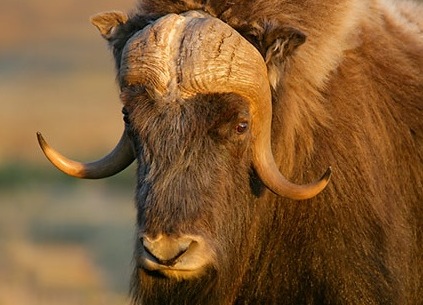
Ox

According to traditional Tibetan history, the Tibetan Empire collapsed as a result of a chain of events that started with a persecution of Buddhism by the king Lang Darma. The story is that Lang Darma ordered that all the monasteries be closed, and that all monks should disrobe. One monk, a Lhalung Palgyi Dorjé, took it upon himself to prevent the dharma from being entirely effaced from Tibet by assassinating the emperor. The story is nicely told in Shakabpa’s Political History:

Lhalung Palgye Dorje set out for Lhasa, wearing a black hat and a black cloak with a white lining. He smeared charcoal on his white horse and concealed his bow and arrow in the long, flowing sleeves of his cloak. When he reached Lhasa he left his horse tied near a chorten (stupa) on the banks of the river and walked into the city. He found King Lang Darma ang his courtiers reading the inscription of the treaty-pillar located in front of the Jokhang Temple. Prostrating himself before the King, the monk freed his bow and arrow without being detected and then, standing up, he fired an arrow straight at the King’s heart. While the King was in his death throes and the people around him thrown into confusion, Lhalung escaped to the river bank. Mounting his horse, he forced it to swim across the river to wash the charcoal away and then, reversing his cloak so only the white lining showed, he returned to Yerpa by a devious route.

At Lang Darma’s death, it was vital to appoint the next king, but there were two claimants to that position. Both claimants had their own supporting factions, which led to more instability. Fighting between the two factions led to an even greater catastrophe–a uprising against the imperial cult itself. The royal tombs were sacked, Central Tibet descended into chaos, and the outer territories fragmented into independent kingdoms. The Tibetan Empire, which had achieved much in its few centuries of existence, had come to and end. Lang Darma is blamed for this chain of events, and has become one of the great villians of Tibetan history, and of Tibetan popular culture too, as Shakabpa points out:

A number of folk tales have since sprung up about Lang Darma. He was supposed to have had horns on his head and a black tongue. To hide his horns, he arranged his hair in two plaits, tied in a raised knot on either side. No one supposedly knew this at the time, unless it was his hairdresser. It is said that this is the origin of the practice for the Tibetan lay officials to plait their hair in this manner. It is also said that some Tibetans, when they scratch their heads and put out their tongues on meeting high-ranking persons, do so to show that they have neither horns nor black tongues.

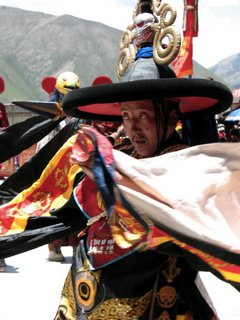
These stories and customs are fun, and the traditional dances based on them are impressive (see the picture below). But some modern scholars have wondered whether Lang Darma really persecuted Buddhism at all. Some have suggested that rather than persecuting Buddhism, Lang Darma simply reduced government support to the monasteries as his empire became financially overstretched. At least one has argued that the whole story of the assassination is a later fabrication. The most thoroughgoing attempt to overturn the traditional story has been made by the Japanese Tibetologist Zuihō Yamaguchi. His rather brilliant article has a complicated argument, relying much on the Chinese historical sources which do not mention any assassination. For now let’s just look at one interesting aspect of Yamaguchi’s argument: his contention that Lang Darma was in fact a fervent Buddhist.

DancerYamaguchi uses a Dunhuang manuscript, Pelliot tibétain 134, as evidence that Lang Darma was really a Buddhist. The manuscript contains an aspirational prayer (mönlam) for the king upon his accession to the throne of the Tibetan Empire. According to Yamaguchi, the prayer states that Lang Darma has already made many offerings to the sangha, is particularly devoted to the Prajñāpāramitā sutra.

I think in some cases Yamaguchi’s translation seems to be stretched to show that Lang Darma was already an active Buddhist before he became king. When we look at the original manuscript, there are indeed many references to good Buddhist deeds, deeds that it is hoped Lang Darma will carry out during his kingship, but nothing clearly showing that he has already carried them out. For example, Yamaguchi translates one passage like this:

May the fact that we worship and chant the sūtra that you yourself recited, the Prajñāpāramitā, lead to all living beings obtaining the teachings of the Mahāyāna and obtaining the seeds of enlightenment.

He takes this as evidence for Lang Darma’s devotion to the Prajñāpāramitā. But I believe the passage would be better translated like this:

May the offering and hearing of the sutras, the personal teachings [of the Buddha] such as the Prajñāpāramitā, lead to all existing living beings obtaining the teachings of the Mahāyāna and obtaining the seeds of enlightenment.

Readers of Tibetan can make their own judgement (see the Tibetan text at the end of this post) but as far as I can see there’s nothing here about the king having recited the sutra himself. The part that Yamaguchi translated as “that you yourself recited” (zhal nas gsungs) actually refers to the fact that the sutras are the teachings of the Buddha, as we see in other Dunhuang Buddhist texts (like IOL Tib J 66). So, this prayer looks to me like a reference to the traditional practice of Tibetan kings acting as patrons for the writing and recitation of sutras. It is after all an aspirational prayer, representing the aspirations of the Tibetan Buddhist sangha for the new king. It functions both as an expression of devotion to the new king and as a reminder of his duties as a good Buddhist king (chögyal).

Yamaguchi has more evidence: a reference in an old catalogue (the Pangtangma) to a treatise called Analysis of the Difficult Points of the Madhyamaka, written by a certain King Pal Dünten. Now, U Dünten is the real name of Lang Darma, which is really a kind of nickname. If the king really wrote a philosophical treatise on that most difficult of subjects, could he really have become a persecutor of Buddhism? Perhaps this really does clinch Yamaguchi’s argument for a Buddhist Lang Darma. Yet the attribution of Buddhist philosophical texts to kings is not quite convincing. Several such texts are attributed to Trisong Detsen too, but would he really have had the time to write them? Isn’t it more likely that such texts were ordered by the king, and ghostwritten by a scholar?

And what about the contemporary Chinese sources, like the Tang Annals, which describe Lang Darma as “fond of wine, enjoying hunting, amorous, brutal and cruel”? The first part of his nickname, Lang, means “ox” and is supposed to have described his ox-like build. This fits with the rather brutish character described in the Tang Annals. But the second part of the name, Darma, is an old Tibetan way of transcribing the word dharma. So the contradictory images of Lang Darma are right there in his name. Now I must end this post, still without an answer to the question with which it began.

*  *  *

References
1. Karmay, Samten G. 2003. “King Lang Darma and His Rule”. In Tibet and Her Neighbours: A History, ed. Alex McKay. London: Hansjörg Mayer: 57-66.
2. Petech, Luciano. 1994. “The Disintegration of the Tibetan Kingdom”. In Tibetan Studies, edited by Per Kværne. Oslo: The Institute for Comparative Research in Human Culture. 649–659.
3. Richardson, Hugh. 1971. “Who was Yum-brtan?” In Études tibétaines dédiées à la mémoire de Marcelle Lalou, edited by Ariane MacDonald. Paris. 433–43. Republished in High Peaks, Pure Earth, edited by Michael Aris. London: Serindia Publications.
4. Scherrer-Schaub, Cristina A. 2000. “Prières pour un apostat: fragments d’histoire Tibétaine”. Cahiers d’Extrême-Asie 11: 217-46.
5. Shakabpa, Tsepon W.D. 1967. A Political History of Tibet. New Haven: Yale University Press.
6. Yamaguchi, Zuihō. 1996. “The Fiction of King Dar-ma’s Persecution of Buddhism”. In Du Dunhuang au Japon: Études chinoises et bouddhiques offertes à Michel Soymié,edited by Jean-Pierre Drège: 231–58. Geneva: Droz.

Tibetan texts
Dkar chag ‘phang thang ma / Sgra sbyor bam po gnyis pa. Beijing: Mi rigs dpe skrun khang. 2003.

Manuscripts
Pelliot tibétain 134, ll. 39-40: zhal nas gsungs pa’I mdo sde/ shes rab gyI pha rol tu phyIn pa la stsogspa mchod cIng phlags pa yang srog cagso ‘tshal gyIs theg pa chen po’I chos thoste//byang chub kyI sa bon thob par gyur cIg/

And a note on Lang Darma’s name…
As mentioned above, Glang Dar ma is a nickname, and is not found in any of the pre-11th century documents (though he is known as Khri or Lha sras Dar ma). The king’s proper name was U’i dun/dum brtan, a rather unusual name which is confirmed by the Dunhuang manuscripts. As for the nickname Glang (“ox”), there are two possibilities, both found in Tibetan histories: (i) that it refers to the year of his birth, the ox year 809, or (ii) that it refers to his ox-like build. Since some of the earliest sources that use the name Glang for the king give his birthdate as 803 (not a year of the ox), Yamaguchi decided that the second option must be the correct one. As for Dar ma, we do find it in several Dunhuang manuscripts from the imperial period with the meaning of dharma or dharma text. According to Yamaguchi it can also mean “youth” but I haven’t seen this meaning attested in the Dunhuang texts.

The Olapati

Kanha
In the last post I looked at the connections between the ‘new’ schools of Tibetan Buddhism (nowadays the Kagyü, Sakya and Gelug) the Dunhuang manuscripts. I tried to show that there is a shared heritage in the sutras translated in the early period, and the sutric contemplations on topics like impermanence and karma.

Could there by any traces among the Dunhuang manuscripts of the ‘new’ tantric lineages that flooded into Tibet from the late 10th century onward? The library cave at Dunhuang was closed up at the beginning of the 11th century, so it seems unlikely, but just possible that we might be able to catch a trace of the ‘new’ lineages. What’s more, I think I have found one.

This trace is connected to the new lineages of Sakya, which derive a number of Indic siddha traditions. One of those siddhas was the famous Virūpa, the source for the transmission of the ‘path and fruit’ or Lamdré practices. Another was Virūpa’s disciple Kāṇha (also known by an number of other names, but we’ll stick to the shortest one), who is the source of another set of esoteric practices. Kāṇha was a Hindu yogin from South India, who often got into arguments with Buddhists, and was converted to Buddhism by Virūpa.

As with most of the great siddhas, there is a funny story about Kāṇha. He is said to have converted a king by taking advantage of the king’s attachment to his many queens. First Kāṇha spent some time with the queens. Then when the queens explained what had happened to the king, the king declared: “He must be killed!” Kāṇha waited for the king’s troops outside the queen’s palace. When the soldiers arrived, Kāṇha back inside. As soon as the troops followed him inside, Kāṇha appeared outside. When both the inside and outside of the palace were completely filled by the troops, Kāṇha sent forth magical emanations outnumbering the king’s troops. The king realized that Kāṇha was a siddha and bowed at his feet.

Stories aside, we don’t really have firm dates for Kāṇha. We know the lineage between Kāṇha and the great Tibetan translator Drogmi contained three people, and Drogmi was born just before the year 1000. So Kāṇha was probably teaching some time in the mid-10th century, if the traditional lineages are correct. This is just where a bit of contemporary evidence, like a Dunhuang manuscript for example, would come in handy.

Kāṇha’s most famous teaching is known by the (apparently) Sanskrit name Olapati. As a text, the Olapati the is quite mysterious. Nobody really knows what the name means (though if you’re interested, see the guesses at the end of this post). And while the Sakyapas practiced an oral instruction on the Olapati known as The Complete Path of Inner Heat they didn’t preserve the Olapati itself in their collections. But the Olapati does seem to have survived. According to two modern scholars of the Lamdré, Cyrus Strearns and Ronald Davidson, the Olapati is to be identified with a canonical text called The Four Stages attributed to a certain Kṛṣṇa (another name for Kāṇha).

Now the Dunhuang scroll Pelliot tibétain 849 contains a list of tantras. As I mentioned in a previous post, the list includes the Guhyagarbha tantra. It also includes an Olipati tantra (the spelling is slightly different, but that is true for almost all of the Sanskrit titles listed in this scroll). When I first saw this Sakya text in the list of tantras I was very surprised. None of the previous studies of this scroll had connected this title with Kāṇha’s text. Could they be one and the same?

The possibility seems less remote when we remember that Pelliot tibétain 849 dates to the end of the 10th century, and contains the notes taken down by a local from a passing Indian tantric master. This Indian master, Devaputra by name, had travelled via Tibet to China on a pilgrimage to Wutaishan, and was on his way back to India when he stopped at Dunhuang. A local called Dro Könchogpal worked with the Indian master on (among other things) a bilingual list of important tantras.

Is this Olipati tantra in our Dunhuang scroll really Kāṇha’s teaching? I think probably it is. The name is unusual enough, and may come from Kāṇha’s South Indian background. The fact that it is called a tantra in the scroll is not really problematic. The local Tibetan who wrote the scroll was not very accurate, and may have assumed he was writing down the names of tantras, when other instructional texts were being listed as well. Or Kāṇha’s teaching may have taken on the status of a tantra in some circles. So here is a siddha’s teaching that came to Central Tibet in the mid-11th century, but was known in distant Dunhuang (if only by name) half a century earlier. And that seems to confirm the traditional Sakya accounts of both Kāṇha’s dates and teachings.

To conclude on the theme of the previous post, when we see the (to later eyes, thoroughly Nyingma) Guhyagarbha tantra together with the (very Sakya) Olapati in the same list, it is a welcome reminder that sectarian divisions and rarely as fundamental as they might seem. History might seem an arcane pursuit sometimes, but it can be a useful way cutting through such divisions.

*  *  *


References

1. Davidson, Ronald. 2005. Tibetan Renaissance: Tantric Buddhism in the Rebirth of Tibetan Culture. New York: Columbia University Press [on the Olapati: pp.200-201]
2. Hackin, Josef. 1924. Formulaire sanscrit-tibétain du Xe siécle. Librairie orientaliste Paul Geunthner, Paris. [On Pelliot tibétain 849]
3. Kapstein, Matthew. 2006 “New Light on an Old Friend: PT 849 Reconsidered”. In Tibetan Buddhist Literature and Praxis: Studies in its Formative Period 900-1400. Leiden: Brill
4. Stearns, Cyrus. 2001. Luminous Lives. Boston: Wisdom Publications. [on the Yellow Book: pp.32-35]

Tibetan texts
1. Dhongthog Rinpoche, T.G. 1976. A History of the Sakya School of Tibetan Buddhism. New Delhi: Paljor Publications.
2. Nag po spyod pa (Kṛṣṇācaryā, alias Kāṇha). Gtum mo lam rdzogs [The Complete Path of Inner Heat]. In Sa skya Lam ‘bras Literature Series vol.11 pp.445-457.
3. Nag po pa (Kṛṣṇa, alias Kṛṣṇācaryā, alias Kāṇha). Rim pa bzhi po [The Four Stages]. Q.2168.

Images
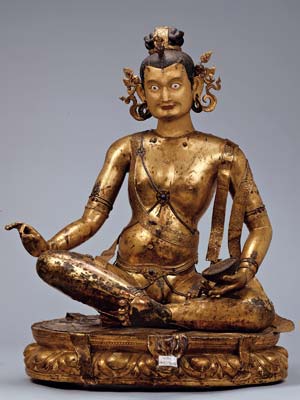
Statue of Kāṇha, from the Museum für Asiatische Kunst, Berlin. From the 2007 exhibition Klöster öffnen ihre Schatzkammern.

And a note…
…on the name Olapati:

  • Matthew Kapstein (2006: p.20) wrote on the name Olipati, from Pelliot tibétain 849: “Oli (perhaps < Skt. āvalī) occurs in the formation of certain technical terms of haṭhayoga, e.g., vajrolimudrā, referring to the yogic practice of sexual congress. A possible interpretation might therefore be *(Vajr)olipaddhatitantra.”
  • Ronald Davidson (2005: 200-201) links the name Olapati to the canonical Tibetan text The Four Stages (Rim pa bzhi pa, Q.2168). He points out that ola survives in the (reconstructed?) Sankrit title to the autocommentary on the The Four Stages, which is Olacatustustaya-vibhaṅga (Tibetan Rim pa bzhi’i rnam par ‘bzhed pa, T.1460). Here ola is equivalent to rim pa, “stage”, while instead of pati we have the standard Sanskrit catuḥ for “four” (bzhi pa).

And another note (added on February 13th)…

The South Indian languages provide plenty of possibilities for all the elements under consideration here, ola, oli and pati. Though I am not any kind of expert in these languages, the possibility is too interesting to ignore, so I am going to speculate, based on Burrow and Emeneau’s A Dravidian Etymological Dictionary and the Cologne Online Tamil Lexicon (http://webapps.uni-koeln.de/tamil).

Since there is no equivalent for the Tibetan bzhi po “the four” in ola/oli/pati, I wonder if the Tibetan name is not a direct translation of Olapati, but rather a descriptive name for the text? In that case, we can look a little more widely for meaning of the name Olapati:

First, ola/oli:

  1. First of all, in many South Indian dialects ōla (or ōlai or ōle) means a page or a book, by extension from the ola palm leaves that are used to make books.
  2. The Tamil noun oli can refer to any sound, to speech or more specifically, to the “loud or audible recitation of a mantra.”
  3. The verbal root oli– or olap– can mean to wash or cleanse in Tamil.
  4. In various South Indian dialects, both oḷa and oḷi have meaning of secrecy and concealment.

Now, pati/patti:

  1. We have the Tamil and Malayam verb pati, “to be imprinted, indented.” Considering that writing on Indian palm leaves is a form of imprinting or indentation, could ōla-pati mean “impressed on palm leaves”?
  2. We have the Tamil verb paṭi, meaning “to practise, habituate oneself to,” which would combine well with some of the meanings of ola/oli attested above, as well as Kapstein’s interpretation of oli.
  3. There is a Tamil noun paṭi, meaning “a step, stair, rung of a ladder, stirrup, grade, rank…” This would be a clear equivalent to the Tibetan rim pa, “stage” and could be combined with some of the meanins of ola/oli above.
  4. And finally, several dictionaries give patti as an equivalent for Sanskrit bhakti, meaning devotion, religious observance and so on. This could be combined with the meaning of oḷa/oīi above to mean “secret” or “hidden” religious observance. Bhakti is particularly associated with deity cults like that of Śīva, which ties in nicely with Kāṇha’s status as a former Śaiva yogin.

In any case, since I have not taken the morphology of these terms into account, I can hardly suggest a best reading here, but if anyone with a knowledge of South Indian languages reads this, I’d be most grateful for any thoughts.

Dunhuang and the ‘new’ schools

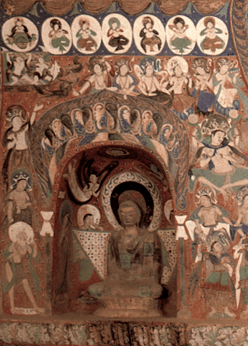
Cave 285In several posts over the last year I’ve tried to point out connections between what we see in the Dunhuang manuscripts and the Nyingma tradition. The Nyingma lineages derived from the early transmission of Tibetan Buddhism, which our manuscripts represent, so these connections are not really surprising. In the Nyingma these early transmissions are known as kama (bka’ ma), to distinguish them from terma (gter ma), the rediscovered treasure tradition. Should our Dunhuang manuscripts be considered kama or terma? I suspect that they cannot really be considered either, because they lack one vital aspect of both of these kinds of transmission: a lineage.
Despite the lack of a lineage, connections between the manuscripts and the Nyingma traditions are clear. As I’ve discussed in previous posts, we have found Padmasambhava in the manuscripts, as well as fragments of his Seven Line Prayer. We have seen the growing importance of Avalokiteśvara (or Chenrezig), later to become the centre of the Mani Kambum treasure cycle. We have seen lists of the nine vehicles and the twenty-eight samaya vows, just as they appear in the later tradition. We have seen the influence of the Mahāyoga tantras, especially the Guhyagarbha, and of Dzogchen appearing here as the view of Mahāyoga.

* * *

Now I would like ask a different question: do the Dunhuang manuscripts have any relevance to the other main schools of Tibetan Buddhism? These schools, of which the main ones flourishing today are Kagyü, Sakya and Gelug, are all known as ‘new’ schools (gsar ma) to distinguish them from the ‘old’ lineages (rnying ma). The ‘new’ lineages came to Tibet from India from the late 10th century onwards, so any overlap with our Dunhuang manuscripts seems unlikely (remember, the library cave was closed at the beginning of the 11th century).

But in one fundamental aspect, the answer to this question is certainly yes. That aspect is the sutras. It is not often realized that over 90% of the sutras in the Tibetan canon were translated in the imperial period, that is, by the mid-ninth century. Thus all of the schools of Tibetan Buddhism hold lineages for the sutras that go back to the early period, and all of them are in this sense, Nyingma (that is ‘old’ rather than ‘new’)! The Dunhuang collection is full of sutras, the heritage of every Tibetan Buddhist school.

What’s more, the sutra-based oral instructions that the Kadam school propagated from the 11th century, simple contemplations on topics like impermanence, cause and effect (karma) and suffering, are also to be found in the Dunhuang manuscripts; in fact it was the particular wish of the emperor Trisong Detsen that these basic teachings of the Buddha be propagated in Tibet above all others. So in this sense, all of the Tibetan schools share a continuity with the earlier tradition, since all schools have their own kinds of contemplation on these topics.

* * *

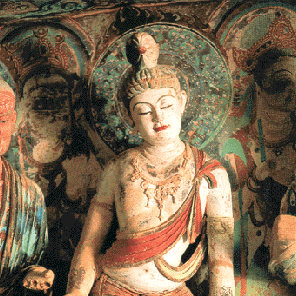
Avalokitesvara Cave 45Turning to the tantric manuscripts, we find that some tantras which are central to the ‘new’ schools were already present in the early period. The most important of these is the Guhyasamāja tantra, which is found among the Dunhuang manuscripts in a version that closely matches the one in the Nyingma tantric canon. This tantra was retranslated in the later period, but the similarities between the ‘new’ and the ‘old’ translation shows that the later translators were quite aware of the previous version, and relied on it when they made their new translation.

As for the Sakya school, there has always been an acknowledged Nyingma aspect of their tantric transmission, that is, the wrathful practices of the deity Vajrakīlaya. The Khön family, from which the heads of the Sakya school have always been selected, goes back to Khön Lui Wangpo, one of the first monks in Tibet, traditionally also considered a disciple of Padmasambhava. Though the Khön family later turned to the ‘new’ transmissions, they kept their lineage of Vajrakīlaya and his associated dharma protectors, as well with the lineages of the deity Viśuddha Heruka (one of the eight deities of the Nyingma Kagyé tradition).

Among our Dunhuang manuscripts are many texts on Vajrakīlaya, both practice texts and the short history that I quoted recently that tells us about Padmasambhava’s teaching of Vajrakīlaya practices. There are also many manuscripts on the wrathful Heruka. So of all the ‘new’ schools of Tibetan Buddhism, the most direct connections with the Dunhuang manuscripts are found among the Sakya, but it seems worth keeping in mind that every school has strong connections (if not always acknowledged) with the early period. It’s good to remember how much everybody has in common. I invite any other ideas about where such connections might lie, and I promise to chase up some more specific connections with the ‘new’ schools in the next posts. Consider it a New Year’s resolution.

Images
1. Meditating monk. Dunhuang cave 285, west wall. (c) The Dunhuang Academy.
2. Avalokiteśvara. Dunhuang cave 45. (c) The Dunhuang Academy.