The red-faced men II: China or Tibet?

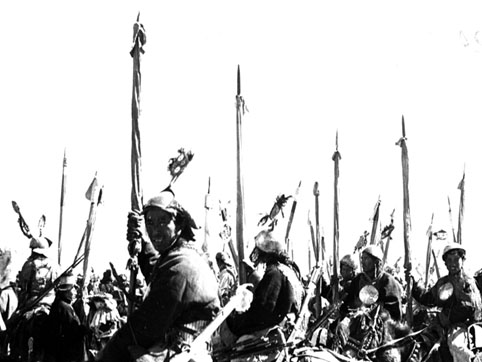
Tibetan warriors

In the illuminating discussion which followed my last post, it transpired that I was not quite correct in saying that Tibetans have always understood “the land of the red-faced men” to be Tibet (thank you, ‘Dab’). In fact no less an authority than the great historian Büton (1290-1364) suggested that in one particular source it referred China:

In the Accounts of Ba it is said that the land of the red-faced men is China.

Well, the Accounts of Ba is one of our oldest Tibetan histories, and we should pay attention to what it says. When we look into the Accounts of Ba we do indeed find a mention of a prophecy about Buddhism coming to the land of the red-faced men. A version of this story appears in both the Accounts of Ba as published by Gönpo Gyaltsen in 1980 (Sba bzhed) and the older version published by Pasang Wangdu and Hildegarde Diemberger in 2000 (Dba bzhed).

Let’s look at the oldest version of the story. While Trisong Detsen is still young and has yet to establish Buddhism in Tibet, two members of the Ba clan, Ba Selnang and Ba Sangshi, are sent to China to receive dharma texts from the Chinese emperor (this is before the invitation of Śāntarakṣita and Padmasambhava to Tibet). While they are travelling, an astrological expert in Bumsang predicts their arrival and identifies them as bodhisattvas. So by the time Ba Selnang and Ba Sangshi arrive at the Chinese court, the rumour that they are bodhisattvas has preceded them, and they get quite a reception. I quote from the Wangdu/Diemberger Accounts of Ba:

The Chinese emperor said [to Ba Selnang and Ba Sangshi]: “You are the two bodhisattvas who should have arrived at around this time according to the expert in astrological science in Bumsang. Even Kim Hashang prostrated to you. The Buddha prophesied that a spiritual master for the practice of the holy dharma would appear in a time close to the final 500 year [period of the dharma] in the land of the red-faced men. According to your behavior, you are certainly the prophesied ones.”

It is possible to see from this passage what made Butön think that the land of the red-faced men was supposed to be China. There is some ambiguity about whether the emperor is linking the prophecy to Ba Selnang and Ba Sangshi’s appearance in Tibet or to their arrival in China. I would certainly argue that the former was intended rather than the latter. Fortunately I can draw on the support of another great Tibetan historian here.

Pawo Tsuglag Trengwa (1504-1564/6) was the author of the most important Tibetan historical work yet to be translated into English: A Scholar’s Feast (Mkhas pa’i dga’ ston). As a historian, Pawo was notable for his critical approach to his sources and his use of neglected and early source material. Rather than just accept Butön’s statement, he went back to look at the Accounts of Ba, and this was his conclusion:

According to the all-knowing Butön, the Accounts of Ba state that the country of the red-faced men is China. But in the Accounts of Ba it is said that when Ba Selnang and Ba Sangshi were sent to China to receive the dharma, an expert in divination said: “Emanations of bodhisattvas looking like this will come as messengers,” and he drew a picture. So when [Ba Selnang and Ba Sangshi] arrived they were given a great reception by the [Chinese] emperor. [The emperor] said, “There is a prophecy that a bodhisattva will appear in the land of the red-faced men who will be a source of the dharma. I am certain that it is you,” and he gave them 1,000 volumes of dharma. So it is very clear that the land of the red-faced men is indeed Tibet.

* * *

See also
The Red-Faced Men I: warriors with painted faces
The Red-faced Men III: the red-faced women

References
1. Obermiller, E. 1931-2. The history of Buddhism (Chos ḥbyung) by Bu-ston. I The Jewellery of Scripture, II The history of Buddhism in India and Tibet. Heidelberg: O. Harrosovitz. Reprint 1986 New Delhi: Sri Satguru Publications. [p.108]
2. Wangdu, Pasang & Hildegarde Deimberger. Dba’ bzhed: The Royal Narrative concerning the bringing of Buddha’s Doctrine to Tibet. Vienna: Verlag der Österreichischen Akademie der Wissenschaften. [pp.48-50]

Tibetan sources

1. Bu ston rin chen grub. Chos ‘byung gsun rab rin po che mdzod [History of Buddhism]. Beijing: Khrung go bod kyi shes rig dpe skrun khang. 1988.
2. Dpa’ bo gtsug lag ‘phreng ba. Chos ‘byung mkhas pa’i dga’ ston [A Scholar’s Feast]. Varanasi: Vajra Vidya Library. 2003. [pp.167-8]
3. Sba bzhed [The Accounts of Ba]. Mgon po rgyal mtshan (ed.). Mi rigs dpe skrun khang. 1980, 1982. [p.7]
The red-faced men I: Warriors with painted faces

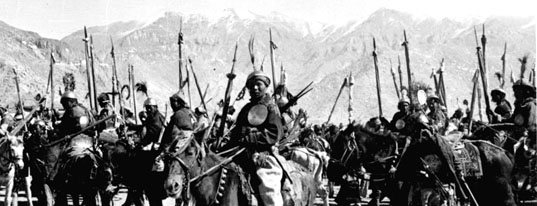
Tibetan mounted warriors

Tibetan histories present the Tibetans before their conversion to Buddhism as violent and unlearned, without writing, law or the civilizing effect of the dharma, and possessing a number of unsavoury customs, including blood sacrifices and painting their faces red with ochre or vermilion. The description of the Tibetans as ‘red-faced men’ came to be a signifier of all of this pre-Buddhist barbarity, and of the civilizing effects of Buddhism. In the early 10th century Nub Sangye Yeshe wrote of early Tibet: “These kingdoms at the borderlands, these lands of the Tibetans, the red-faced barbarians.” A couple of centuries later the Sakya patriarch Sönam Tsemo quoted the following prophecy (spoken by the Buddha) in his history of the dharma:

“Two thousand five hundred years after my parinirvāṇa, the true dharma will be propagated in the land of the red-faced men.”

In Sönam Tsemo’s time, the date of the Buddha’s passing was thought to be around 2130 BC, which is indeed around 2,500 years before the introduction of Buddhism to Tibet in the mid-7th century. After Sönam Tsemo this prophecy continued to appear in many Tibetan histories. So, where did this characterization of the early Tibetans as ‘red-faced men’ come from? If the Tibetans did have the custom of painting their faces with ochre or vermilion before going into battle, then the first impression that their enemies—such as the Central Asian kingdoms—formed of these newcomers would have been of terrifying ‘red-faced men’.

As for the prophecy, Sönam Tsemo said that it was from a scripture called The Enquiry of the Goddess Vimala. Now this surely must be the same text as the one found in the Tibetan canon called The Enquiry of Vimalaprabhā, a Khotanese text that was translated into Tibetan. Cast in the form of a prophecy, it deals with the fears of the Khotanese Buddhists under the onslaught of the Tibetan war machine in the 7th century, and their hopes for a saviour. (FW Thomas whimsically suggested that the The Enquiry of Vimalaprabhā was the Khotanese Romance of its age and that its heroine was Khotan’s Joan of Arc!) The prophecy about the dharma being propagated in the land of the red-faced men does not in fact appear here, but the Tibetan warriors are constantly referred to as ‘red-faced men’.

It does then seem that we have the Khotanese to thank for the enduring image of the early Tibetans as ‘red-faced men’. This is only one instance of the cultural influence of Khotan upon Tibet, an influence that was later almost entirely forgotten by the Tibetans themselves. After the 10th century Khotan became part of the Islamic world, and its influence on Tibetan Buddhism ended. The Tibetans gradually forgot even the location of the place called Khotan (or rather Liyül in Tibetan), often confusing it with distant Nepal. In an odd parallel, many later Islamic geographies seem to have confused the location of Tibet with Khotan.

As a postscript to this discussion, I couldn’t ignore the much-quoted prophecy attributed to Padmasambhava which also speaks of Buddhism coming to the ‘red-faced men’, often interpreted uncritically as a reference to Native Americans:

When the iron bird flies and horses run on wheels the Tibetan people will be scattered like ants across the face of the world, and the dharma will come to the land of the red-faced man.

I have never seen a reliable reference to the source of this prophecy (presumably it ought to be from a treasure text) and I’d be happy to be put right if anybody is able to point out a source. However, even if there is something like this prophecy in a genuine Tibetan source it should be pointed out that Tibetans would always have understood the phrase ‘red-faced men’ to refer to themselves.

*  *  *

See also
The Red-faced Men II: China or Tibet?
The Red-faced Men III: the red-faced women

References
1. Thomas, F.W. 1935. Tibetan Literary Texts and Documents, Part I: Literary texts. London: Royal Asiatic Society.
2. Vogel, Claus. 1991. “Bu-ston on the date of the Buddha’s Nirvana. Translated from his History of the Doctrine (Chos-‘byung). In The Dating of the Historical Buddha. Göttingen: Vandenhoeck and Ruprecht.

Tibetan Sources
1. Dri ma med pa’i ‘od kyis zhus pa [The Enquiry of Vimalaprabhā]. Q.835.
2. Gnubs sangs rgyas ye shes. Bsam gtan mig sgron / Rnal ‘byor mig gi bsam gtan [A Lamp for the Eyes of Contemplation]. Leh, Ladakh: S. W. Tashigangpa, 1974.
3. Bsod nams rtse mo. Chos la ‘jug pa’i sgo [An Introduction to the Dharma]. In Sa skya bka’ ‘bum, vol.I.

Image
Photograph of Tibetan soldiers in ceremonial costumes supposed to represent Imperial-period Tibetan soldiers. Taken by Lt. Col. Ilya Tolstoy and Capt. Brooke Dolan in 1942-3. See Rob Linrothe’s site.

Buddhism and Empire II: Portrait of a monk

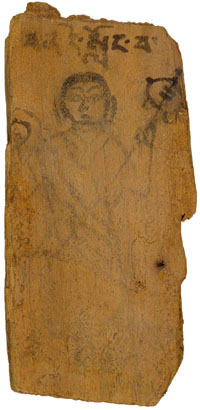
IOL Tib N 2280This little piece of wood (IOL Tib N 2280) was found among the Tibetan woodslips in the hill fort of Mazar Tagh, one of the outposts of the Tibetan Empire. It can be dated to the period of the Tibetan occupation of Khotan, between the 790s and 840s. On the top is written ban de slong ba, “a begging monk”. It is probably a portrait, sketched by one of the soldiers at the fort, of an actual monk who came to beg there. Though Mazar Tagh lies some way from the nearest city, Khotan, it was actually a pilgrimage site, known to the Khotanese Buddhists as The Hill. Thre is evidence for this among the Khotanese manuscripts, where we find a poetic account of one monk’s pilgrimage to The Hill.

So our monk in the portrait probably made the pilgrimage to The Hill, and then visited the Tibetan fort to ask for food. We know that the Tibetan soldiers often ran out of food supplies, from their many letters written to the main garrison at Khotan to ask for more. I wonder how often they gave anything to the pilgrim monks. That partly depends on how far Buddhist values had permeated the ordinary Tibetan soldiers manning the Empire’s outposts. Since giving to monks was an important way of generating merit for oneself, a soldier who had truly absorbed Buddhism might give something despite running short of food.

The picture of the monk is, obviously, rather crude and certainly not the work of a trained artist. So we can’t draw conclusions about the monk’s ethnic origin based on the way his facial features are drawn here; I would still suggest that he is most likely to have been Khotanese. The upper undergarment and robe (worn over the right shoulder) are drawn clearly enough, as is the fan he holds in his left hand. It’s not clear what he is meant to be holding in his right hand; perhaps a begging bowl is intended.

Further suggestions welcomed!

Sources
Emmerick, R.E. A Guide to the Literature of Khotan. Tokyo : The International Institute for Buddhist Studies, 1992.

In search of the Guhyagarbha tantra

Vajrasattva (Cave 14)The Guhyagarbha tantra is a vital part of Tibet’s Nyingma (“ancient”) lineages. And yet, ever since the 11th century, when certain partisans of the new translations questioned the authenticity of the Guhyagarbha tantra, its status became a disputed issue in Tibet.

The most detailed and sustained attack on the authenticity of the Guhyagarbha tantra was written by the 11th century translator Gö Khugpa Lhetse, based on his failure to find any lineage for the tantra in India and the fact that, according to his judgement, it didn’t resemble genuine Indian tantras. Gö Khugpa’s criticism was rather rash: features which he found suspect in the Guhyagarbha are in fact also found in tantras of the new translation period that he accepted. Nevertheless, enough doubt remained that the tantra was excluded from the scriptural canon (bka’ ‘gyur) compiled in the 14th century.

According to some Nyingma apologists, Gö Khugpa attacked the tantra because he had been refused certain transmissions by Zurpoché Shakya Jungne, one of the most influential Nyingma figures of that period. The story has some credibility, as Gö Khugpa is portrayed as a competitive and rather bad-tempered character in some non-Nyingma histories, including the Subtle Vajra, the early Sakya history translated by Cyrus Stearns in his book Luminous Lives. There we see Gö Khugpa falling out with his teacher Drogmi and trying to outdo him by travelling to Nepal to meet the great master Maitripa (in fact he meets Drogmi’s own teacher Gayadhara, who fools him into thinking he is Maitripa).

In any case, if Sakya scholars have not tended to join in these attacks on the Guhyagarbha tantra’s authenticity, it may be because Śākyaśrībhadra, the Kashmiri guru who taught Sakya Paṇḍita, verified a Sanskrit manuscript of the tantra which had been found at Samyé (this is mentioned in a 12th or 13th century Sakya biography of Śākyaśrībhadra). The manuscript was passed from hand to hand until it reached Gö Lotsawa Zhönu Pal, author of the Blue Annals, who wrote:

When the Great Kashmiri Pandita [Śākyaśrī] arrived at Samyé, he discovered the Sanskrit text of the Guhyagarbha. Later it came into the hands of Tatön Ziji, who presented it to it Shagang Lotsawa. The latter sent the manuscript to Chomden [Rigpai] Ralgri, who accepted it and composed The Flower to Ornament the Accomplishment of the Guhyagarbha. He showed the text at an assembly of tantrikas at Mamoné, and highly praised it. After that Tarpa Lotsawa made a translation of the Subsequent Guhyagarbha Tantra which had not been found before. Most of the pages of the manuscript were damaged. The remaining pages of the Sanskrit manuscript are in my hands.

So the authenticity of the Guhyagarbha tantra seems to be rather a non-issue, despite all the polemical activity devoted to the question over the centuries in Tibet. Still, some may be interested in the Guhyagarbha-related material that is to be found in the Dunhuang collections. While these manuscripts are alost certainly no earlier than the 10th century, they do provide some insights into the role of the Guhyagarbha in early Tibet:

  • Some of the sādhanas (manuals for meditation practice) quote the Guhyagarbha, though this is a little inconclusive, since (i) it is difficult to find exact parallel passages in the tantra itself and (ii) the Guhyagarbha is not mentioned by name. See for example IOL Tib J 332, which was originally noticed by Ken Eastman in his article listed below.
  • One manuscript (IOL Tib J 540) is a list of the mantras and the names of each of the 42 deities from the Guhyagarbha‘s peaceful maṇḍala.
  • One scroll, which I mentioned in the previous post (Pelliot tibétain 849), contains a list of tantras in Tibetan and Sanskrit. It includes the Guhyagarbha–listed as rgyud gsang ba’I snyIng po in Tibetan and ‘Gu yya kar rba tan tra in Sanskrit (the Sanskrit tranliterations on this scroll are wildly erratic). The scroll is, as I mentioned previously, probably notes from the teachings of an Indian guru who passed through Dunhuang on his way to China. However, it is dated to the very end of the 10th century, so this tells us little about the existence of the tantra in Tibet prior to this time.

Thus something of the Guhyagarbha tantra is there in the manuscripts, but it has a lesser presence than one might expect given its importance in the later Nyingma tradition. What is perhaps most striking is how many more references and quotations from a different tantra, the Guhyasamāja, are found among the manuscripts. The Guhyasamāja tantra itself appears in an almost complete manuscript (IOL Tib J 438), and is quoted more often and by name in various treatises and sādhanas. This raises the question of whether the Guhyasamāja tantra was actually more influential in pre-11th century Tibet than the Guhyagarbha tantra.

Perhaps the attacks on the Guhyagarbha and similar tantras were after all, as the Nyingma apologists suggest, politically motivated. In the struggles between the holders of the old lineages (i.e. the incipient Nyingmapas, the Zur family in particular) and the translators of the newly arrived tantric lineages, the Guhyagarbha was an easy target, as it was not featured in any of the new lineages, unlike the Guhyasamāja. Equally the Nyingmapas seem to have focussed more and more on the Guhyagarbha from the 11th century onward–perhaps exactly because it was not shared with the new schools.

References
1. Dorje, Gyurme. (no date). The Guhyagarbha Tantra: Introduction. Online at the Wisdom Books Reading Room
2. Eastman, Kenneth. 1983. “Mahāyoga Texts at Tun-huang”. Bulletin of the Institute of Cultural Studies, Ryukoku University 22: 42-60.
3. van der Kuijp, Leonard. 1994. “On the Lives of Śākyaśrībhadra (?-?1225)”. Journal of the American Oriental Society 114/4: 599–616. Available on JSTOR.
4. Martin, Dan. 1987. “Illusion Web: Locating the Guhyagarbha Tantra in Buddhist
Intellectual History”. Christopher I. Beckwith (ed.) Silver on Lapis: Tibetan Literary Culture and History. Bloomington: The Tibet Society. 175-220. Available for free download here.
5. Roerich, G.N. (trans.) 1949. The Blue Annals. Calcutta: Royal Asiatic Society of Bengal. (See pp.104-5.) Also available here.
6. Stearns, Cyrus. 2001. Luminous Lives. Boston: Wisdom Publications.
7. Wangchuk, Dorji. 2002. “An Eleventh-Century Defence of the Authenticity of the Guhyagarbha Tantra“. In Eimer and Germano (eds), The Many Canons of Tibetan Buddhism. Leiden: Brill.

Images
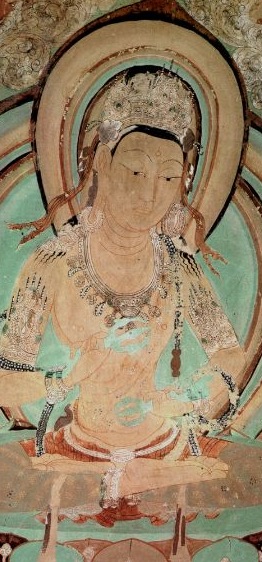
A 9th century wall painting of Vajrasattva from Dunhuang Cave 14. © The Huntington Archive.