Secrets of the Cave II: The “Library Cave”


The really frustrating thing about the discovery of the Dunhuang cave, source of the earliest Tibetan manuscripts, is that nobody recorded what it looked like when it was reopened after some 900 years. Aurel Stein — who didn’t discover the cave, but was the first person on the scene to record what he saw, wrote:

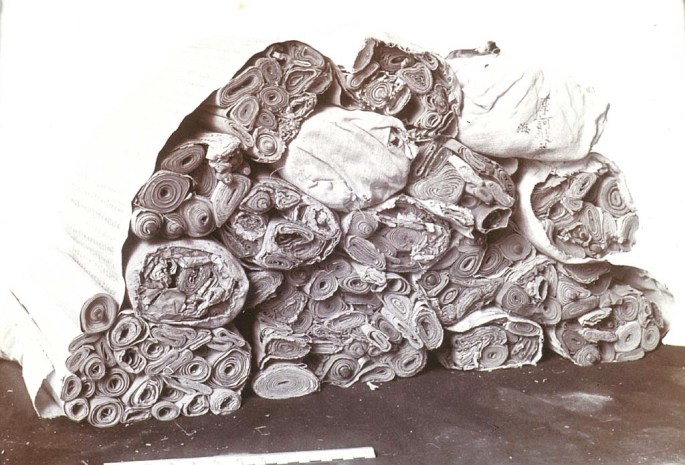
Mixed up with these disarranged leaves, Chinese and Tibetan rolls, and portions of large Tibetan Pothis, there were found convolutes of miscellaneous Chinese papers, written on detached sheets. The utter confusion prevailing in these bundles and their careless fastening, often without an outer cloth cover, clearly showed that no trouble had been taken to preserve the materials in whatever kind of arrangement they might have originally been found.

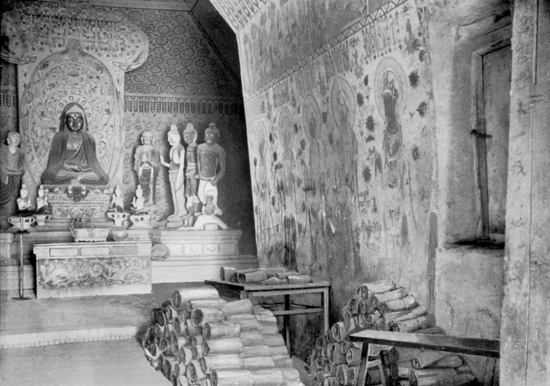
Stein himself contributed to the problem. He had to negotiate with the Chinese monk Wang Yuanlu, who had discovered the sealed cave and was wary of the foreigner’s motivations. So Stein did not press Wang for access to the cave himself. Instead, Wang climbed inside and handed manuscripts out, and Stein (and his Chinese assistant) examined them in the larger space of Cave 16 (as you can see in the picture above). So, we have no archeological record of how the manuscripts were arranged in the cave before it was sealed, and this is one reason why nobody has yet been able to agree why the manuscripts were put in there in the first place.

*  *  *

When Stein wrote about his discovery of a cave full of manuscripts at Dunhuang, he called it a “monastic library” but I don’t think he really considered this very seriously, and he didn’t offer any theories about why a Buddhist monastery would place its whole library in a cave. Then, later on, when scholars looked more closely at the manuscripts which had monastic library stamps, they saw that they came from a variety of different monasteries. Why would that be?

Well, it could all be down to a monk called Daozhen, a member of the Sanjie monastery. In the year 934, he spent some time in his monastery’s library, and noticed how poorly stocked it was. Filled with religious enthusiasm, he vowed to make it better:

I will go carefully through the cartons and storehouses of all the families, seeking after sold and decayed scriptural texts. I will gather them in the monastery, repair and patch them from beginning to end, and pass them down the ages. Their light will beautify the gate of mystery for ten thousand generations and one thousand autumns.*

As Stephen Teiser has pointed out, Daozhen was no ordinary monk, but a member of one of the ruling families of Dunhuang, with plenty of connections to the wealthy laity. So it would not have been difficult for him to approach them for manuscripts which they no longer needed. Another scholar, Rong Xinjiang made the leap to arguing that the fruits of Daozhen’s labours are the contents of the Dunhuang cave itself.
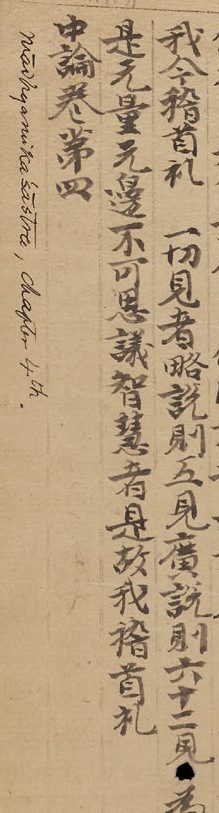
As he promised in his vow, Daozhen collected unwanted fragmentary or duplicate manuscripts, and used them to fill gaps in the Sanjie monastery’s library, or to repair incomplete works in that library. Thus according to Rong, the existence of so many incomplete manuscripts in the Dunhuang cave is due to Daozhen’s efforts in collecting manuscripts from elsewhere. Rong also pointed out that many of the manuscripts are not actually incomplete, and seem to have been originally stored in the cave in neatly catalogued bundles.

Then in the early 11th century, Rong argues, the entire library of the Sanjie monastery was moved over to the Dunhuang cave and sealed. Why? Probably for its own safety, for fear of the Islamic armies who were threatening the Silk Route cities to the west. Thus for Rong, the contents of the Dunhuang cave represent a complete monastic library, rather than a variety of libraries and personal collections.

*  *  *

Rong’s theory is thorough and well-argued, and many have found it very convincing. You can read it yourself, in English translation, online: see the link below. But it is not actually conclusive. Shortly after Rong published his theory, another scholar (Dohi Yoshikazu) attacked it, arguing that only about 200 manuscripts can be shown to come from Sanjie monastery, which is a tiny fraction of the thousands of manuscripts from the cave. Nor is there any evidence that this monastery was near the caves (most if not all were several miles away in the nearby town). He also pointed out that another monastery in Dunhuang (Baoen), was inspecting and restocking its library at the end of the tenth century. So Sanjie was hardly a unique case.

Ultimately, I don’t think that Rong’s argument is necessarily wrong. It’s more that he presents it as a rebuttal of all other theories, especially that of what he calls “the sacred waste school.” When we don’t have command of all the historical facts, it doesn’t seem very wise to identify oneself with one particular theory to the exclusion of all others. Even if we accept that the Sanjie library really was sealed up in the Dunhuang cave, does that mean that it couldn’t also have been a repository for other pious deposits as well? And if we see something in Rong’s theory that this library was put in the cave to save it from non-Buddhist invaders, do we have to give up the possibility that people placed manuscripts in the cave at other times and for other reasons?

*  *  *

References

Dohi Yoshikazu. 1996. “Tonko isho fūhei no nazo wo megutte” 敦煌遺書封閉の謎をめぐって. Rekishi to chiri: Sekaishi no kenkyū 486: 32–33.

Rong Xinjiang. 2000. “The Nature of the Dunhuang Library Cave and the Reasons for its Sealing.” In Cahiers d’Extrême-Asie 11: 247–275. Online version here.

Stein, M. Aurel. 1921. Serindia: Detailed Report of Explorations in Central Asia and Westernmost China. 5 vols. Oxford: Oxford University Press. (quotation above from vol.II, p.811)

Teiser, Stephen. 1994. The Scripture on the Ten Kings and the Making of Purgatory in Medieval Chinese Buddhism. Honolulu: University of Hawaii Press.

*  *  *

Images

1. Photo showing Cave 16 and the manuscripts piled up for Stein to examine near the entrance to Cave 17, the “library cave”.

2. The manuscript Or.8210/S.5663, which was commissioned by Daozhen.

*  *  *

Note

* This is part of the colophon to the National Library of China manuscript Xin 新 329. The translation is from Teiser 1994. Daozhen’s commissioning of manuscripts is mentioned in another colophon, in the manuscript Or.8210/S.5663.
Secrets of the Cave I: “Sacred Waste”

The Tibetan manuscripts from the sealed cave in Dunhuang are still the earliest that we have (along with those from the Tibetan forts in the Taklamakan desert). So, some readers might be surprised to hear that there is absolutely no agreement about why they were put in the cave, and why it was sealed up. Our failure to answer these questions remains deeply problematic. How much can we say for sure about these sources for Tibetan culture and history if we don’t know these basic facts about the reasons they have survived to this day?

Marc Aurel Stein was the first archeologist to reach the caves and gain access to the manuscripts. (He did not however, discover them; that honour goes to the Chinese monk Wang Yuanlu.) In his immense reports of his expedition, Serindia, he speculates about why the manuscripts were placed in Cave 17 (the number he gave the manuscript cave). He suggested that they were essentially discarded manuscripts, which nobody needed anymore, but could not be destroyed because of their sacred, Buddhist content. They were, in his influential phrase, “sacred waste”.

This idea was widely accepted by Dunhuang scholars like Akira Fujieda, and many still argue for it. In China it has a name:  feiqi shuo, the “waste theory.” I’ve always found it a bit unsatisfactory as an explanation. For one thing, it doesn’t easily explain all the non-religious manuscripts in the cave, or the many beautiful and complete manuscripts (and paintings too). It seems a bit naive about the complexities of material culture. And most of all, this apparently pragmatic explanation doesn’t really engage with Buddhist ritual practice.

*  *  *

Actually, Stein himself had a more nuanced view (he usually did). In Serindia he mentioned that some of the bundles of manuscripts looked as if they had been picked up and deposited in the cave as a religious (or as he put it, “superstitious”) act. This touches on a truth that the phrase “sacred waste” does not — that the act of depositing manuscripts can itself be a religious act. But what kind of religious act might lie behind depositing manuscripts in a cave?

As well as scraps and fragments, the cave contains hundreds of complete copies of the same sutra.We know that many of these were copied for patrons, from a single copy of the Lotus Sutra for a nun mourning the loss of her mother, to hundreds of copies of the Sutra of Aparamitayus to ensure the long life of the Tibetan emperor. Apart from the merit generated by the writing of these manuscripts, they had no other use. Placing them in the cave was the final act in a ritual process. This has been put nicely by John Kieschnick in his book on Buddhism and material culture:

In this context, the prodigious store of copies of the Diamond Sutra at Dunhuang, virtually identical in content and originally belonging to only a few monastic libraries, begins to make sense: for the most part these are “receipts” for merit-giving transactions, rather than scriptures that were read.

This also explains the presence of Buddhist paintings, many of them in good condition, in the cave. The pictures of donors that are often found at the bottom of these paintings show that they too were commissioned, painted, and finally deposited, in the process of creating and dedicating merit.

*  *  *

Now, what if all the Buddhist manuscripts deposited in the cave (not just the sutras explicitly copied to generate merit) had a ritual function? This struck me a few years ago when I read Richard Salomon’s thoughts on the oldest Buddhist manuscripts in the world: the Kharosthi scrolls.

It can be safely assumed that the manuscripts in question, regardless of their specific character or condition, were understood and treated as relics. The status of their written representations of the words of the Buddha as dharma-relics, functionally equivalent to bodily relics of the Buddha or other Buddhist venerables, is widely acknowledged in the Buddhist tradition. Thus, the essential motivation for interring manuscripts is obvious; it was a form of relic dedication.

Of course, the Kharosthi manuscripts are not the Dunhuang manuscripts (as far as we can tell, the former seem to have been buried in the foundations of a monastery). Still, this way of looking at the Dunhuang manuscripts makes me doubtful of the highly pragmatic explanations of the “sacred waste” theory, like Akira Fujieda’s idea that the manuscripts were disposed of once printing was introduced to Dunhuang. Or Fang Guangchang’s theory that they were taken out of local monasteries after a large-scale inventory project.

So, if the phrase “sacred waste” brings to mind some kind of fancy landfill site, understanding the manuscripts as relics might bring us closer to the world of the Buddhist monks of Dunhuang. If the manuscripts were “functionally equivalent” to the body of the Buddha, every time someone deposited a manuscript in the cave it was a ritual act, pregnant with symbolism, and operating in the system of merit creation and dedication. Even if we don’t chuck out the waste theory, this seems worth keeping in mind.

*  *  *

References

Fang Guangchang. 1988. “Dunhuang yishu zhong de fojiao zhuzuo” 敦煌遺書中的佛教著作. Wenshi zhishi 1988.10: 87-90.

Fujieda Akira. 1966. “The Tun-huang Manuscripts: A General Description, Part I.” In Zimbun: Memoirs of the Research Institute for Humanistic Studies, Kyoto University 9 (1966):1-32.

Fujieda Akira. 1969. “The Tun-huang Manuscripts: A General Description, Part II.” In Zimbun: Memoirs of the Research Institute for Humanistic Studies, Kyoto University 10 (1969):17-39.

John Kieschnik. 2003. The Impact of Buddhism on Chinese Material Culture. Princeton and Oxford: Princeton University Press. (quote on p.170)

Richard Salomon. 2009. “Why did the Gandhāran Buddhists bury their manuscripts?” In Stephen C. Berwitz, Juliane Schober and Claudia Brown (eds), Buddhist Manuscript Cultures: Knowledge, Ritual and Art. London and New York: Routledge. 19–34. (quote on p.30)

M.A. Stein. 1921. Serindia: Detailed Report of Explorations in Central Asia and Westernmost China. 5 vols. Oxford: Oxford University Press. (quote on p.820)

*  *  *

Images

1.  Bundles of scrolls from the cave, photographed by Stein. (c) British Library, Photo 392/27(589).

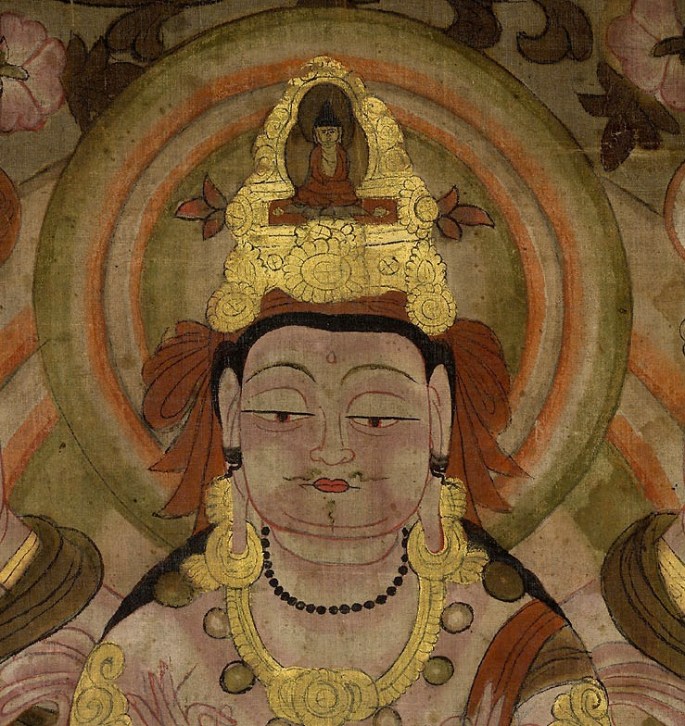
2. A painting of Avalokiteśvara, one of the high-quality and undamaged paintings put into the cave in the 10th century. (c) British Museum (Stein Collection) 1919,0101,0.2.

*  *  *

A final note…

If I seem to have missed things out in this discussion, that’s because it’s the first in a series. Next up, II: The Cave Library, and III: The Cave of Monk Wu.

Dharma from the Sky III: Self-Appointed Buddhas

The Tibetan manuscripts found when the sealed cave in Dunhuang was opened in 1900 are still the oldest in the world. But many of them are not as old as we once thought. When the manuscripts were first studied it was assumed that they all dated from the time when the Tibetans ruled Dunhuang, between 786 and 848. It’s a reasonable assumption which is, unfortunately, completely wrong. Certainly some manuscripts do date from this time, but many don’t. We now know that the Tibetan language continued to be used in and around Dunhuang long after the fall of the Tibetan empire, right up to the time the cave was sealed up at the beginning of the eleventh century.

At first it might seem disappointing that we can’t pick up a Dunhuang manuscript and assume that it was produced during the Tibetan empire. But does dating something later necessarily make it less interesting? I don’t think so. Look at the tantric manuscripts for instance. What’s been emerging from recent studies on these is the continuity between what was practised at Dunhuang in the 10th century and the emerging Nyingma traditions of the next few centuries. These manuscripts don’t tell us much about Buddhism in the Tibetan imperial period, but what we get instead is a glimpse into Tibet’s “dark age” when the Nyingma traditions were in their infancy.

*  *  *

Let’s look at a manuscript that is widely assumed to have been written in the time of the Tibetan Empire. I think that it was perhaps not, and that giving it a later date might allow us to understand it better. Found on the scroll IOL Tib J 370, the text was first studied by Hugh Richardson, who translated its title as “The Dharma that Came Down from Heaven.” It tells of the activities of the great emperors Songtsen Gampo and Tri Song Detsen in bringing Buddhism to Tibet, and then goes on to lament a decline in  Buddhism values in Tibet.

It’s a fairly short poem, and apparently not complete, breaking off before the end. Quite why it’s called “The Dharma that Came Down from Heaven” is not clear. Though as Rolf Stein, another great Tibetologist who studied this text, pointed out, the Tibetan word dar ma didn’t mean the teachings of the Buddha in general, but more specifically, a book of Buddhist teaching. So the reference is to a book that fell from heaven — a familiar theme in the later Tibetan tradition that tells of the first appearance of Buddhism in Tibet when books fell on the roof of an ancient emperor (something I wrote about here a while ago). A better translation of the title would be “The Scripture that Fell from the Sky”.

Both of these scholars assumed that the poem dated to the imperial period. In some ways, I can see why. The language is archaic. Yet looking at the scroll itself, I think it was certainly written in the tenth century. For one thing, the handwriting style does not match anything produced in the imperial period. For another, the way the text is written on the back of a Chinese scroll at the end of a series of scriptures and prayers, and in a different handwriting from the texts that precede it, is similar to other scrolls produced in the late 10th century.

*  *  *

If we date this poem to the post-imperial period, something that puzzled both Richardson and Stein suddenly becomes much easier to understand. As I mentioned, at the end of the poem the author laments the decline of Buddhism. Both Richardson and Stein thought that this was a reference to a ban on Buddhism in the mid-eighth century, which was overturned by Tri Song Detsen when he declared that Buddhism was to be Tibet’s state religion. But this assumption didn’t help either scholar to interpret the end of the poem, which they struggled with unsuccessfully.

Now, if the poem was written later than was previous thought, the decline of Buddhism described at the end of it could be the one that happened at the end of the Tibetan empire. With that in mind, let’s have another go at translating the troublesome last lines:

Because the king died and his son was young, the good religion and the old learning declined. How can we practice in the Tibetan way the supreme path of truth, the religion of virtue? Or the adherence to the ten virtues of the Vinaya and the royal laws of the kings, protectors of men? Or the orally taught systems of the wise ancestors?

In between Śākyamuni, who manifested first in this world, and Maitreya, who [is next] to come after he passes away into nirvana, there are suddenly a great many self-appointed buddhas appearing without authentification. Each of them has a different system which is not in accord with the zhu, the dharma or the vajrayāna, i.e. the three [systems] of the seven [past] generations of buddhas. The dharmas are like seeds…

This translation is nowhere near perfect, but I hope it gets closer to what the author is trying to say. It doesn’t look like this is about the ban on Buddhism in the eighth century. It looks more like a complaint about the decline of Buddhism after the reigns of the great Buddhist emperors, when the empire was beginning to fall apart. The author here is concerned about people calling themselves buddhas and teaching something that is unrecognisable as the dharma. So the decline is not a decline in numbers, but in standards.

Interestingly, this new reading of the poem makes it very similar to another poem about the dark age in the manuscript Pelliot tibétain 840, which I wrote about in a previous post. That poem also begins by celebrating the great Buddhist emperors before going on to talk about a decline in standards:

From the Divine Son Darma on down,
And from his descendent Ösung on down
In general the dharma spread and flourished,
Spread and flourished excessively, it’s said,
So that everyone born as a human wanted to accomplish it.

Perhaps when our poem says, “Because the king died and his son was young” it is also referring to Darma and his son Ösung, who was very young when his father died in 842. The later tradition blames the decline of Buddhism very much on Lang Darma, but a close study of the sources suggests that it was only after his death that things started to go wrong for the empire, and for Buddhism as a state religion.

As for those “self-appointed buddhas” that our poem decries, there are ample references to such characters in writings from the next couple of centuries (the 11th and 12th). We have, for example, reports of a Newari called Karudzin who “put a meditation hat on his head, stuck some feathers in it, dressed in fur, made the announcement at Samye, ‘I am Padma,’ and taught innumerable wong teachings.” Then there was the fellow who called himself “Buddha Star-King”, who became famous in Western Tibet until he was bested in a magical contest by the translator Rinchen Zangpo. On them, see Dan Martin’s excellent articles, listed below.

*  *  *

That mysterious title, referring to dharma books falling from the sky, might be interpreted differently as well. Perhaps it isn’t, as Richardson and Stein thought, the first ever reference to the legend of how Buddhism first arrived in Tibet. Perhaps it is instead a sarcastic allusion to the teachings of the self-appointed buddhas, which seem to have dropped out of nowhere. I wonder if the metaphor in the broken-off last sentence might have explained the title.

So, does dating the poem in IOL Tib J 370 to the tenth century rather than the early ninth make it less interesting? We lose a contemporary account of the Tibetan imperial period, but we gain a vivid portrayal of the challenges facing Buddhism in Tibet’s dark age. It’s a portrayal informed by a nostalgia for the past era of the Buddhist emperors, and overlapping with this, fears of what will happen to Buddhism in Tibet without imperial regulation. But like the similar poem in Pelliot tibétain 840, the elegant and literary way in which these fears are expressed shows (perhaps unintentionally) that at least some Tibetans remained highly literate and well versed in Buddhism.

*  *  *

See also

Dharma from the Sky I: Legends and history

Dharma from the Sky II: Indian or Chinese dharma?

*  *  *

References

1. Hugh Richardson. 1998 (originally published 1977). “The Dharma that Came Down from Heaven”: A Tun-huang Fragment. In High Peaks, Pure Earth. Chicago: Serindia. 74-81.

2. R.A. Stein. 1985 “Tibetica Antiqua IV: La tradition relative au début fr bouddhisme au Tibet.” BÉFEO 74: 83-133.

Both Richardson’s and (especially) Stein’s are well worth reading and contain many more insights about this text that I haven’t covered here.

3. Dan Martin. 1996. “Lay Religious Movements in 11th- and 12th-Century Tibet: A Survey of Sources.” Kailash 18.3-4: 23-55.

4. Dan Martin. 1996. “The Star King and the Four Children of Pehar: Popular Religious Movements of 11th- to 12th-Century Tibet. Acta Orientalia 49.1-2: 171-195.

*  *  *

Tibetan text

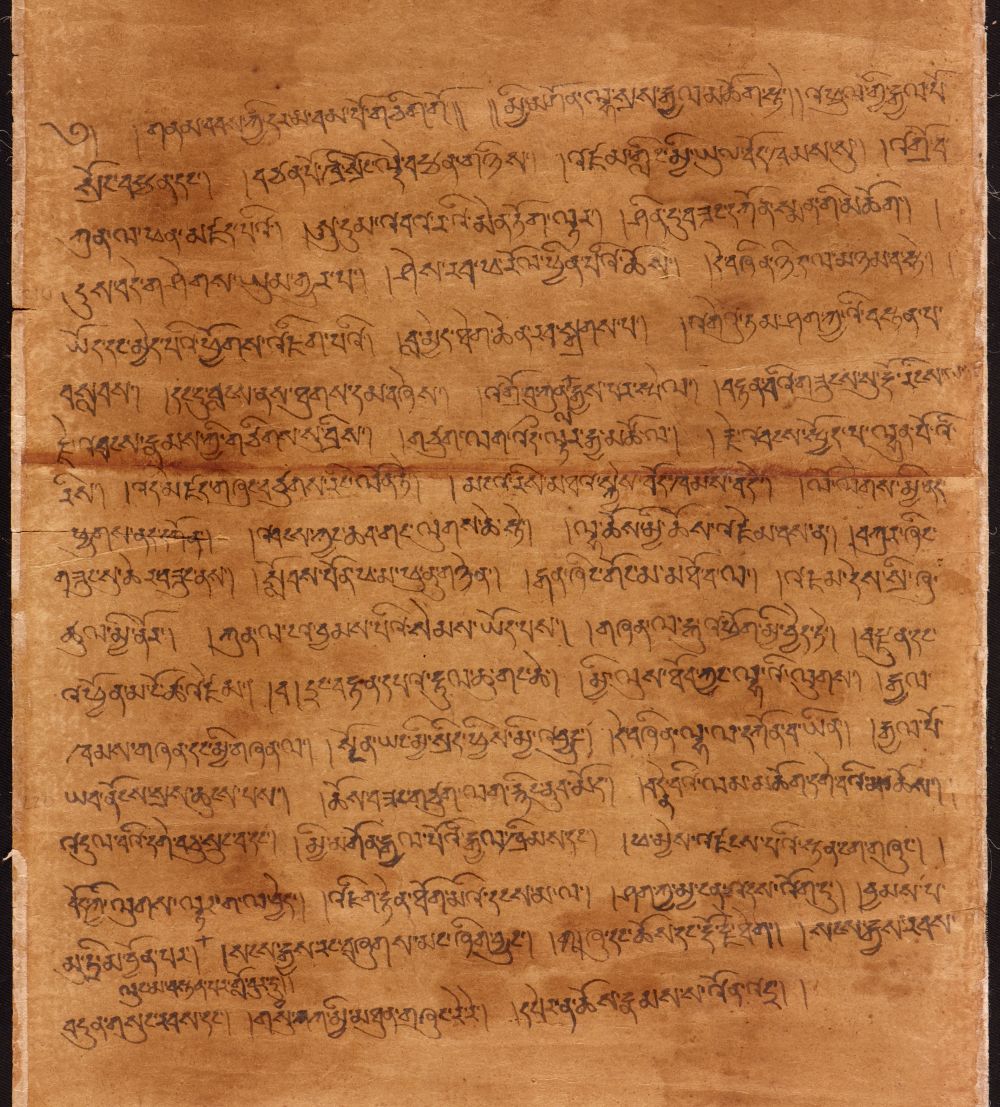
rgyal po yab nongs sras chungs pas// chos bzang gtsug lag rnying bub mod// bden ba’i lam mchog dge ba’i chos// ‘dul ba’i dge bcu srung ba dang// myi mgon rgyal po rgyal khrims dang// pha myes ‘dzangs pa’i stan ngag gzhung// bod kyi lugs ltar ga la byed// ‘jig rten thog ma’i dangs ma la// shag kyi mya ngan ‘das ‘og du// byams pa mu tri ma byon par// (lung ma bstan par glo bur du//) sangs rgyas rang bzhugs man zhig byung// -g-zhu dang chos dang rdo rje theg// sangs rgyas rabs bdun gsung rabs dang gsuM ka myi mthun gzhung re re// dper na chos rnams sa ‘on ‘dra//

And unresolved questions…

1. The thing that I still can’t make out is that triad of zhu / chos / rdo rje theg. Richardson suggested reading the first word as gzhung, but the scribe actually wrote a /g/ and then crossed it out, and his or her spelling is not that bad. And why should the vajrayāna be separate from the dharma?

2. I’m aware that “self-appointed buddhas” as a translation of sangs rgyas rang bzhugs is not uncontroversial. I have taken bzhugs with its connotation of assuming a position, as in the term for enthronement, khri la bzhugs. But rang bzhugs could be translated in other ways.

Amdo Notes III: Gold and turquoise temples

In the late 960s a pilgrim passed through Amdo. He was a Chinese monk from Wutaishan, and like many Chinese Buddhists before him, he hoped to visit India to study at the great university of Nalanda. We know about this particular pilgrim because he left his passport behind in Dunhuang, where it was sealed into the library cave and only emerged again in the 20th century.

This pilgrim’s passport is more like a series of letters of recommendation written to monasteries along the pilgrim’s route. Interestingly, though he was a Chinese monk, he took a fairly indirect route so that he could visit the major Tibetan Buddhist sites of Amdo. His itinerary through Amdo went like this:

  1. The city of Hezhou, now known as Linxia.
  2. The mountain retreat of Dantig (see the previous post).
  3. The city of Tsongka, near the modern city of Ping’an.
  4. The city of Liangzhou, now known as Wuwei.
  5. And then along the Silk Route to Ganzhou and Dunhuang.

All of these places (except Dantig) are now Chinese cities, with very small, if any, Tibetan population. There is little left to show that many of them were once strongholds of Tibetan culture and Tibetan Buddhism. The pilgrim’s itinerary tells us that he was visiting Hezhou and Tsongka to see their “gold and turquoise temples.” And these were not little kingdoms either. Chinese sources report that in the year 998 Liangzhou had a population of 126,000, the majority of whom were from Tibetan backgrounds.

*  *  *

So it’s strange to walk through the city of Ping’an now, and imagine what once was there. Tsongka appears in one of the earliest Tibetan inscriptions, the Zhol pillar in Lhasa (dated by Hugh Richardson to the 750s or 760s). Here Tsongka is the site of battles between the Tibetan and Chinese armies. Later, at the beginning of the 11th century, Tsongka came to the aid of China’s Song dynasty, as one of the last bastions holding out against the rising Tangut empire. Since Tsongka was friendly with the Chinese, it was their lifeline in maintaining the trade route with the West. Tsongka continued as an independent kingdom until the 12th century when it was finally swallowed up by the Tangut empire. But it was still famous enough in the fourteenth century that a local boy who went to study in Central Tibet was known as Tsongkhapa: “the man from Tsongkha.”*

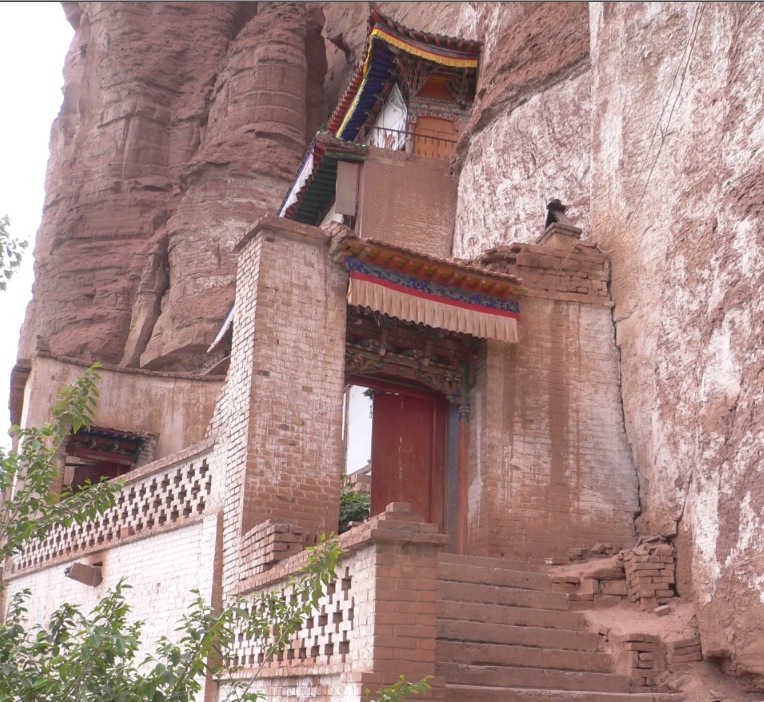
If you squint, can you see Tsongka’s shimmering gold and turquoise temples through the heat haze and pollution of Ping’an? Perhaps not. But you can go just a little way out of the city, where the mountains rise up on the other side of the Yellow River, and visit the ancient cliff temple of Martsang. Here, it’s said, was where the monks who fled the persecution of Buddhism by the emperor Lang Darma (see here), finally came to rest.

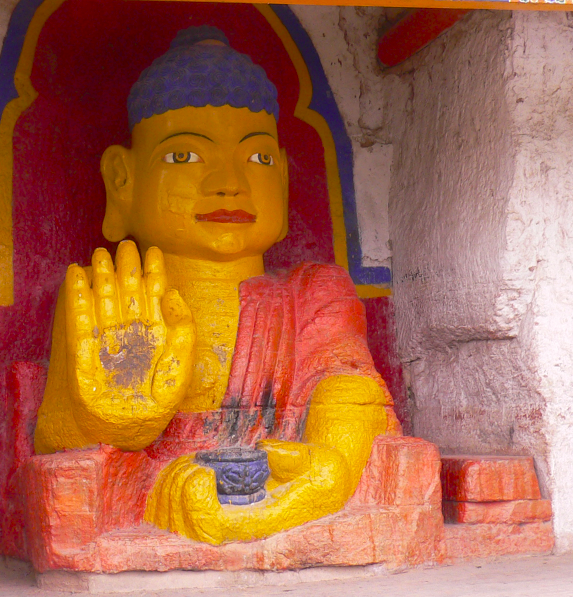
Below the temple at Martsang is this image, said to be a self-manifesting Maitreya. That is to say, the image is said to have emerged spontaneously from the rock. I heard that it was dated by scientists to the Tang dynasty, but I haven’t been able to verify that claim. In any case, as you can see, it seems to have been repainted fairly regularly.

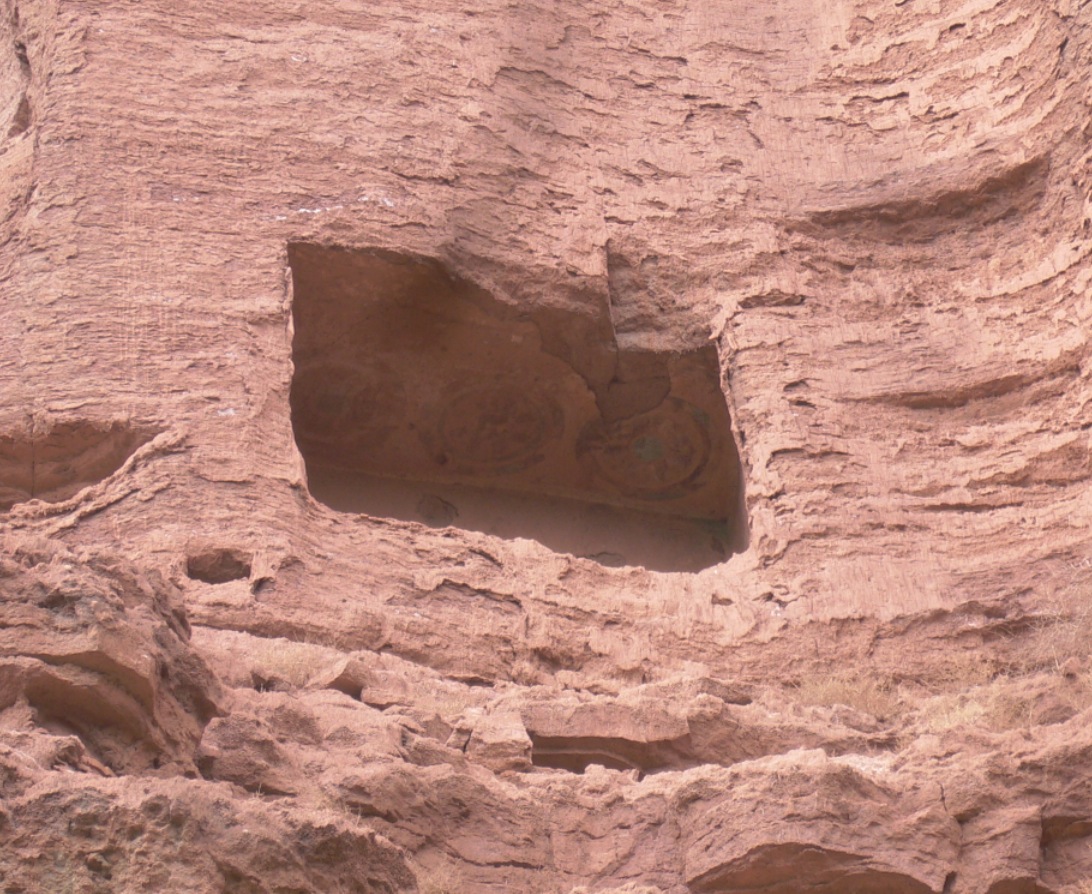
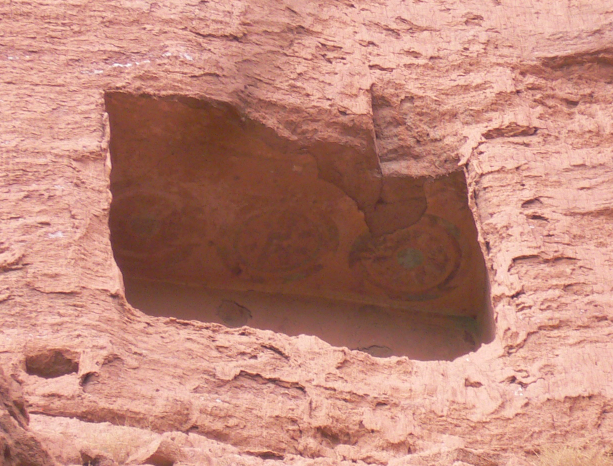
In  the cliffs above the Maitreya image you can see this inaccessible cave. If the temple at Martsang isn’t old, this certainly is. Notice the three mandalas painted on the ceiling.

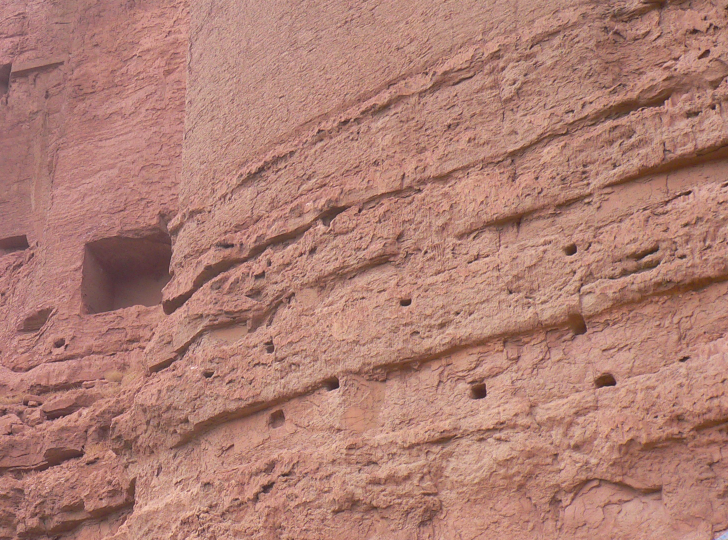
And notice as well the little square holes leading up to the cave. Perhaps this was once a walkway, or an even bigger structure built into the side of the cliffs. It seems that there was once a larger complex of Buddhist caves here. From here, when you turn around and look back towards the modern city sprawling below you, and beyond that the lush Yellow River valley it’s easier to believe that this was once home to a Tibetan kingdom.

*  *  *

References

Ronald Davidson. 2005. Tibetan Renaissance. New York: Columbia University Press.

Ruth Dunnell. 1994. ‘The Hsi Hsia’. In Herbert Francke and Dennis Twitchett (eds.), The Cambridge History of China, vol.6. Cambridge, Cambridge University Press. 907–1368.

Iwasaki Tsutomu. 1993. ‘The Tibetan Tribes of Ho-hsi and Buddhism during the Northern Sung Period’. Acta Asiatica 64: 17–37.

Photographs (c) Imre Galambos.

*  *  *

* Note:

At some point Tsongka seems to have changed its name slightly, with the final ka turning into a kha. I have no idea why this happened, but I suppose it was some time between the tenth and fourteenth centuries.