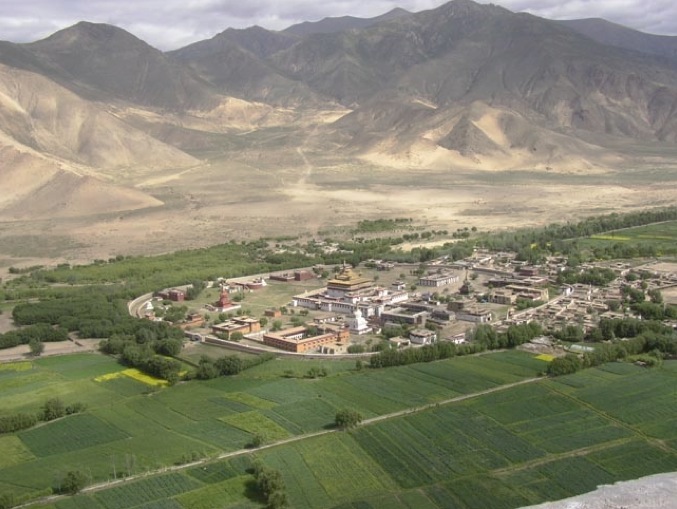
Why does history get written? I think we’d all agree that the motives for creating history are mixed, and just as complex as the uses it gets put to after it’s written. Though most of Tibet’s histories are histories of religion, it would surely be naive to imagine that the motives of their authors were wholly religious. After all, the union of religion and politics (chösi zungdrel in Tibetan) was not just a fact of life in Tibet, it was an ideal, a dearly-held expression of the uniqueness of Tibet’s culture.
So how does this apply to the story of the great debate between Chinese and Indian Buddhism that is supposed to have taken place at Samyé monastery under the aegis of the emperor Tri Song Detsen? The debate is certainly presented in religious terms, as a battle between two interpretations of the Buddhist scriptures. On the Chinese side, the Chan approach of the single method: the realization of the nature of mind leading to instant enlightenment. On the Indian side, the gradual approach of the six perfections leading to a gradual awakening in ten stages.
The classic account of the debate and the source for all later Tibetan historians, is the Testament of Ba. And this, even in the earliest form available to us, is clearly not a disinterested account. It gives the proponent of the Chinese view a brief paragraph to defend his position, followed by pages and pages of the proponents of the Indian view. And most of the refutation of the Chinese approach is spoken by a Tibetan nobleman from the Ba clan. But hang on, isn’t the Testament of Ba all about the Ba clan? Well, it certainly seems to have been put together by people from that clan, and it certainly places the Ba clan in the middle of the action in the story of how Buddhism came to Tibet.
I don’t think it’s much of an exaggeration to say that the story of early Tibetan history is the story of the Tibetan clans. Before Tibetan history began to be recorded, the clans were contesting with each other. During the Tibetan empire, the clans were in theory united under the emperors, but in truth, they continued to contest with each other, and this was one of the major factors in the ultimate failure of the empire. And after the empire fell, the fighting between the clans created what the historians called “the age of fragmentation.”
As for the Ba clan, they were deeply involved in the imperial court and often in competition with the Bro clan for the top ministerial positions. They seem to have played some part in the conspiracy against the Buddhist emperor Ralpachen, leading to his assassination and the enthronement of the deeply unpopular Langdarma. Given that Langdarma came to be blamed for the collapse of monastic Buddhism in Tibet, and the inception of the age of fragmentation, it seems that the Ba clan had some PR work to do if they wanted to demonstrate their credentials as supporters of the revered Buddhist emperors. And that’s what the Testament of Ba does, quite successfully.
* * *
 So where does the story of the debate fit into this? Obviously it puts the representatives of the Ba clan at the side of the greatest Buddhist emperor. It may also be a not-so-subtle attack on another major clan, the Dro, the clan that most frequently crops up in the Ba clan’s power struggles. And as the empire began to fall apart the first civil war was between the governor of Tibet’s northeastern territories (who was from the Dro clan) and a general who wanted to set himself up as a local warlord (from the Ba clan). The governor sided with the new Chinese power in the region, and the general was, after committing some appalling brutalities, eventually executed. For more about this see here and here.
So we shouldn’t be surprised if the old enmity between Ba and Dro finds expression somewhere in the Testament of Ba. Perhaps in the story of the debate? Consider the evidence:
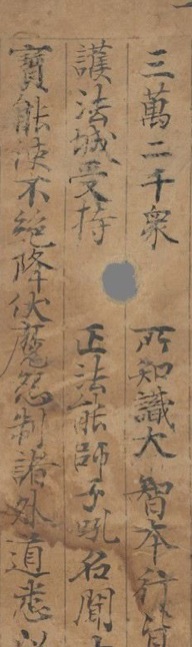
1. There’s a Chinese manuscript from Dunhuang (Pelliot chinois 4646) that tells another debate story. As in Testament of Ba, the Chinese side is represented by the Chinese monk Moheyan, but the proponents of the other view are only mentioned as “Brahmin monks.” This manuscript also talks about “discussions” by letter over several months, rather than a staged debate. And the biggest difference is that it ends with the Tibetan emperor giving his seal of approval to the Chinese teaching:
The Chan doctrine taught by Mahayana is a fully-justified development based on the text of the sutras; it is without error. From now on the monks and laity are permitted to practise and train in it under this edict.
But what is most relevant to us is that it mentions that Moheyan was invited by one of Tri Song Detsen’s queens, the one from the Dro clan. The Chinese author of the text makes this quite clear.
2. A Tibetan manuscript from Dunhuang (
Pelliot tibétain 996) gives us an account of a lineage of Chan masters. It begins with an Indian master who travelled to the Silk Road city of Anxi.* Here’s a translation of the beginning, which gives an idea of the tone of the work:
The master Artenhwer, an instructor who knew the path of the sameness of all phenomena travelled to Anxi from India, for the sake of sentient beings. There he gathered three hundred students, and taught them how to enter the Mahāyāna. He received divine food offerings from the sky, which satiated his three hundred students. At over a hundred years old he passed away in the posture of nirvana. Then the king of Anxi struck the body and said “If the master came to explain the dharma to multitudes of sentient beings, why did he only teach a few words?” And, having died, the master rose again for three days and taught the dharma to the king of Anxi and the Chinese prince of Gazhou.
The lineage of this Artenhwer gets passed down to a Chinese monk called Man Heshang. And he is supported by Trisumjé, the delön (the minister responsible for the northeastern marches of the Tibetan empire) — this is almost certainly a famous Tibetan minister from the Dro clan who lead the negotations for to the 823 Sino-Tibetan peace treaty. Later in this Chan lineage there’s a Tibetan master called Puk Yeshé Yang, who is supported by a monk from, once again, the Dro clan.
So, is it reasonable to suggest that the Chan teachers like Moheyan were known to have the patronage of the Dro clan? That would certainly make the story of the debate in the Testament of Ba very useful in their struggle with the Dro. Not only does it place them at the centre of the narrative of the transmission of Buddhism to Tibet, it’s also one in the eye for the Dro clan and their favourite Chan teacher.
* * *
This rivalry might answer a question posed by Matthew Kapstein: why is Testament of Ba generally well disposed towards Chinese Buddhism, except in the story of the debate? Earlier in the Testament of Ba we hear about a member of the Ba clan travelling to China receiving teachings from the Korean Chan teacher known as the Reverend Kim. While later Tibetan historians tended to present the debate as a rejection of Chinese Buddhism per se, the Testament of Ba, especially in its earliest known forms, suggests more specifically a rejection of Moheyan’s brand of meditation practice.
That’s enough for now. I won’t go into the question of whether the debate actually happened, although the very different version in the Chinese text certainly suggests that we might be better off thinking of a series of discussions, mostly by exchanges of letters, rather than a debate. And the author of 10th century Lamp for the Eyes of Meditation, which is all about how to rank the simultaneous and gradual methods, fails to mention any debate. And many, if not all, of the Tibetan Chan manuscripts from Dunhuang date from after the Tibetan empire, and thus well after when the debate was supposed to have happened, suggesting that the decline of Chan in Tibet happened slowly, and for other reasons.
* * *
See also…
Tibetan Chan I: The Emperor’s Chan
Tibetan Chan II: The teachings of Heshang Moheyan
Tibetan Chan III: More teachings of Heshang Moheyan
* * *
A note on places and people…
So where is Anxi (An se in the Tibetan text)? Most people, following Lalou, have identified it with the great northern Silk Route city of Kucha. But this might not be right. Anxi was the name of the Chinese command centre for its western territories. This was in Kucha until the late 680s, when that city was taken by the Tibetan army, and the Chinese moved the Anxi commandery to Qocho (Ch. Gaochang). By my calculations, separating each member of the lineage by 25 years, Artenhwer should have been around in the first half of the 8th century, by which time Anxi may have referred to Qocho.
As for Artenhwer (A rtan hwer), this looks like a Tibetan transliteration of a Chinese transliteration of a foreign name, so finding the original may be a hopeless task. Flemming Faber identified it as the popular Persian name Ardasir, but as far as we know, there was no Buddhism in Persia by this time. It certainly doesn’t sound particularly Indian. Turkic perhaps? Any informed answers or wild guesses great appreciated…
And Dro Trisumjé? Hugh Richardson considers the identification of Pelliot tibétain 996’s Trisumjé with the army commander Dro Trisumjé doubtful. But it doesn’t seem at all unlikely to me that bde blon Trisumjé mentioned in Pelliot tibétain 996 might have later held the role of army commander (dmag gi mchog). His involvement in the Sino-Tibetan treaty involves the same region that fell under the rule of the bde blon. A letter written by a Chinese officer to a Zhang Khri sum rje (Pelliot tibétain 1070 — see Demiéville’s Concile de Lhasa, pp.280-290) says that he chose Dunhuang as his residence and founded a temple there. Roberto Vitali has argued that this is Dro Trisumjé, and that he must have lived in Dunhuang before 810, when, due to a promotion to the rank of minister and general of the northeast army, he would have moved to a major prefecture like Guazhou. Though Vitali didn’t consider Pelliot tibétain 996, the fact that Trisumjé held the post of bde blon only strengthens his case.
* * *
And some Tibetan…
From the beginning of Pelliot tibétain 996 (f.1r):
$//mkhan po nam ka’I snying po’i dge ba’i bshes nyen gyI rgyud mdor bshad pa// dge ba’I bshes nyen yang/ chos mnaym pa nyId kyI lam rIg pa’/ mkhanpo a rtan hwer/ sems can gyI don du rgya gar yul nas/ yul an ser gshegs te/ slob ma sum brgya bsdus nas/ theg pa chen po’i don la cI ltar ‘jug pa’I sgo bshad/ lha’I zhal zas nam ka las blangs te/ slobs sum brgya tshIm bar byas so/ lo brgya lon nas/ ner ban thabs su dus las ‘das so/ de nas an se’I rgyal pos lus brda+bs te/ mkhan pos sems can de snyed la chos bshad na/ bdag la tshIg ‘ga’ yang ma bstan par gshegs sam zhes smras pa dang/ tshe ‘das te zhag gsum lon ba slar bzhengs te/ an se’I rgyal po kwa c[u’]I wang chos bshad nas dus la ‘das so/
* * *
References
Hugh Richardson wrote about the rivalry between Dro and Ba as a background to the debate in:
1. Hugh Richardson. 1998. “Political Rivalry and the Great Debate at Bsam-yas.” In High Peaks, Pure Earth. London: Serindia: 203-206. (Unlike most articles in this collection, this one had not previosly been published.)
This is the earliest extant version of the Testament of Ba is the Dba’ bzhed:
2. Pasang Wangdu and Hildegard Diemberger. 2000. The Royal Narrative Concerning the Bringing of Buddha’s Doctrine to Tibet. Wien: Verlag der Osterreichischen Akademie der Wissenschaften.
That is, apart from a manuscript fragment from the 9th or 10th century:
3. Sam van Schaik and Kazushi Iwao. “Fragments of the Testament of Ba from Dunhuang”. Journal of the American Oriental Society 128.3 (2008 [2009]): 477–487.
The classic work on the Chinese text on the debate (or discussions), the Dunwu dacheng zhenglie jue 頓悟大乘政理決 is:
4. Paul Demiéville. 1958 (republished in 2006). Le Concile de Lhasa. Paris: Institute des hautes études chinoises.
Later Demiéville found another version of the text in the Stein collection, Or.8210/S.2647. As for the Tibetan Chan lineage in Pelliot tibétain 996, this was studied and published even earlier, in 1939, by Marcelle Lalou (surely the first person to discover the existence of Tibetan Chan among the Dunhuang manuscripts):
5. Marcelle Lalou. 1939. “Document tibétain sur l’expansion du Dhyāna chinois.” In Journal Asiatique October-December 1939: 505-523.
On the involvement of the Ba clan with the assassination of Ralpachen (or, if you follow his ingenious argument, actually of Langdarma) see:
6. Zuiho Yamaguchi. 1996. “The Fiction of King Dar-ma’s Persecution of Buddhism”. In De Dunhuang au Japon. Geneva: Librairie Droz. 231-258.
On the battle between two members of Dro and Ba in Amdo/Hexi, see:
7. Luciano Petech. 1994. “The Disintegration of the Tibetan Kingdom”. In Tibetan Studies, edited by Per Kværne. Oslo: The Institute for Comparative Research in Human Culture.
On Dro Trisumjé, and other aspects of clan rivalry during the Tibetan empire, see pages 18, 21-22 of:
8. Roberto Vitali. 1990. Early Temples of Central Tibet. London: Serindia Publications
and this too:
9. Roberto Vitali. 2004. “The role of clan power in the establishment of religion (from the kheng log of the 9-10 century to the instances of the dByil of La stod and gNyos of Kha rag).” In The Relationship between Religion and State : (chos srid zung ‘brel), in Traditional Tibet, edited by Christoph Cuppers. Nepal, Lumbini International Research Institute.
And finally, Matthew Kapstein’s discussion of the attitude towards Chinese Buddhists in the Testament of Ba is on pages 34-35 of:
10. Matthew Kapstein. 2000. The Tibetan Assimilation of Buddhism. Oxford University Press, 2000.

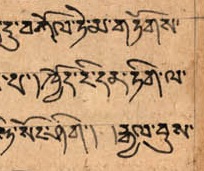 There is a copy of this sūtra in a Tibetan manuscript from Dunhuang – IOL Tib J 76 — which confirms that the story, and the occurrence of the name of Dantig in it, was known in the tenth century.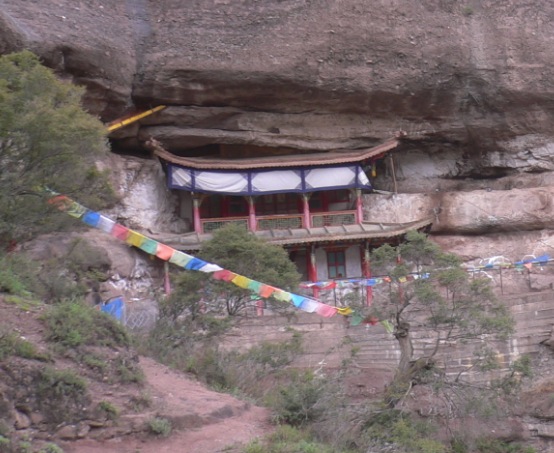
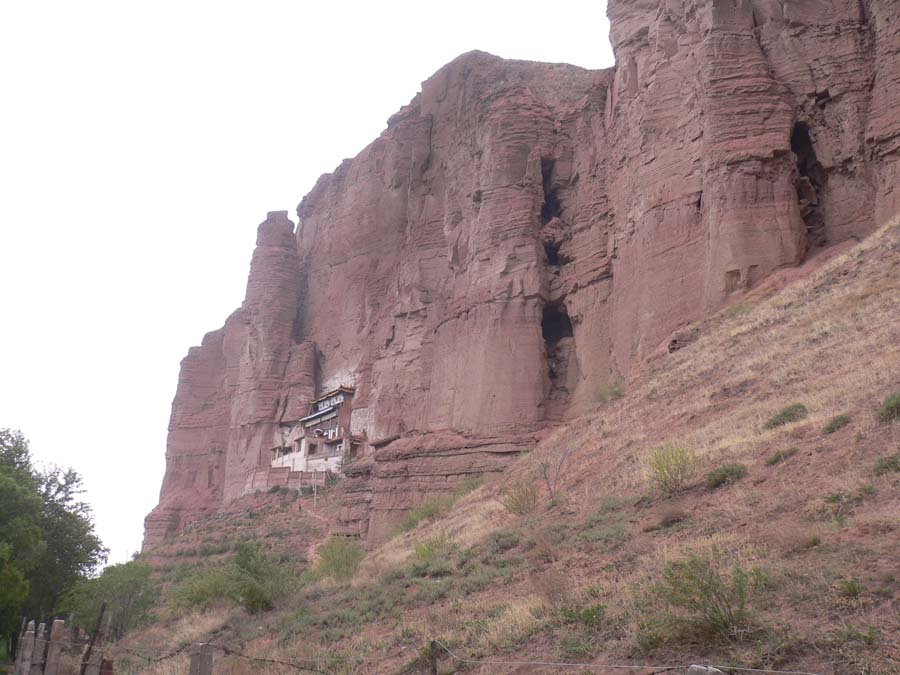
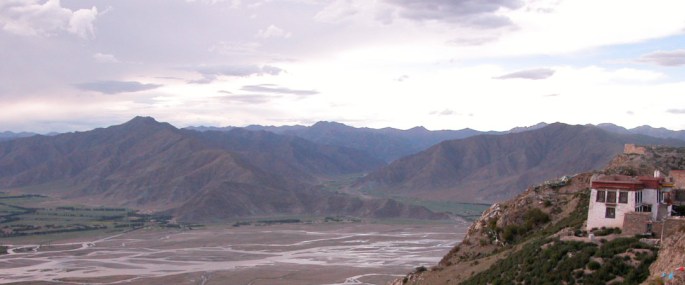
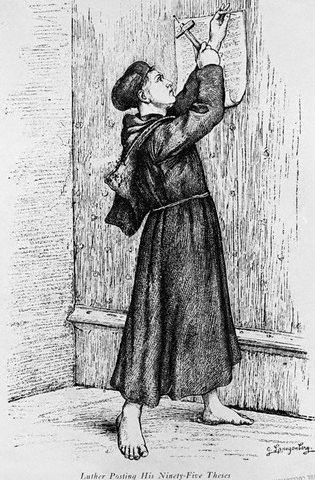 At the end of the page he signed off with a brief colophon: “This was affixed to Sangpu Neutok by Samyépa Ngagi Wangpo. May it cause happiness to increase!” He then gave the page to the monk, who took it to Sangpu and pinned to the throne in the main assembly hall. When it was found it caused quite a stir, but Ngagi Wangpo was already far away. (Those familiar with European history may be reminded of Martin Luther nailing his “ninety-five theses” to the door of the church at Wittenberg some 200 years later.)
 early Tibet