British Barbarians, Tibetan Prophecies

You probably know about the Younghusband Mission to Lhasa. Quite a few books have been written about it, though with the honorable exception of Patrick French’s biography of Younghusband, they tend to stick to the voluminous official and unofficial accounts published in English. This is a pity, because there’s no doubt that many Tibetans had strong feelings about Younghusband’s sacking of Gyantse and invasion of Lhasa. This came home to me forcefully when I read the Nechung Oracle’s pronouncement on the invasion while looking through the biography of the 13th Dalai Lama Thubten Gyatso.

This massive biography, in two volumes, was written by Purchog Rinpoché (the tulku of the more famous Purchogpa who was the 13th Dalai Lama’s principle tutor). As a fairly traditional namtar or sacred biography it mostly deals with religious topics, but a foreign army marching into Lhasa could hardly be ignored. The biography tells us how  the Dalai Lama and a group of trusted advisers and religious teachers fled the advance of the British, leaving the throne-holder of Ganden monastery to negotiate a treaty.

One of the people fleeing with the Dalai Lama was the Nechung Oracle, a monk chosen as the medium or oracle for the deity Dorjé Drakden, who was consulted before any important decision was taken. I think the oracle at the time of the invasion was Orgyen Thinley Chöpel, a Nyingma monk from Central Tibet’s biggest Nyingma monastery, Mindrolling. (An interesting figure in his own right: in his youth he had travelled to Eastern Tibet, where he met one of the greatest scholars of the nineteenth century, Jamyang Khyentsé Wangpo, and received from him a statue of Padmasambhava which was later housed in the Jokhang.)

Once the Dalai Lama, the Nechung Oracle, and the rest of the court-in-exile were a safe distance from Lhasa, the oracle was consulted, and he spoke in emotional terms of the invasion:

Urged on by spirits and demons,
The British, with their false God, their wealth and manpower,
Came to this Snowy Land surrounded by mountains
With their barbaric army.
These events, the like of which I’ve never seen before
Have broken the heart of this old devil.

The sense of shock and outrage felt by the Tibetans at the invasion of their sacred land is striking. The oracle had more to say, but I won’t translate any more of the speech here. I’ll put the full text in Tibetan below, and if you’d like to try your hand at translating more of it, please do, and let me know how you get on!

*  *   *
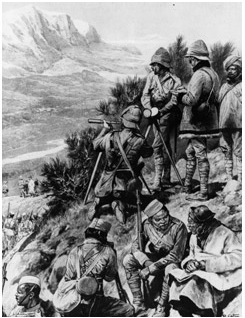
The better-known English-language sources on the Younghusband Mission do (it must be said) give us a lot more of the details behind the invasion. These sources include Younghusband’s telegrams to Curzon which were recorded in the “Blue Book” of official correspondence. The telegrams show Younghusband’s hawkish tendency and his frustration with the obstacles thrown into his path by the Dalai Lama. He writes:

The real opposition we are encountering is that of the Dalai Lama and his followers, the monks at Lhasa, who declare that they are concerned for the preservation of their religion, in other words of their priestly influence by which the Tibetans are at present strangled. The influence of the Chinese has vanished completely, the present weak Ambam being confronted with a young and headstrong Dalai Lama; nor is it likely to be revived when the new Ambam arrives at Lhasa (which he is expected to do in the next few days) as he is not supported by Chinese troops. To influence the Dalai Lama, therefore, we must rely on our own efforts. (Further Papers Relating to Tibet, p.1: telegram of 4th February 1904)

As a good imperialist, Younghusband suggests that his is a moral mission as well as a political one, a mission to liberate the Tibetans from oppression. After this, and many more telegrams, Younghusband got the permission to proceed on to Gyantse, and then as it became clear that the Tibetans had no intention of negotiating, to Lhasa itself. On the 13th July, Lord Curzon telegrammed the Secretary of State thus:

To-morrow the Mission will commence advance to Lhasa… We are authorising Younghusband to secure the signature of the Dalai Lama to Convention embodying terms finally approved, and to sign it himself, subject to ratification by His Majesty’s government. (Further Papers Relating to Tibet, p.31: telegram of 13th July 1904)

Naturally, the Dalai Lama had different ideas. As the British Army approached Lhasa, he decided to escape. His biographer explains his decision to flee Lhasa, stating that if he met with the British, peace terms would be made according to their discretion, and the rule of Tibet would be taken over by the British. He goes on to say that the Dalai Lama’s other reason for leaving Lhasa was to go and consult with the emperor of China — but in fact the Dalai Lama travelled to Mongolia, sending his trusted envoy Dorjiev to seek the help of the Russians, before travelling on to Kumbum monastery and then to Wutaishan, not arriving in Beijing until 1907.

*  *  *

As for Younghusband, after securing the trading agreements that had been the original reason for invading Lhasa, he and his army swiftly returned to India. In the next few months the British government (many of whom had opposed the invasion from the start) quickly took the treaty apart, reducing many of the gains Younghusband had fought for. As representatives of the Manchu court arrived post-haste in London and protested that the Tibetans were not allowed to sign treaties on without Chinese permission, a new treaty was drawn up, ratified by China and Britain (it was, of course, entirely ignored by the Tibetans).

The Younghusband Mission instilled a lasting fear among the rulers of China that the permeability of Tibet’s border with India could leave China wide open to attack. The weak and bankrupt Manchu court had been happy to ignore Tibet for the last century, but in the wake of Younghusband’s invasion they made Tibet one of their main strategic priorities. In 1908, mere weeks after the Dalai Lama returned to Lhasa, a Chinese army occupied the city, and the Dalai Lama fled again, this time to India.

According to the 13th Dalai Lama’s biography, this was all prophesied by Padmasambava. The previous Dalai Lama (the 12th) Thrinley Gyatso is said to have received the prophecy directly from the Lotus Born himself. Padmasambhava told the 12th Dalai Lama that unless he took a wife, he would die young (he did), and  predicted the rebirth of the next Dalai Lama. He then spoke these words:

The king will roam foreign lands and a foreign army will come to Tibet;
You the ruler of Tibet will travel to the country of China,
And the ruler of China will send the Chinese army to Tibet.

*  *  *

References

1. Thub bstan rgya mtsho’i rnam thar (written in 1940, published in India in the 1950s). TBRC id: W3087.
2. The Blue Book, or, Cabinet and other confidential papers relating to Tibet, 27 February 1903 – 26 April 1905. B.P.13/41.(13.)
3. Patrick French. 1994 Younghusband: The Last Imperial Adventurer. London: HarperCollins.
4. Charles Allen. 2004. Duel in the Snows: The True Story of the Younghusband Mission to Lhasa. London: John Murray.

*  *  *

Images

1. The Nechung Oracle Lobsang Namgyal (1894-1945), from the Tibetan Album (who also have a brief biography). Note that this is not the Nechung Oracle who was consulted in 1904.
2. “A British outpost in Tibet watches for reinforcements” (Getty Images, retrieved from this BBC page on the Younghusband Mission).

Tibetan texts

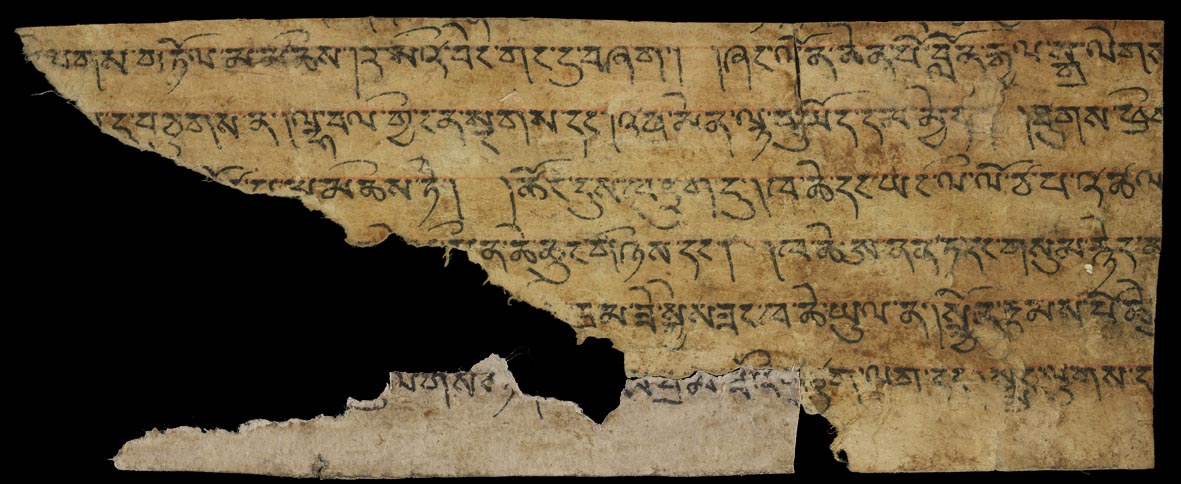
The Nechung Oracles words, from the biography of the 13th Dalai Lama, vol.I, f.395a.1 (the translated section is between the asterisks):

hrī: slob dpon phyag na pad+mo yi//
sku tshe mi ‘gyur rdo rje’i khrir//
ngoms par bzhugs pa bka’ drin che//
*dam sri ‘byung pos rgyud bskul te//
lha log dbyin ji mi nor dpung//
gangs ris bskor ba’i kha ba’i ljongs//
hang shed dpung ngos ‘di nyid kyang//
mtshungs med kyi bya gzhag ‘di ‘dra la//
‘gyur srid na ‘dre rgan tsi t+ta ‘gas//*
‘di ‘dra rigs tsam rigs tsam yang//
nged dmar nag gnyis po sri zhu la//
‘bral med kyis mi mngon dbyings nas kyang//
snying dum bur gyur pa’i las ‘dra zhing//
yin kyang don g.yar dam rdo rje’i rgya kha nas//
‘gyur med kyi ‘phrin las ‘jug pa yang//
snga dus nas da lta’i dus ‘di bar//
bstan dang dga’ ldan chab srid//
slod dpon sku ‘phreng rim pa dang//
da lta’i slob dpon ‘di nyid bar//
sri zhu’i gnas la rgya ma grol//
mdud pa ‘doms shing ‘phrin las la//
nyin mtshams yug tu sku’i grib bzhin//
‘grogs pa’i ‘phrin las zhus zin na//
da dung de dang de mtshungs pa//
sri zhu’i bya gzhan phra rags rnams//
sngar bzhin ‘phrin las ‘gyur med zhu//
cung zad bstan dang sems can gyi//
dam tshig la rag bsod nams dman//

And Padmasambhava’s prophecy, from vol.I, f.384b.3-4:

rgyal po mthar ‘khyams mtha’ dmag bod la ‘ong :
bod rgyal khyod ni rgya yi yul du ‘gro :
rgya nag rgyal pos rgya dmag bod du gtong :

What Are Those Monks Doing?

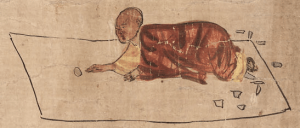
I’d like to share something with you that’s puzzled me for some time. I first came across this illustration a few years ago. It’s in the Dunhuang manuscript Or.8210/S.8555. Click on the image or the number to see the whole thing, then come back here if you have any ideas.

What do you see? My first impression was that this looks like a stoning, with three monks throwing rocks at the fourth, prostrate monk. Are we looking at a punishment? I’m not sure the Vinaya sanctions this kind of thing. And it does look like the fourth monk has removed his shoes and is performing prostrations on a mat. While the other monks are throwing stones at him. Really? Why?

*  *  *

It was only recently, when I looked at the back of the manuscript, that I started to think I might have solved this puzzle. There’s a single line of Chinese writing, saying “Lotus Sutra, seventh fascicle”. Now, this could be nothing to do with the picture. I’m all too familiar with scrolls that have been reused for notes, writing exercises and, of course, idle doodles. But this picture is more than a doodle. Surely it means something.
Well, have a look at this verse from Chapter 10 of the sutra:

If when a person expounds this sutra
there is someone who speaks ill and reviles him
or attacks him with swords and staves, tiles and stones,
he should think of the Buddha and for that reason be patient.

Could that be the scene depicted here? I thought so, but then came across an even better bit of text in Chapter 20, which is a story about a bodhisattva called Never Disparaging:

This monk did not devote his time to reading or reciting the scriptures, but simply went about bowing to people. And if he happened to see any of the four kinds of believers far off in the distance, he would purposely go to where they were, bow to them and speak words of praise, saying, “I would never dare disparage you, because you are all certain to attain Buddhahood!”

Proving that you can’t please all of the people all of the time, there were some who were offended by this behaviour:

Among the four kinds of believers there were those who gave way to anger, their minds lacking in purity, and they spoke ill of him and cursed him, saying, “This ignorant monk – where does he come from, presuming to declare that he does not disparage us and bestowing on us a prediction that we will attain Buddhahood? We have no use for such vain and irresponsible predictions!”

The four kinds of believer, by the way, are monks, nuns, lay men and women. The story seems to be aimed against those Buddhists who didn’t hold with the Lotus Sutra’s doctrine that everyone will attain Buddhahood eventually.

Many years passed in this way, during which this monk was constantly subjected to curses and abuse. He did not give way to anger, however, but each time spoke the same words, ‘You are certain to attain Buddhahood.’ When he spoke in this manner, some among the group would take sticks of wood or tiles and stones and beat and pelt him. But even as he ran away and took up his stance at a distance, he continued to call out in a loud voice, “I would never dare disparage you, for you are all certain to attain Buddhahood!” And because he always spoke these words, the overbearing arrogant monks, nuns, laymen and laywomen gave him the name Never Disparaging.

So, the key phrase there is, “some among the group would take sticks of wood or tiles and stones and beat and pelt him.” Though in the end the bodhisattva runs away and continues not disparaging his tormentors from a safe distance, note that he begins by bowing to them. So here we have all the elements of our illustration. And I think, perhaps, the puzzle is solved.

*  *  *

Of course the tormentors in our picture are not monks, nuns, laymen and laywomen, but just monks. But I don’t think that’s a deal-breaker. What’s interesting is the clothing of the monks. I assume this reflects the context in which the picture was made, that is, Dunhuang in the 9th or 10th centuries (I suspect). From which it appears that the monks at Dunhuang wore robes similar to those that Tibetan monks wear nowadays.

*  *  *

Incidentally, those nasty people who threw the stones, tiles and the like got their comeuppance. They had to spend an awfully long time in the deepest hell. The Buddha, who is the narrator of course, tells us this, and he also reveals that the bodhisattva Never Disparaging was the Buddha himself in a former life. And those nasty people? Well, even hell doesn’t go on forever, and at the end of the chapter the Buddha reveals that they are here now, among his audience. Anyhow, I think the story of Never Disparaging complements nicely this season’s messages of goodwill, tolerance and the like. Best wishes to all for Christmas and New Year. You are certain to attain Buddhahood!

*  *  *

References

The translations here are from Burton Watson, The Lotus Sutra (New York: Columbia University Press, 1994). I haven’t delved into the complexities of the text itself, and the sharp-eyed will notice that I didn’t address the question of whether either Chapter 10 or 20 falls within the seventh fascicle (juan qi) of the Sutra. Of course, to do this we must look at the different canonical versions of the sutra (Burton Watson’s translation is based on the most popular one, attributed to Kumarajiva), and then the several versions in Dunhuang that are not clearly related to the canonical versions. And that’s assuming that we are only looking at Chinese versions. All I have been able to ascertain at this point is that the Tibetan version the story of Never Disparaging appears in Chapter 19, falls under fascicle 11 (bam po bcu gcig pa) in the Peking Kanjur version. Any further thoughts are most welcome.

The Abbot, or Ironing out History’s Wrinkles

Picking through a manuscript collection piece by piece can be painstaking work, but it’s rarely boring. I never cease to be amazed by the mere fact that these ancient things were written, used and reused by very different people who held them in their hands in a very different place and time.  And then there are the occasional magical moments, when you come across something really fascinating that nobody else has noticed before.

This happened to me a few months ago when I was compiling a catalogue with Kazushi Iwao. We were sifting painstakingly through the main series of Chinese manuscripts in the British Library, to see whether there were any Tibetan manuscripts in there that had been overlooked.  We came across something that looked sort of familiar… Something about Rasa (the old name of Lhasa) … something about a Brahmin called Ananta.

Aha! The penny dropped. This was part of the story of how Buddhism was introduced to Tibet by the tsenpo Tri Song Detsen. It looked very similar to the version of that story in an important and early Buddhist history called  The Testament of Ba. A quick check of that text revealed that yes, this was a fragment of the Testament of Ba.

Now this was exciting (to us at least) because nobody knows when the Testament of Ba was written. Though everyone agrees that it’s an early history, the oldest manuscript that’s been found is from the 12th or 13th century (this version is called the Dba’ bzhed). The fragment we’d found could well be from the 9th century, taking us to only a short while after the actual reign of Tri Song Detsen.

*  *  *

The fragment tells the story of how the abbot Śāntarakṣita was invited to Tibet by Tri Song Detsen. This was the first stage of the tsenpo’s adoption of Buddhism, overturning the anti-Buddhist policies of his ministers. But when the abbot arrived in Lhasa, Tri Song Detsen had second thoughts, and was worried that this foreigner might be bringing black magic or spirits with him. So the abbot was confined to the Jokhang temple, and interviewed by a minister.

Since the abbot didn’t speak Tibetan, an interpreter had to be found. After a search, a fellow called Ananta was discovered. He was in Tibet because his father had been convicted of a serious crime in Kashmir and had been exiled. So Ananta became the interpreter as the abbot was questioned for three months about his doctrines. Eventually the minister assured Tri Song Detsen that the abbot posed no threat, and he was allowed to begin his task of establishing Buddhism in Tibet.

Now I don’t know about you, but that story doesn’t seem the most auspicious starting-point for Buddhism in Tibet. Later historians didn’t think so either. Even the oldest version of the Testament of Ba changes the language slightly, so that instead of the abbot being confined in the Jokhang (the Tibetan word bcugs is the same used in legal documents for imprisonment) he’s politely “asked to stay” there.

In later versions of the Testament (like the Sba bzhed), the suspicions about the abbot are placed in the minds of the ministers, instead of the Tri Song Detsen himself. This absolves the tsenpo from harbouring bad thoughts about the saintly abbot. This more polite version was the one used by the historian Butön in his famous history of Buddhism. He also dropped the figure of Ananta, with his shady past, from this part of the narrative. And some other historians simply ignored the whole interrogation-of-the-abbot episode.

*  *  *

Personally, I like the early version of the story, and probably for the same reason that the Tibetan Buddhist historians were uncomfortable with it. It has wrinkles in it that get in the way a seamless narrative of the introduction of Buddhism to Tibet by glorious kings, monks and yogins. It seems more like a record of what “really happened” than a pious story meant to inspire the faithful. You might not agree, and I’m sure that this preference down to my own cultural conditioning. But perhaps you’ll agree that our little manuscript discovery has helped us to see how this particular wrinkle was gradually smoothed out by generations of historians. Which is quite interesting whether you prefer your history wrinkled or smooth.

*  *  *

References
1. Sam van Schaik and Kazushi Iwao. “Fragments of the Testament of Ba from Dunhuang”. Journal of the American Oriental Society 128.3 (2008 [2009]): 477–487.
2. Pasang Wangdu and Hildegard Diemberger. 2000. The Royal Narrative Concerning the Bringing of Buddha’s Doctrine to Tibet. Wien: Verlag der Osterreichischen Akademie der Wissenschaften.

Images
1. Statue of Śāntarakṣita. Photograph by Matthieu Ricard, (c) Getty Images (click on image for link).
2. The two fragments together: Or.8210/S.9498(A) and Or.8210/S.13683(C).

*  *  *

Update: Transcriptions of the fragments are now available on the OTDO website here and here. And the images of the fragments, along with the other fragments that they were glued together with, can be seen on the IDP website here and here.

*  *  *

Pasang Wangdu and Hildegard Diemberger’s translation of the Dba’ bzhed

The mKhan po sent a messenger to prostrate in front of the bTsan po and to inquire about whether he should meet him immediately. [He was] asked: “Please, stay at Pe har for a while.” The bTsan po suspected that there could be some black magic and evil spirits (phra men) from lHo bal [in the doctrine of the mKhan po]” Then [the bTsan po] ordered Zhang blon chen po sBrang rGya sbra (sgra) legs gzigs, Seng ‘go lHa lung gzigs and ‘Ba’ Sang shi, “You three ministers, go to Ra sa Pe har (vihāra) to meet A tsa rya Bo dhi sa twa and prostrate in front of him. Then investigate whether I need to suspect the presence of black magic and evil spirits from lHo bal or not.” The three arrived at Ra sa Pe har (= vihāra). There was no translator. So, in six market-places it was ordered that each chief merchant (tshong dpon) had to search for a translator from Kashmir (Kha che) or Yang le. In the lHa sa market three people were found, namely, two Kashmiri lHa byin brothers and the Kashmiri A nan ta. The two lHa byin brothers were unable to act as translators except for some language of trade. As far as A nan ta is concerned: he was the son of the Brahman sKyes bzang who had commited a serious crime and had been sent into exile in Tibet because according to the law of lHo bal Kashmir (lHo bal kha che) Brahmans could not be executed. [A nan ta] had studied the Brahman sacred scriptures (gtsug lag), grammar (sgra) and medicine, and was therefore able to translate the language of the doctrine.

(Pasang and Diemberger 2000: p.43-45)

Tales from the Scriptorium III: Scribal doodles

PT1164 detail

When the scribes of Dunhuang were given bundles of paper to write Tibetan sutras on, they were allowed to lose a few sheets. If they lost more than their allowance, it was a serious matter. As I discussed a while ago, scribes could be punished with ten lashes per incomplete bundle, their property could be impounded, and their relatives could be imprisoned. I wonder whether this had any effect on the merit that the copying of the sutras was meant to generate.

Anyway, the sheets of paper that scribes were allowed to keep were called lektsé (glegs tshas), and several examples of them have survived in the Dunhuang collections. They provide a fascinating insight into the life of the scribes. Sometimes we see them practising their handwriting or writing drafts of letters. It seems that these sutra scribes were not very well paid, if they were paid at all. But they could use their scribal skills to make some money on the side by writing letters and contracts for those who couldn’t write. This practice became so common that letters and contracts were still being written in Tibetan long after the end of Tibetan rule in Dunhuang.

*  *  *

Picture 2

But today I just want to look at one of the nicest bits of scribal scrap paper, Pelliot tibetain 1164, which is covered in animal doodles. According to the signature, it was the scrap paper of a scribe called Jeu Taklek (Rje’u Stag legs), unusual in that he seems to have been Tibetan rather than Chinese. Another inscription on the paper states (if I read it right) that these are “all the wild beasts of Shachu.”* Shachu was the name for Dunhuang at this time (Shazhou in Chinese).

Picture 3

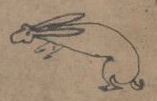
I see an antelope, some kind of large bird, a horse, a pigeon, a dog (or fox) and a rabbit. You may see differently. Some of the animals, especially the dog/fox, have a lot of character…

Picture 3

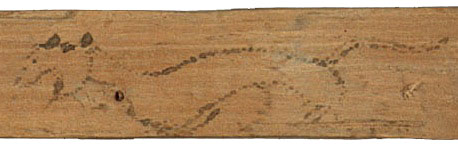
This dynamic stance reminds me of the sketch of the otter on the back of a woodslip done by a soldier at the Tibetan fort of Miran, which turned up in a previous post here. And here it is again:

IOL Tib J 404 versoWhich makes me wonder, was there a tradition of animal-sketching among the early Tibetans?

*  *  *

See also
Tales from the Scriptorium I: Expensive manuscripts
Tales from the Scriptorium II: It’s a scribe’s life

Note
* The Tibetan seems to be sha cu rgya rang kun kun. The word rgya might just refer to the antelope.

References
Tsuguhito Takeuchi. 1995. Old Tibetan Contracts From Central Asia. Tokyo: Daizo Shuppan.